LAHORE: In early December, the Punjab government quietly introduced legislation that could significantly expand police powers over public protests, raising concern among legal experts and rights advocates about its potential impact on the right to assemble in Pakistan’s most populous province.
Tabled on December 8, the Police Order (Second Amendment) Act 2025 seeks to establish a dedicated Riot Management Unit and grants law enforcement broader authority to control protests and riots, while introducing harsher penalties for those who participate in unrest and those accused of assisting rioters.
The bill amends the Police Order of 2002 and proposes the creation of a Riot Management Unit headed by an additional inspector general of police. Under the proposed law, a deputy commissioner, in coordination with the district police chief, would have the authority to declare any area a “riot zone”. Once an area is designated as such, police would be empowered to cordon off roads, restrict movement and order members of the public to vacate the area.
The legislation states that no suit, prosecution or other legal proceedings shall lie against officers of the Riot Management Unit for actions taken in the discharge of their official duties. Such officers, the law adds, “shall be presumed to have acted in good faith”.
Alongside these expanded powers, the bill introduces strict penalties for those deemed responsible for unrest.
Any person convicted under the Act whose actions result in death, injury, physical harm, mental anguish or psychological damage would be required to pay compensation to the affected individuals. The same liability would extend to those found to have aided, instigated, provoked or conspired with members of an unlawful assembly.
Anyone who attacks a police officer, a member of a law enforcement agency or a “private person” could face up to ten years in prison. The same punishment would apply to individuals who assist such attacks. These offences are classified as cognizable and non-bailable in the bill.
To ensure swift enforcement, the bill directs trial courts to hear cases arising under the Act on a day-to-day basis and decide them within 30 days.
The proposed law also expands the use of surveillance.
The Riot Management Unit would work in coordination with the Punjab Safe City Authority for the monitoring of rioters. Any video or photograph collected through this system would be admissible as evidence in court and presumed to be true unless proven otherwise.
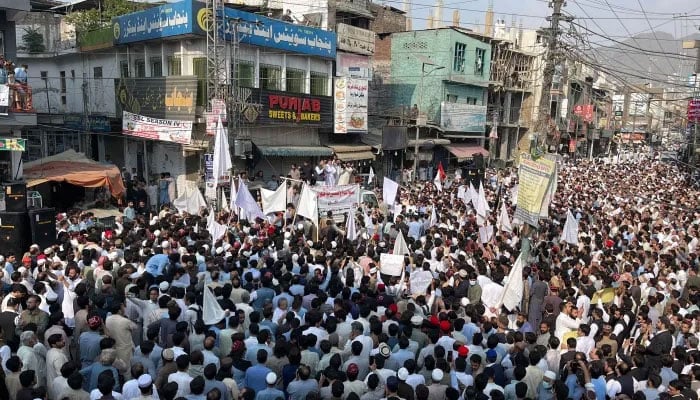
The bill comes months after Tehreek-e-Labbaik Pakistan (TLP) staged demonstrations in Lahore in October against US President Trump’s 20-point ‘Gaza Plan’. The protest camps were later dismantled by police and party workers arrested.
At the same time, the PTI has repeatedly accused the Punjab government of denying it permission to hold political rallies in the province and of using heavy-handed tactics against its supporters, who have been demanding the release of former prime minister Imran Khan.
Experts have raised concerns that the bill lacks any mechanism to check the abuse of power by police officers during protests and could deter citizens from participating in demonstrations altogether.
“Any use of force [by police] during assemblies must remain subject to independent, prompt, and impartial investigation”, Harris Khalique, the secretary general of the Human Rights Commission of Pakistan, told The News.
He added that a sentence of up to ten years imprisonment for attacking a police officer, including for those who merely assist, appeared “excessive and disproportionate”, warning that it could discourage people from participating in protests.
“Assemblies should not be treated as threats”, Khalique said. “Dispersal must be a last resort. The police should prioritise de-escalation and isolate violent individuals rather than penalising entire assemblies”.
Asad Jamal, a Lahore-based lawyer, told The News that the bill grants expanded powers to the executive authority to declare areas riot zones and to impose lengthy prison terms.
“Such vague wording risks allowing authorities to persecute rather than prosecute and to inflict disproportionate punishments on protesters who may gather to express their democratic right to express dissent against governmental policies”, Jamal said.
He also raised concerns over the provision that allows video footage collected through Safe City cameras to be presumed true.
“If taken literally, this could imply that the burden of proof could be shifted on the accused, which could also have serious negative consequences for due process and right to a fair trial”, Jamal said.
Speaking to The News, Punjab Information Minister Azma Bukhari said the impression that extraordinary powers were being given to the police was wrong.
She said the Punjab government was in the process of establishing a dedicated anti-riot force like other countries and legislation to that effect was in process. She revealed that international-level training and equipment will be provided to the new force.
She said this step would relieve the police force of extra burden; they will continue their normal policing while the new force will deal with mobs, protesters and rioters.