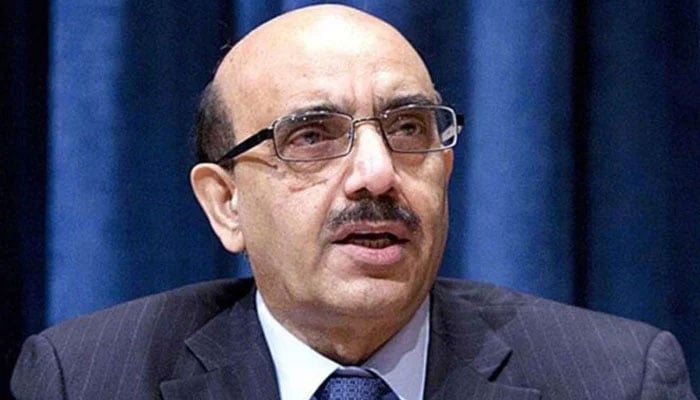
MUZAFFARABAD: Pakistan has emerged as a major geopolitical pivot for the United States, China and Russia, and India’s renewed disinformation campaign is a reaction to this strategic reality, said Sardar Masood Khan, former Ambassador of Pakistan to the United States, China and the United Nations.
While commenting on recent misrepresentation of facts by Indian state linked media networks, Ambassador Khan described India’s information warfare as “systemic, state sponsored and ideologically driven,” noting that misinformation and propaganda have long been employed by the BJP and RSS to malign Pakistan.
“This is not new. Indian disinformation has previously been exposed in Europe and elsewhere. It is a weapon they repeatedly use—but one that increasingly fails,” he said, adding that recent false narratives, including those propagated by RT India and Indian sponsored outlets, have once again collapsed under scrutiny.
Ambassador Khan underscored that 2025 marks a breakthrough year for Pakistan’s diplomacy, catalysed by Pakistan’s measured and responsible conduct during and after the May 2025 conflict with India. He noted that Pakistan’s dignified acceptance of U.S.-led cease fire diplomacy contrasted sharply with India’s belligerence, significantly enhancing Islamabad’s credibility in key global capitals. “Our relations with Washington were already improving, but after the war they grew exponentially,” he stated. Highlighting tangible diplomatic and security gains, Ambassador Khan pointed to the United States’ approval of a $686 million F 16 upgrade package, following earlier sustainment packages approved in 2022 and early 2025. “This reflects renewed trust, enhanced interoperability, and recognition of Pakistan’s role in regional peace and security,” he said, adding that Pakistan has also been entrusted with sensitive mediatory roles, including U.S.–Iran back channel diplomacy and multilateral efforts toward a Gaza cease fire.
Beyond security, Ambassador Khan emphasised Pakistan’s economic and technological breakthroughs, including agreements on crypto tokenisation of sovereign assets, partnerships with Binance, U.S. investment in critical minerals, and collaboration in renewables and agriculture. “These are not symbolic gestures. They are concrete indicators of Pakistan’s reintegration into global economic and strategic frameworks,” he said.
Responding to questions about India’s motivations, he said India’s propaganda reflects strategic jealousy and confusion. “India finds itself in a strategic wilderness. Its long claimed ability to counter China has been exposed as exaggerated, its military and communications credibility damaged, and its diplomatic standing weakened after the May war,” he observed. He added that while some forces in Washington continue efforts to stabilise U.S.–India ties, India’s credibility has suffered irreversible setbacks.
He further noted “India’s real challenge is internal. Hindutva extremism under the BJP is eroding secularism, dividing society, and poisoning India’s own future,” he said, warning that external aggression and propaganda cannot compensate for internal fragmentation.
Concluding his remarks, Ambassador Khan urged Pakistan to avoid complacency. “India’s lies have been exposed, and Pakistan’s stature has risen—but this is not a moment for self satisfaction. It is a moment for vigilance, consolidation and hard decisions,” he said. “Opportunities are before us, but so are challenges. We must strengthen our foundations to fully realise Pakistan’s strategic potential.”