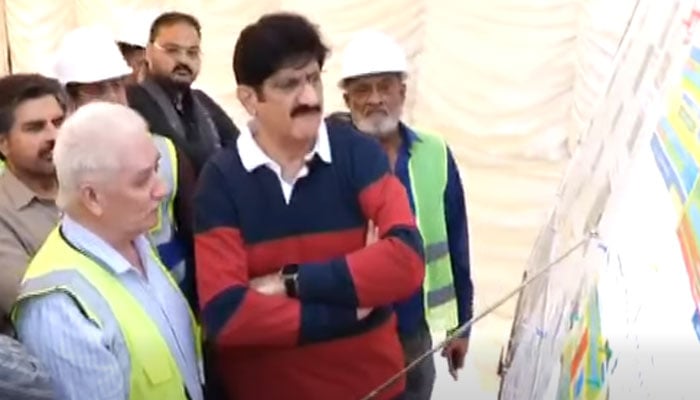
Sindh Chief Minister Syed Murad Ali Shah on Sunday morning undertook an extensive visit of Karachi to review the progress of multiple mega development and transport infrastructure projects, including Shahrah-e-Bhutto, the Korangi Causeway Bridge junction, the Malir River bridges, flyovers in Malir, and the Red Line and Green Line corridors.
Accompanied by Sindh Local Government Minister Syed Nasir Hussain Shah, Special Assistant to the CM Syed Qasim Naveed and Karachi Mayor Murtaza Wahab, the CM inspected ongoing works and received detailed briefings from the relevant department and project officials.
During the visit, the CM said Karachi’s development projects are not merely construction activities but “long-term investments for the city’s economic growth, traffic improvement and quality of life”.
“These projects are essential for transforming Karachi into a modern, competitive and liveable city. There will be no compromise on quality, transparency or timelines,” he asserted. He visited the Korangi Causeway Bridge, a junction project of Shahrah-e-Bhutto, where he was briefed on its progress and design features. The Rs1.89 billion mega project is being executed under the LG department.
The project includes four loops and four slip roads, with a total length of 2.7km and a main carriageway measuring 741.656m. The combined length of the slip roads is 1,427.16m. The LG minister told the CM that the construction work commenced on October 1, and 40 per cent of the project has been completed so far.
Directing the LG minister to accelerate construction, the CM said: “Due to its location over the Malir River, the Korangi Causeway often submerges during the monsoon season, causing severe traffic disruptions. Once completed, this junction will ensure smooth traffic flow, and provide long-term relief to citizens.”
He stressed the importance of safety arrangements and effective alternative routes during construction, saying that “citizens’ convenience during the ongoing works must be ensured”. The project will significantly reduce traffic congestion in Korangi, Qayyumabad and the adjoining areas, and boost industrial and commercial activities upon completion, he added.
He also inspected the construction of the National Highway 5 (N-5) bridge over the Malir River near Murghi Khana. The project is being implemented under the 2024-25 development programme of the provincial government.
With a total cost of Rs2.9216 billion, the project began this March 20, and is scheduled for completion by next March 20. The bridge will have a total length of 457m and a carriageway width of 15m, along with ramps, service roads, medians, footpaths and a modern bridge structure.
“Infrastructure projects like this bridge are indispensable for addressing Karachi’s traffic challenges. Delays will not be tolerated, and the project must be completed within the stipulated time frame,” the CM directed.
He said the bridge would ensure “safe, faster and more efficient travel for Karachiites, particularly the residents of Malir as well as the surrounding areas”. During his visit to Malir, he reviewed the construction work on the Khalid Bin Walid Road flyover at Bhains Colony over the railway line. The project is being executed under the Competitive & Livable City of Karachi (CLICK) Phase-II programme, sponsored by CLICK and implemented by the Karachi Metropolitan Corporation.
The flyover, stretching 682m in length and 20.65m in width, will connect the Mehran Highway to N-5. It will feature two lanes on each side, with each lane measuring 3.65m in width. The project also includes ramps, an at-grade road of 1,418m, parking lanes and footpaths.
The total cost of the project is Rs1.6218 billion, with financial progress at 48 per cent and physical progress at 58 per cent. The mayor told the CM that all 20m and 50m girders have been launched, while work on MSE walls is progressing on both sides.
“This flyover is part of our broader vision to improve urban mobility and make Karachi a more liveable city,” the CM said, adding that the project is expected to be completed by January. He inspected the Red Line corridor from Malir Cantt to Numaish. He termed Red Line “one of the most important and strategic public transport projects of the Sindh government”.
“The purpose of Red Line is to provide fast, safe, dignified and environmentally friendly transport to Karachi’s residents. This project will revolutionise daily commuting by Karachiites.” Transport Secretary Asad Zamin briefed the CM that the Red Line corridor comprises two lots: Lot One extends from Malir Halt to the Mosamiyat intersection on University Road, spanning 9.65km, while Lot Two measures 12.85km.
Lot One includes seven modern bus stations, three underpasses, two flyovers, two bus depots, drainage systems, landscaping works and a dedicated bus rapid transit infrastructure. The total cost of Lot One exceeds Rs13.79 billion, with overall project completion at 36.01 per cent. Replying to the CM’s query, Zamin attributed the delays in executing the projects to heavy rains, utility line relocation issues and design changes.
The CM directed the relevant authorities to expedite the work. “Development projects must be completed at the earliest, with minimal inconvenience to citizens. Local communities and traders must be facilitated, and environmental and safety standards must be strictly observed.”
He also reviewed the ongoing work on the Green Line project at MA Jinnah Road, including bus stops, ticketing systems and underpass facilities, with TransKarachi CEO Fawad Soomro briefing him. “MA Jinnah Road is one of the busiest arteries of Karachi. Work on Green
Line must be carried out at the fastest possible pace while ensuring safety and smooth traffic flow,” the CM instructed. Concluding his visit, he reiterated that his government remains committed to delivering modern infrastructure solutions for the city. “These projects are not just roads, flyovers or bus corridors, they are guarantees of Karachi’s prosperity. We will ensure better, safer and faster travel for every citizen.”
He directed all the relevant departments, consultants and contractors to strengthen coordination, enhance monitoring, and use technology and smart management tools to ensure timely completion of the projects with the highest quality standards.