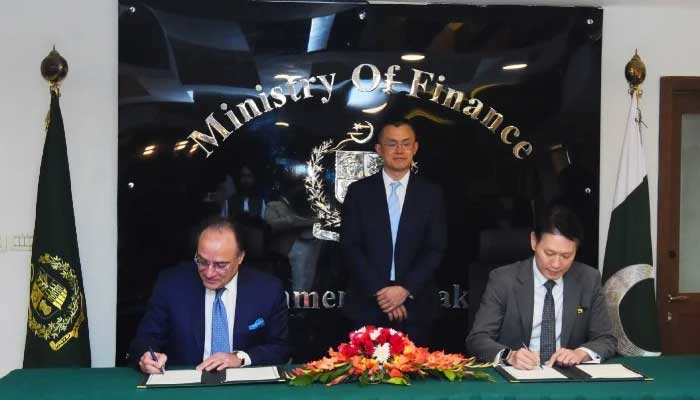
ISLAMABAD: Pakistan Friday inked a memorandum of understanding (MoU) with Binance to explore the “tokenisation” of up to $2 billion in the country’s assets, the finance ministry said on Friday.
“The MoU establishes a framework for exploring potential collaboration on the tokenisation and blockchain-based distribution of Pakistan’s real-world and sovereign assets,” read a statement issued by the finance ministry.
The assets can include sovereign bonds, treasury bills, and commodity reserves such as oil, gas, metals or other raw materials owned by the government. Tokenisation is the process of creating a digital version of an asset.
The ministry also said the initiative could involve assets of up to $2 billion, subject to approvals, with the aim of improving liquidity, transparency and international market access.
Finance Minister Muhammad Aurangzeb said the MoU signaled Pakistan’s reform trajectory and “a long-term partnership.”
Binance founder Changpeng Zhao said the agreement was “a great signal for the global blockchain industry and for Pakistan,” adding that it marked the beginning of a move toward full deployment of the tokenisation initiative.
Separately, the Pakistan Virtual Assets Regulatory Authority (PVARA) issued no objection certificates (NOCs) to Binance and HTX, allowing them to begin regulated engagement in the country’s digital asset market.
The NOCs were granted after a formal review process in coordination with the public sector stakeholders, focus on governance, compliance, risk management, and alignment with emerging regulatory requirements, read a statement issued by the PVARA.
“The introduction of this structured NOC framework demonstrates Pakistan’s commitment to responsible innovation and financial discipline,” said the finance minister.
The NOCs permit the firms to register on the FMU goAML system, engage with the Securities and Exchange Commission of Pakistan (SECP) for local subsidiary incorporation, submit full VASP licence applications, and provide AML-registered services after goAML registration.
The issuance of the NOCs, however, does not constitute a full operating licence, read the communique.
PVARA Chairman Bilal Bin Saqib termed the development “the beginning of a new chapter for Pakistan’s digital asset ecosystem”.
“The issuance of these NOCs is the first step toward a fully licenced and regulated environment that places consumer protection, financial integrity, and responsible innovation at its core,” he added.
With Pakistan ranked third globally in crypto adoption and an estimated 30–40 million users, annual trading linked to the country is projected above $300 billion. PVARA emphasised timely regulation to ensure transparency, governance, and market integrity while signaling that Pakistan was open to responsible innovation under structured rules.
Mehtab Haider adds: Meanwhile, the Asian Development Bank (ADB) has approved two projects worth $540 million to accelerate SOE reforms in Pakistan and enhance disaster resilience in the coastal districts of Sindh.
The $540 million loan comprises a $400 million results-based loan for accelerating SOE transformation program for Pakistan and a $140 million concessional loan for the Sindh Coastal Resilience Sector Project.
The SOE reform program marks a significant milestone in Pakistan’s efforts to tackle critical challenges in corporate governance and commercial performance within its SOEs.
“The SOE reform program for Pakistan seeks to improve governance and optimize the performance of Pakistan’s commercial SOEs, which are vital for the country’s economic stability and development,” said ADB Country Director for Pakistan Emma Fan.
“The program will also prioritize restructuring and commercialization of the National Highway Authority, one of the largest and most complex entities within Pakistan’s SOE portfolio.”
The program is ADB’s first results-based loan exclusively dedicated to public sector management reform. The bank has been a longstanding partner in supporting Pakistan’s SOE reforms through sector investments, policy operations, and technical assistance.
Substantial progress has been achieved over the past five years with ADB’s support, including the enactment of the SOE Act and SOE Policy in 2023, establishment of a central monitoring unit, and introduction of public service obligation agreements aligned with international best practices.
The results-based approach will facilitate improved corporate governance and drive advancements in institutional capacity, digitalization, road safety, and financial sustainability.
The ADB has also approved a complementary technical assistance grant of $750,000 to provide expertise and capacity-building support, ensuring effective implementation of reforms. These efforts aim to foster a competitive and resilient public sector, stimulate private sector development, and contribute to Pakistan’s long-term, inclusive economic growth.
The Sindh Coastal Resilience Sector Project aims to strengthen disaster resilience in the vulnerable and underserved districts of Badin, Sujawal, and Thatta. The project is set to improve the lives of over 500,000 people, safeguard 150,000 hectares of agricultural land, and restore 22,000 hectares of forest in Pakistan.
These outcomes align with Pakistan’s National Flood Protection Plan IV, Sindh Climate Change Policy, and ADB’s Strategy 2030 priorities on environment and resilience.
The project will help reduce greenhouse gas emissions, enhance biodiversity, and improve food security, supporting ADB’s ambition to mobilize $40 billion for food systems transformation by 2030.
The project is co-financed by a $20 million grant and a $20 million concessional loan from the Green Climate Fund through the Community Resilience Partnership Program Investment Fund, administered by the ADB.
“The coastal communities in Sindh are increasingly vulnerable to severe natural hazards, including flooding, saltwater intrusion, and water scarcity. This project will protect livelihoods, strengthen food security, and empower women to play a central role in resilience planning and implementation,” said Ms. Fan.
The project, implemented by the Sindh Irrigation Department and the Sindh Forest and Wildlife Department, will integrate resilient water resources infrastructure, nature-based solutions, and improved coastal management.
Key investments include upgrading drainage and flood protection systems, restoring mangrove and inland forests, and strengthening monitoring and modeling capacity to support future resilience investments. Community-based resilience plans will ensure locally anchored and inclusive solutions, with at least 25% of funds allocated to initiatives led or undertaken by women. The project complements parallel financing from the International Fund for Agricultural Development, which supports livelihood development in the same districts.
The ADB is a leading multilateral development bank supporting inclusive, resilient, and sustainable growth across Asia and the Pacific. Working with its members and partners to solve complex challenges together, the ADB harnesses innovative financial tools and strategic partnerships to transform lives, build quality infrastructure, and safeguard our planet.