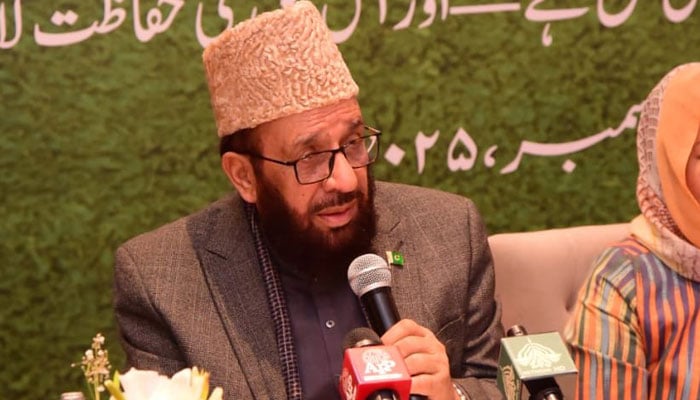
ISLAMABAD: Declaring breastfeeding a divine command grounded in Quranic injunctions and the sayings of Prophet Muhammad (PBUH), Federal Minister for Religious Affairs Sardar Muhammad Yousuf on Thursday announced a national movement to promote breastfeeding and curb preventable newborn deaths linked to formula feeding.
He said infants in Pakistan continue to die from diarrhea, pneumonia and malnutrition because families abandon breastfeeding without medical reason, adding that such behaviour amounts to “committing a sin” when Allah Almighty has clearly directed mothers to breastfeed their children.
Speaking at a national consultation titled Advocating, Promoting and Supporting Breastfeeding Guided by Quranic Injunctions and Sayings of Prophet Muhammad (PBUH) at a local hotel, he said breastfeeding is not only a health matter but a religious obligation. He urged ulema across the country to dedicate at least five minutes of their Friday sermons to explaining the religious and social importance of breastfeeding.
He said the ministry, with the support of UNICEF, will mobilise scholars and community leaders nationwide to counter the rising promotion of formula milk through commercial channels and revive breastfeeding as a moral, religious and public health priority. He added that breastmilk substitutes cannot match breastmilk in strength, nutrition, immunity or long-term physical and mental health benefits.
The event was organised by the Ministry of Religious Affairs in collaboration with UNICEF and attended by leading scholars including Council of Islamic Ideology Chairman Allama Raghib Naeemi, Pakistan Ulema Council Chairman Allama Tahir Ashrafi, Muhammad Bux Sani and Dr Shahid from the ministry, as well as ulema and scholars from various schools of thought.
Representatives of other faiths, including Christianity, Hinduism and Sikhism, also participated. UNICEF Deputy Representative in Pakistan Sharmeela Rasool, UNICEF Nutrition Chief Anteneh Girma Minas and several health experts were also present.
A joint declaration, presented by UNICEF’s Fahmida Khan, was unanimously endorsed by ulema, calling for religious mobilisation, community education, strict regulation of formula milk marketing and creation of supportive spaces for breastfeeding mothers.
In his keynote address, Allama Raghib Naeemi said nearly six million children are born in Pakistan every year and only about 2,000 of them medically require formula feeding after losing their mothers. He said every other child is born with complete nourishment provided by nature in the form of breastmilk, which protects against diarrhea, pneumonia and other infections, strengthens mental development and creates an irreplaceable bond between mother and child.
Allama Naeemi criticised the country’s rising dependence on formula milk, saying families spend over 110 billion rupees every year despite the Quran’s clear instruction on breastfeeding and completing its term of two years to 30 months. He called breastmilk substitutes a curse and said avoiding breastfeeding without medical grounds is a sin.
He urged mosques to establish worship and breastfeeding-friendly spaces for mothers so they can pray and feed their children with dignity. He also called for the creation of secure breastfeeding areas for working mothers and said promoting breastfeeding must become a nationwide religious and social movement.
Addressing the gathering, Sharmeela Rasool said breastfeeding is fundamental to Pakistan’s nutrition and health challenges, where around 40 percent of children remain stunted. She said Pakistan loses hundreds of newborns every day from preventable causes, stressing that breastfeeding can reduce mortality, save nearly 900 million dollars currently spent on formula milk and conserve the vast quantity of water used in its preparation.
She said breastfeeding is also a climate and development issue, and called for empowering women, engaging communities and using mosques and other worship spaces to promote it. Allama Tahir Ashrafi said breastfeeding for two years is also a natural form of birth spacing that protects maternal and child health. He demanded action against clinics and aesthetic centres that discourage breastfeeding and influence women to avoid it, saying such facilities should be penalised or sealed. He called for joint conferences of ulema and healthcare professionals to dispel myths and encourage early and exclusive breastfeeding.
Health experts including Dr Saba Shuja and Dr Muhammad Salman highlighted national breastfeeding indicators and stressed the need for early initiation within the first hour of birth. Dr Maqbool Hussain of the Pakistan Pediatric Association discussed the broad health benefits of breastfeeding and warned that formula feeding increases the risk of infections and long-term health complications.
A panel discussion brought together Maulana Haroon Rasheed, Allama Arif Hussain, Pir Mumtaz Ahmed Nizami, Maulana Samiullah Agha, Dr Ali Tariq and representatives of minority faiths, all of whom supported a unified national effort to restore breastfeeding as a shared religious, cultural and public health responsibility.