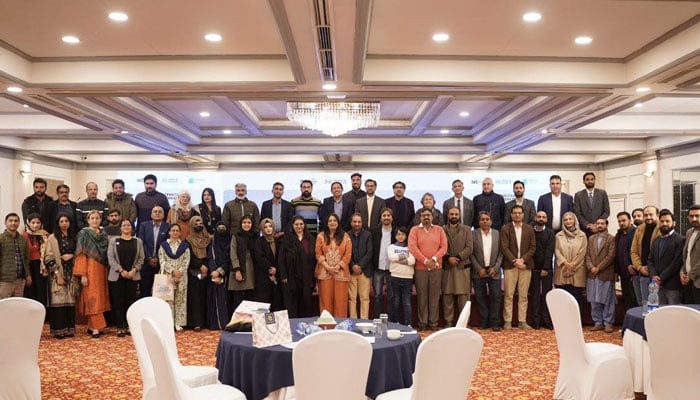
Islamabad:Climate resilience depends not only on infrastructure and adaptation planning but equally on integrating information integrity in climate governance to safeguard truth, transparency and trust.
This was the stated by experts and speakers at the National Conference on Climate Disinformation organised on Thursday by the Institute for Research, Advocacy and Development (IRADA) with assistance from International Media Support (IMS) and the Digital Democracy Initiative of Denmark, Norway and the EU.
IRADA Executive Director Muhammad Aftab Alam said climate disinformation can negatively impact public understanding of climate change and discourage much-needed action. “We hope that media, civil society, policymakers and development partners can work together to strengthen climate information integrity and protect climate-vulnerable communities,” he added.
IMS Program Manager Adnan Rehmat highlighted the importance of effective climate communication to raise awareness of adaptation and mitigation efforts. “Climate communication is the road that connects climate policy with climate action,” he said.
Dr. Abid Suleri, the Executive Director of the Sustainable Development Policy Institute (SDPI), said climate plans should flow upwards from the district level to the national level rather than a top-down approach that ignores the issues of local communities.
He said Pakistan has three windows of opportunities in 2026 to improve climate action in the form of the NFC award, the IMF’s Resistance Sustainability Facility, and the use of climate data for informed decision-making.
A baseline research study titled Climate Disinformation in Pakistan: Silencing Indigenous Peoples’ Voice was launched at the event. The study identifies the forms of climate disinformation and their impact on Indigenous communities in the country, based on content analysis, an online survey, expert interviews and discussions with community representatives.
According to the study, climate disinformation in Pakistan is triggered by climate-induced extreme weather events, uses emotionally charged messages to spread fear or confusion and predominantly spread through social media in Urdu and regional languages.
The study found that the five types of climate disinformation most prevalent include alarmist or sensationalist content, conspiracy-driven narratives, denial or delay narratives, oversimplified or false solutions, and religious fatalism.
The study also described that the climate disinformation impacts indigenous communities by negatively affecting their decisions about safety and livelihoods, by creating psychological distress and cultural upheaval, eroding their trust in public institutions, discouraging indigenous ecological knowledge and local adaptation methods, and intensifying the exclusion of indigenous peoples from climate policy and governance.
Report co-author Humera Qasim Khan said the report recommends embedding information integrity into Pakistan’s climate governance frameworks to ensure coordinated and accountable action against climate disinformation.
She said algorithmic accountability measures by Big Tech companies and social media networks are also needed to curb the unchecked spread of climate disinformation online. The conference also featured panel discussions among climate activists, journalists, fact-checkers and science communicators to find opportunities to mobilise the domestic climate movement and to support local communities through reliable climate news for meaningful action.
Climate and water expert Dr. Hassan Abbas said the economic incentives and financial benefits are needed to pull people into adopting sustainable solutions. He said it is the job of government to incentivise entrepreneurs and businesses to create the economic engine that pulls society towards climate action.