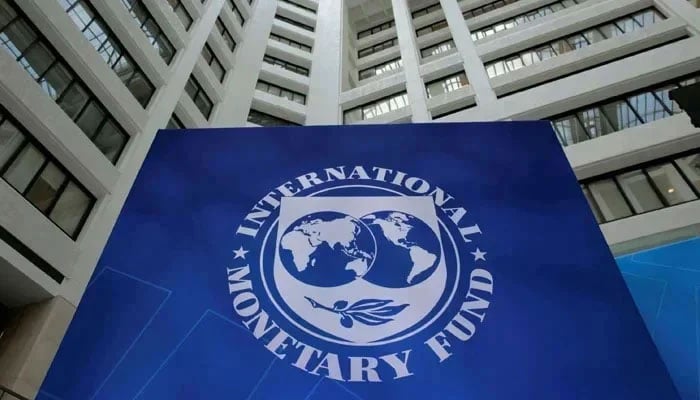
KARACHI: Pakistan has received $1.2 billion from the International Monetary Fund (IMF) under the Extended Fund Facility (EFF) and Resilience and Sustainability Facility (RSF) loan programs, the country’s central bank said on Thursday.
The IMF’s executive board completed its second review under the EFF on Monday and approved the release of special drawing rights (SDR) amounting to 760 million for Pakistan. Additionally, the IMF’s board approved the disbursement of the first tranche of SDR 154 million under the RSF, the State Bank of Pakistan said in the statement.
With these two tranches, total disbursements under both lending facilities have reached approximately $3.3 billion so far.“Accordingly, the SBP has received SDR 914 million (equivalent to about $1.2 billion) under the EFF and RSF in value December 10, 2025 from the IMF,” the SBP said.
“The amount would be reflected in the SBP’s foreign exchange reserves for the week ending on December 12, 2025,” it added.The foreign reserves held by the SBP increased by $12 million to $14.59 billion as of December 5. Following the release of funds from the IMF, the SBP’s reserves have surpassed $15.5 billion, which is the target set by the SBP for this month. However, the SBP indicated that the impact of the IMF’s payout will be reflected in its upcoming foreign reserves data. Additionally, the global lender has raised the reserves target for June 2026 by $155 million to $17.8 billion, aligning with the SBP’s projections.
The IMF has adjusted Pakistan’s projected current account deficit for FY26, increasing it from 0.4 per cent of GDP to 0.6 per cent of GDP. The SBP expects the current account deficit will be in the range of zero to 1.0 per cent of GDP in the fiscal year 2026.
The IMF’s latest round of financial support helps keep Pakistan’s loan program on track. It arrives as the country attempts to rebuild its forex reserves and control inflation, all while addressing IMF requirements to increase revenue and progress with the privatisation of state-owned companies. The IMF loan primarily focuses on maintaining macroeconomic stability, strengthening public finances, improving productivity and competitiveness, and ensuring the viability of the energy sector, among other goals.
The Washington-based lender and Pakistan reached a staff-level agreement on two programs in October. The country’s 37-month EFF was approved in September 2024 and aims to build economic resilience and enable sustainable growth. Additionally, the 28-month RSF was approved in May to support Islamabad’s efforts in reducing vulnerabilities to natural disasters and enhancing economic and climate resilience.
In a statement issued after the executive board discussion this week, the IMF acknowledged Pakistan’s policy efforts and progress made towards stabilising its economy, despite the challenging global environment and recent floods in the country. As a result, the IMF has revised Pakistan’s GDP growth target for FY26, lowering it from 3.6 per cent to 3.2 per cent.
“In the face of an uncertain global environment, Pakistan needs to maintain prudent policies to further entrench macroeconomic stability, while accelerating reforms necessary to achieve stronger, private sector-led, and sustainable medium-term growth,” Deputy Managing Director Nigel Clarke said.