ISLAMABAD: The National Assembly’s Standing Committee on Finance failed to persuade the Federal Board of Revenue (FBR) to reduce the “exorbitant” tax on the import of latest 5G-enabled mobile phones on an immediate basis. It directed the tax authority to come up with different scenarios by March 2026 so the proposal for rationalisation can be considered in the 2026-27 budget.
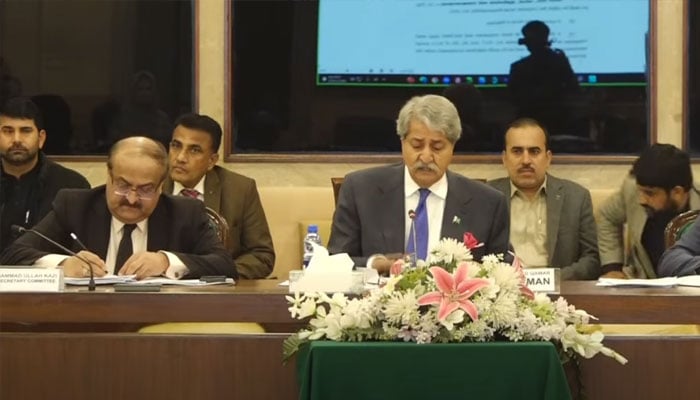
The meeting chaired by Syed Naveed Qamar held a detailed discussion after multiple lawmakers, particularly Ali Qasim Gillani, Sharmilla Farouqui and Hina Rabbani Khar argued that excessive taxation had pushed even mid-range smartphones out of reach. Syed Naveed Qamar pointed out that smartphones were no longer a luxury item but a basic necessity and said the long-used justification of being “in an IMF programme” could no longer be used to continue burdensome duties.
Pakistan Telecommunication Authority (PTA) Chairman Maj-Gen (retd) Hafeez Ur Rehman, opposed the move to end taxes on the imported mobile phones arguing that there were 94 percent locally produced mobile sets in Pakistan and only 6 percent were imported phones. Only 2 percent locally produced phones were 5G enabled.
FBR Chairman Rashid Mahmood Langrial agreed with the observations of the committee that the tax rates should be rationalised on the import of mobile phones, but said that the task of rationalising taxes should be given to the Tax Policy Office of the Ministry of Finance. “Lead should be taken by the Tax Policy Office for this exercise,” the FBR chairman said.
FBR’s Member Customs Shakeel Shah informed the committee that the FBR has collected Rs82 billion taxes on the import of mobile phones during 2024-25 whereas Rs18 billion were collected from high-end mobile phones (23-24 percent of the total collection from mobile phones). Only 5 percent duty is imposed on the import of mobile phones in CKD/SKD kits condition for local assembling lines. A lot of local assembly lines are manufacturing mobile phones starting from the price of Rs15,000.
PPP MNA Ali Qasim Gilani strongly criticised the existing tax structure, claiming consumers were forced to pay taxes again when their mobile phones were lost or replaced. He said FBR’s assessed market values were significantly higher than actual prices, resulting in inflated tax demands. “Even six- to eight-year-old iPhones are being taxed at unrealistic rates,” he said, adding that the FBR had set the value of the iPhone 16 at USD 1,600 despite market prices being far lower.
The FBR chairman said that if any valuation was found higher than market levels, it would be revised. He noted that average smartphone prices had recently decreased and said the FBR could work with the Ministry of IT to rationalise taxes proportionate to actual market trends. He also clarified that Ninth Schedule of the Sales Tax Act directly deals with the mobile phone taxation.
Committee member Sharmila Farooqi called the current taxation regime “excessive and unfair,” revealing she had purchased a phone worth Rs370,000 but had not opened the box because the tax payable amounted to Rs190,000. “Sixty percent tax on a single phone is unjustified. Take taxes, but not to the point where taxpayers can’t breathe,” she said.
Representatives from the Pakistan Telecommunication Authority (PTA) rejected claims that the authority imposed any direct taxes, stating all duties were collected by the FBR. The PTA chairman added that 94 percent of smartphones used in Pakistan were locally assembled, while only 6 percent — primarily higher-end models — were imported. “Except for Apple, all major smartphone brands are now being manufactured in Pakistan,” tax officials added.
The PTA chief also said Pakistan’s 5G spectrum auction was planned for February next year, with full deployment expected by 2026.