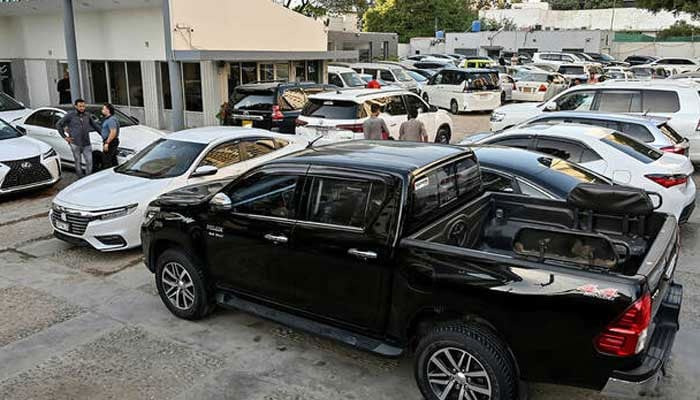
ISLAMABAD: The Economic Coordination Committee (ECC) of the Cabinet on Tuesday approved the summary tabled by the Ministry of Commerce, abolishing the Personal Baggage Scheme, while the Transfer of Residence and Gift Schemes for importing vehicles have been made more stringent.
The ECC also revised the margins of Oil Marketing Companies (OMCs) and dealers on petrol and diesel and granted its approval to the circular debt management plan.
The ECC approved seven major points for the import of used cars. According to the summary, on the basis of the agreement reached among stakeholders, the ECC of the Cabinet approved that: (i) only the Transfer of Residence and Gift Schemes will be retained; (ii) minimum safety, environmental standards, and regulatory measures, as applicable to commercial importation of used vehicles, shall also apply to vehicles imported under the retained schemes; (iii) the intervening period for import of vehicles shall be increased from two years to three years for all schemes; (iv) vehicles imported under these schemes shall remain non-transferable for one year; (v) the minimum stay abroad shall be enhanced to three years with at least 850 cumulative days for all schemes; (vi) the requirement that the vehicle must be from the same country where the sender resides shall apply to the Transfer of Residence Scheme only and not to the Gift Scheme; (vii) necessary amendments shall be inserted in Appendix-F of the Import Policy Order, 2022, accordingly.
According to an official announcement from the Ministry of Finance, the ECC of the Cabinet met on December 9 at the Finance Division under the chairmanship of the Federal Minister for Finance & Revenue, Senator Muhammad Aurangzeb.
The ECC reviewed the Circular Debt Management Plan for FY 2025–26, presented by the Power Division, to ensure financial sustainability and efficiency in the power sector. The ECC directed the Power Division, in coordination with the Finance Division, to develop a medium-term plan for gradually reducing fiscal support. It also asked the Power Division to establish a follow-up mechanism with the DISCOs to ensure delivery of the targets committed to the government.
On a summary by the Ministry of Commerce, the ECC approved amendments to the vehicle import procedure, retaining only the Transfer of Residence and Gift Schemes. Under the revised framework, commercial-import safety and environmental standards will apply to these schemes, the intervening import period will be extended from two to three years, and imported vehicles will remain non-transferable for one year. The ECC also approved a summary seeking restrictions on chloroform imports due to its toxic and carcinogenic nature and decided that trichloromethane (chloroform) would only be imported by pharmaceutical companies and only with an NOC issued by DRAP.
The ECC further considered a summary regarding the claim of M/s Ghani Glass for a concessionary gas/RLNG tariff and decided the request was untenable as such subsidies were no longer permissible and wider export-support initiatives were already in progress.
On another summary, the ECC approved a Technical Supplementary Grant (TSG) of PKR 1.28 billion for the Pakistan Digital Authority (PDA) to facilitate digital transformation and technological innovation across government departments.
It further approved the release of funds as a technical supplementary grant relating to the development expenditure of the Cabinet Division for FY 2025-26, as proposed by the Interior and Narcotics Control Division. The ECC also approved the allocation of Rs5 billion to the Housing and Works Division through a Technical Supplementary Grant for the current fiscal year. The ECC also approved creating a special-purpose company to wind up PASSCO and settle its remaining liabilities. Additionally, it accorded in-principle approval for the release of budgetary allocation for PIA Holding Company Ltd. (PIAHCL) to meet pension and medical-related expenses of PIACL employees.
In a significant policy move with both immediate and long-term implications for Pakistan’s fuel pricing framework, the Economic Coordination Committee (ECC) approved a partial increase in margins for oil marketing companies (OMCs) and petroleum dealers, while tying the remaining adjustment to progress on sector-wide digitisation.
Acting on the Petroleum Division’s Option-1 recommendation, the ECC sanctioned a 50 per cent increase in margins — an uplift of Re0.61 per litre for OMCs and Re0.67 per litre for petroleum dealers. The remaining half of the proposed adjustment will be granted only upon demonstrable advancement in the digitisation of petroleum product movement from refineries and ports to retail outlets. The Petroleum Division has been instructed to submit a progress report on digitisation by June 1, 2026.
Although, the ECC decision is effective immediately, officials within the Petroleum Division indicated that its practical implementation may begin on December 16, 2025. With international petroleum prices trending downward — high-speed diesel alone shedding Rs9.88 per litre as of 8 December — authorities expect that the margin adjustment will be absorbed without burdening consumers.