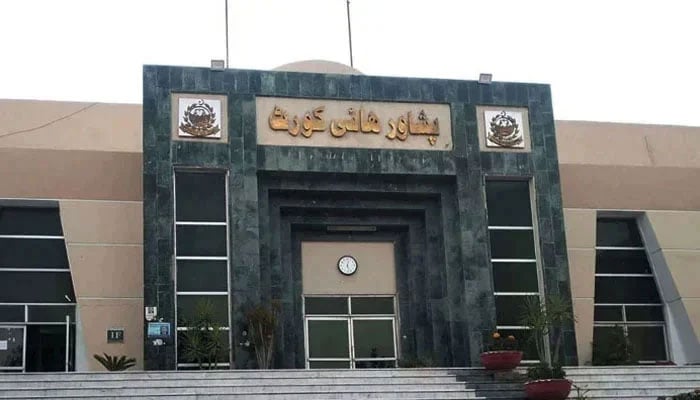
PESHAWAR: The Peshawar High Court (PHC) has declared the calls for strikes and boycotts of court proceedings by bar councils and bar associations as unconstitutional and illegal.
The court also ruled that such strikes not only obstructed the judicial process but also deprived litigants of their fundamental rights.
The court observed that preventing lawyers from pursuing cases was unlawful and that court boycotts resulted in losses worth billions of rupees.
The court also set aside the suspension of licenses of two lawyers Shabbir Hussain Gagiyani and Ali Azim Afridi and ruled that bar councils had no authority to suspend a lawyer’s license.
The two-member bench comprising Justice Syed Arshad Ali and Justice Wiqar Ahmad heard the writ petitions filed by Shabbir Hussain Gagiyani and Ali Azim Afridi.
A detailed 43-page judgment authored by Justice Syed Arshad Ali remarked that lawyers and bar associations were guardians of democracy, justice and the rule of law, promoting freedom, transparency and moral responsibility in society.
According to the judgment, Article 10-A of the Constitution guarantees every accused the right to engage a lawyer of their choice. In the case of advocate Shabbir Hussain Gagiyani, he appeared as counsel for a police officer, Bahramand Shah, accused of killing a youth in Charsadda on August 22. The accused later surrendered before the law and applied for bail, however, unjustified objections were raised, which the court termed unconstitutional and against established legal traditions.
The bar association had also passed a resolution that no lawyer would represent the accused police officer. During the hearing, a group of lawyers created disorder in the courtroom, which was held to be against judicial decorum. Subsequently, the Pakistan Bar Council suspended the lawyer’s license and PHC Bar Association also declared his actions to be in violation of its resolutions.
Similarly, in the case of advocate Ali Azim Afridi, the Khyber Pakhtunkhwa Bar Council suspended his license for appearing in court on a strike day, terming it a violation of discipline. Both lawyers challenged these actions in the PHC. Bar council members, however, raised objections regarding the court’s jurisdiction in these matters.
The court ruled that every lawyer had the right to plead a case and every litigant had the right to be represented by a lawyer of their choice. These matters, it added, related directly to the protection of the fundamental rights of lawyers and litigants, and the court was constitutionally empowered to intervene where such rights were violated.
The court also observed that suspending lawyers’ licenses and preventing them from appearing in courts was unlawful. It further ruled that bar councils and bar associations were meant to perform administrative and facilitative functions, not to issue punitive decisions. Therefore, the verdict said cancelling a lawyer’s license or barring them from court proceedings was not permissible under the law.
The court declared that calls for strikes, issuance of notices and preventing lawyers from appearing in courts by bar associations were illegal. Articles 4, 8, and 10-A of the Constitution guarantee every citizen the right to a fair trial. The duty of a lawyer is to pursue clients’ cases with dignity. Due to lawyers’ strikes, thousands of pending cases are adjourned, delaying justice and eroding public confidence in the judicial system.
In Khyber Pakhtunkhwa, daily losses due to lawyers’ strikes amount to approximately Rs57 million. The daily operational cost of the PHC’s principal seat and benches exceeds Rs14 million, session courts over Rs19 million, and civil courts more than Rs23 million. Additional expenses include those of the Advocate General’s offices, Attorney General’s offices, prosecutors, law officers, police, hundreds of government witnesses and litigants.
The court advised lawyers to adopt civilised methods of protest instead of strikes or boycotts, such as wearing black armbands, displaying banners or holding peaceful gatherings.
The court directed the additional registrar of the PHC to circulate this judgment to all courts across the province. Consequently, both writ petitions were allowed.