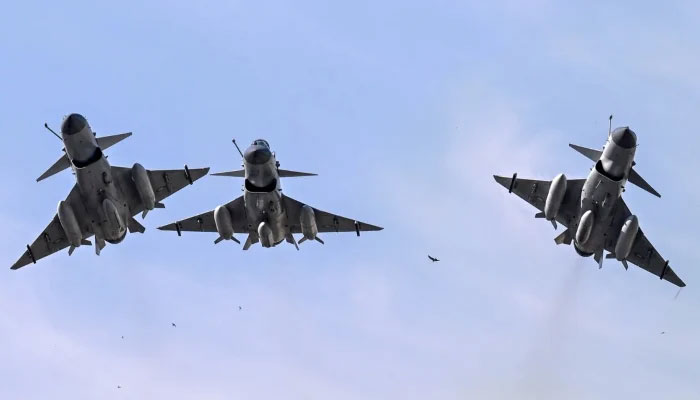
The peak period of Indo-Pak armed conflict was from May 7-10 when the two nuclear armed neighbours were eyeball to eyeball and the world was fearful of further escalation of what was called as the shortest war in South Asia. For the first time since December 1971 Indo-Pak war, the use of air force, missiles and drones by the two countries made a history when on May 8-9 it appeared that their armed conflict may further escalate and transform as a full-fledged war.
It is not for the first time that Indo-Pak conflict was de-escalated neutralising the threat of an all-out war in South Asia. In the winter of 1986-87 when tension on Indo-Pak borders escalated because of ‘operation brass-tacks’ launched by the Indian army on its Rajasthan border with Pakistan, the threat of war was averted when the then President General Zia-u-Haq under the cover of cricket diplomacy visited Jaipur in early 1987 and told the then Indian Prime Minister Rajiv Gandhi to de-escalate tension. In 1987 Pakistan was not a declared nuclear state but reportedly had nascent arsenal of nuclear weapons which President Zia threatened to unleash against India. Rajiv Gandhi got the message and operation brass-tacks was called off.
Furthermore, in 1990 when the Kashmir uprising escalated tension between India and Pakistan, the United States through its intelligence sources got the reports that Pakistan was activating its nuclear weapons to counter any attack from New Delhi. That alarmed Washington which led to the departure of a mission led by Robert Gates, Director of CIA to Islamabad and New Delhi to de-escalate the threat of war. Other examples of de-escalating Indo-Pak tension along with borders and threat of war were: attack on the Indian parliament December 2001 which for a year led to mobilisation of one million forces of the two countries eye ball to eye ball. It was because of pressure exerted by the United States and other western powers that India agreed to de-escalate military tension by ordering withdrawal of its forces from border followed by Pakistan. Western powers had threatened the government of the then Prime Minister Atal Vehari Vajpayee to de-escalate tension with Pakistan or face the withdrawal of investment from India. The Kargil war of May-June 1999 was de-escalated with American mediation when the then Prime Minister of Pakistan Nawaz Sharif visited Washington on July 4 prompting American President Bill Clinton to de-escalate tension by using his good offices with the Indian Prime Minister Vajpayee urging him to accept Pakistani request for a ceasefire.
The Mumbai terrorist attacks of November 2008, Uri and Pulwama attacks of 2016 and 2019 respectively also escalated tension along the Line of Control. But April 2025 terrorist attack in Pahalgam in Indian-administered Kashmir was unprecedented because it led for the first time to the use of massive air power, missiles and drones by India and Pakistan against each other. Reviewing escalation and de-escalation of Indo-Pak conflict proves how the nuclear factor was instrumental in this regard. Pakistan adheres to a policy of minimum nuclear deterrence and doesn’t accept No-First Use option in case of escalation of armed conflict with India. Knowing that Pakistan made it clear that crossing the red line by India will compel Islamabad to take all necessary measures to protect its sovereignty and territorial integrity the U.S and other powers tried to diffuse the situation.
For how long the world will play a role to de-escalate armed conflict between India and Pakistan and to what extent the present ceasefire will hold remains to be seen. The manner in which India came under American pressure to agree for a ceasefire with Pakistan is a source of great embarrassment for New Delhi. The mood in New Delhi when it launched ‘operation Sindoor’ was highly belligerent and aggressive but when it acquiesced to reach ceasefire deal with Pakistan, its pride, power and self-esteem was gone. But, those in Pakistani who are jubilant on their victory over India must understand the fact that the Indian Prime Minister Narendra Modi is like an ‘injured lion’ who will not miss any opportunity to avenge humiliation of his country at the hands of Pakistan.
De-escalation of May 7-10 armed conflict between India and Pakistan needs to be examined from three angles. First, how crisis management was used by the world powers particularly Untied States, Russia and Saudi Arabia to prevail over the two nuclear armed countries in order to avoid an all-out war. Communication between the National Security Advisers of India and Pakistan to de-escalate armed conflict and agree for a ceasefire needs to be sustained because the two countries since long have numerous military confidence-building measures including hot line between Director General Military Operations (DGMOs).
During the decade of 1980s and 1990s India and Pakistan had a mechanism of crisis management and confidence building which got weakened in the second half of 2000. measures by the Modi government like revocation of article 370 and 35-A by absorbing Jammu & Kashmir in the Indian Union; suspending the Indus Water Treaty and attempting to destasbilise the Baluchistan province of Pakistan mitigated security and confidence building mechanism between the two countries. Presently, Indo-Pak tis are at the lowest ebb because of the downgrading of diplomatic ties; suspension of road, rail and air links, banning of their air space for each other and suspension of trade. Second, after losing to Pakistan in its May 7-10 armed conflict, the Indian strategic hawks are looking for opportunities which can restore their pride. For that matter Pakistan must be careful; keep its eyes and air open and should not give any chance to the Modi government to embark on another adventure.
Even now, hawks in Delhi are confident that they can avenge their humiliation by
weakening Pakistan from inside. By depriving Pakistan of water from its legitimate share of Indus, Chenab and Jhelum rivers as ensured under the Indus Water Treaty (IWT), India is confident that it can starve its western neighbour. It is high time that Pakistan approaches World Bank, UN Security Council and International Court of Justice to launch complain against India that suspending IWT is tantamount to serious violation of international law. India is also trying to destabilise Baluchistan by rendering covert support to Baloch Liberation Army (BLA) and its declaration of so-called independent state of Baluchistan.
Finally, if Pakistan is economically and politically stable adhering to good governance and rule of law, it can cope with any external and internal threats successfully. Pakistan must sustain its edge over India by effectively countering any future Indian adventure.
The writer is Meritorious Professor of International Relations and former Dean Faculty of Social Sciences, University of Karachi. He can be reached at: [email protected]).