Kashmiri shawls are a world within themselves and carry stories that are way beyond time - a centuries-old narrative woven in fiber, a testament to patience and a repository of the valley's soul, writes Mushaal Hussein Mullick...
craft
we had moved to the houseboat for reasons best left unsaid, Dal Lake is beautiful, with its lotuses, shikaras and traditional houseboats rocking to the gentle rhythm of its depth. While the gentle sway of the boat may punctuate my writing today, the focus will be on the busy hands of my fellow countrymen who deserve to be economically, socially and humanly addressed.
Legend says the great sage Kashyapa drained this primordial water to kill a demon, leaving behind a valley that was essentially a drained seabed. The water drained land of Kashyapa became Kashmir. Nestled amidst the towering green Himalayas, holding giant water lakes, slithering rivers, proud grazing herds of Changthani, wild Markhors, stars blazoned skies, tall cedar and Indian maple forests, Kashmir needs to be a world of peace to match the exquisiteness of its surroundings and beautiful people - but it is not.
Perhaps that is why the air here feels heavy, pressing against the chest; the mist hides the ‘demon’ – the legendary giant. I hear the whispers of the sauntering mist and move inside. The hearth is warm; my chair awaits my nightly ritual of reading and prayers before I allow the sway of the boat to help carry me through another night.
Rocking in my chair, I see Silk Road busy - caravans upon caravans, lost travellers, go-getters, perhaps a tired Marco Polo sitting down to take a breath. He is stared at by the fast-moving Chinese tradesmen holding rolls of soft shiny silk for the courts in Delhi, Tehran, Baghdad, Samarkand, as when time enabled each city to shine. The clanking of wheels on rutted stony pathways is loud; it mixes with the tinkering bells of collars on the beasts pulling weight. The mountains, silent centennials, are witnessing history in the making.
I hear the footsteps treading through the passes; the mist is getting clearer. The great Sufis like Sheikh Noor-ud-din Wali, Mir Syed Ali Hamdani are walking in with their conservative groups of a few hundred. They have traversed the earth from the golds of Persia to come bless this land -a land that is going to see unending chaos. They have brought their gift of meditation, resilience and identity for perseverance - three gifts that enable Kashmir even today. They have also brought the vision to recognise the symbols of beauty and identity woven into the land. The images of chinar, lotus and kingfisher will soon become visible in silken-soft shawls, richly gleaning carpets, sparkling copper pottery and gold-laden papier mache. Kashmir is getting ready to enter a blooming golden period when the waters will sing, the craftsmen will dance and mountains will stand extra tall.
To understand the crafts of Kashmir, you must first understand that they were not born of commerce, but of a desperate need to manifest the divine in a land - the story begins not with a loom or a chisel, but with artisans, mystics and dreamers, turning the valley into Iran-e-Sagheer, ‘Little Iran’. It was a spiritual honeymoon, a marriage of Persian finesse with Kashmiri resilience.
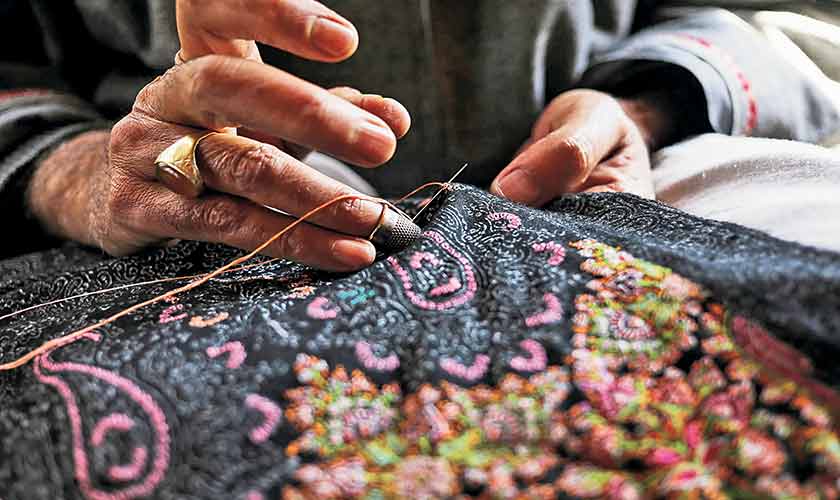
The crafts became their prayer, their resistance and their curse. To hear the blind weaver of Pashmina and Kani’s song, you will need to walk with me through the labyrinthine alleys of the old city, where the sunlight struggles to touch the ground. Here, the silence is broken only by the rhythmic click-click-click of the Kani spools. These small wooden sticks, made of ageless wood, are the bones of the trade. The Kani shawl is not merely a garment; it is a mathematical poem written in wool. But the cost of this poetry is the weaver’s sight. There is a haunting saying among the artisans, “Hath ka tilla, sona chandi” (Gold and silver from the hands), but it ends in darkness. The intricacy of the Talim, the coded pattern script, demands such intense focus that by the time a master weaver reaches forty, his eyes often fail him. The weavers trade their vision for the heat of fire in the kitchen. In the glow of a candle, or these days a mobile phone torch, (because the electricity is often gone), a weaver sits. He is working on a Do-shalla (double shawl), a technique popularised by Emperor Akbar. He remembers the stories of the Karkhanas (factories) of old, where the “shawl-bafs” were so indebted to their masters that they could never leave. They were prisoners of their own genius.
The production of Kar-I-Qalamdan also presents a stark case study in the bio-politics of labour. Historically, this craft represented sustainable alchemy: the transmutation of waste (paper, rice glue) into high-value cultural artifacts adorned with Gul-e-Vilayat (foreign floral) motifs. I shudder to think of the molten gold and silver being poured into each piece at the cost of poison going into the lungs, but this poison enables the transformation of otherwise waste into family heirlooms.
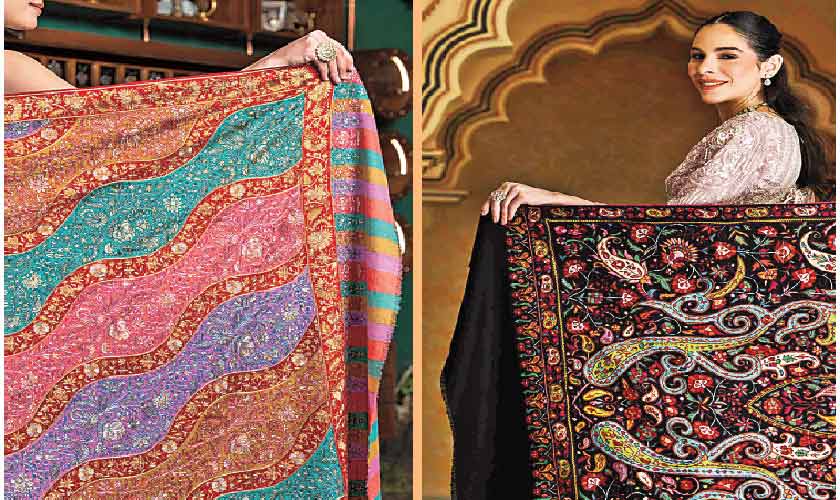
I think it is getting cold too, I peer outside to see a shikara swiftly searing into the depths of the lake – maybe someone is going home late. I wrap my shawl tighter to draw warmth from this beautiful piece of work and then get stuck on the incredibly beautiful paisleys lining the edge. Kashmiri shawls are a world within themselves and carry stories that are way beyond time - a centuries-old narrative woven in fiber, a testament to patience and a repository of the valley’s soul.
At the heart of the finest Kashmiri shawls lies pashmina, the soft under-fleece of the Changthangi goat that roams the Himalayan plateaus at 14,000 feet. This fiber, finer than human hair (12-16 microns), was called ‘soft gold’ along the Silk Road. The collection happens during spring molting, when herders comb - never shear - the goats’ winter undercoats. It takes the fleece of three to four goats to make a single shawl.
The most intricate technique uses small wooden spools called kanis (sometimes over a hundred different coloured ones for a single shawl). Weavers work from a coded pattern - the talim - creating designs by interlocking threads. A single kani shawl can take six months to two years to complete, woven by two artisans working in tandem on a simple handloom.
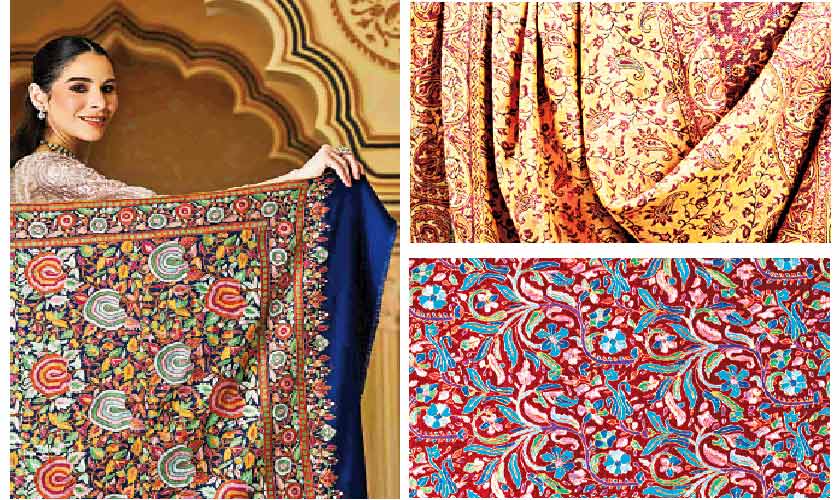
For sozni embroidery, the shawl becomes a canvas. Artisans embroider intricate patterns using needle and thread, often working without sketching first, the design exists in memory and muscle, passed down through generations. Every motif whispers a story:
The Paisley (Boteh): The iconic teardrop shape, called buta locally, has contested origins. Some say it represents the Zoroastrian flame, others a mango, a pinecone or even a cypress bent by wind. It became the ‘Kashmir pattern’ that later conquered Victorian England and Scotland’s Paisley mills.
Chinar Leaves: The majestic maple of Kashmir, with its five-pointed leaves that turn crimson in autumn, appears frequently. It symbolises the valley itself, beauty, resilience and the passage of seasons.
The Flowering Tree: Often centered on a shawl, the booti or flowering shrub represents paradise gardens, echoing the Mughal charbagh tradition. Each blossom, each branch has meaning: continuity, fertility and the tree of life.
Hashia (Borders): The elaborate borders frame the world within. Traditional designs include the badam (almond), representing prosperity and intertwined vines suggesting interconnection and eternity.
From then till today, these shawls are imperial gifts and symbols of prestige. Emperor Akbar established royal karkhanas (workshops) and the shawls travelled as diplomatic currency. Napoleon gifted Empress Josephine a Kashmiri shawl that sparked European obsession; by the 1800s, owning one was essential for fashionable European women.
The shawls also carry stories of grandmothers teaching children the first knots, dimming eyesights and folklores.
My chair is a carved walnut wood piece, with the same paisley resting here and a rather proud kingfisher ready for flight. The carpet beneath my feet is adorned with the tree of life – its bright sapphire, azure, ruby, amethyst, aquamarine and pearl palette - jewel-like tones – giving me a sense of regalness yet keeping my feet grounded. But it is all quiet, like the stealthily moving shikara. I write because I need to document this silence. This divinely inspired beauty is quiet – it has lost its voice or perhaps never gained one. It probably did not need one for it sat comfortably in its Himalayan citadel. But it needs to be heard by the world.
Kashmiri handicrafts, held securely in museums around the world, in wardrobes of the rich, in the living rooms of the aesthetically aware and in the hearts of those who create each piece, live a troubled voiceless life. They need a voice and I would not know how to scream loud enough for all of them.
The writer is a prominent painter, human rights activist and former government advisor. Pictures courtesy: https://www.pashmina.com/pashmina-shawl