As the world accelerates towards sustainable development and low-carbon economies, Pakistan must also redesign its transportation future. You! takes a look…
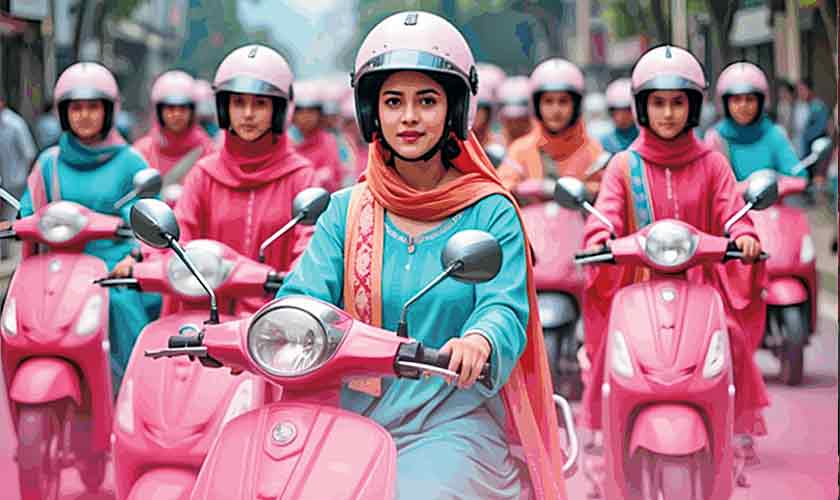
Environmental concerns are on the rise around the world, as carbon emissions are increasing rapidly, becoming one of the leading causes of global warming. These emissions come from different sectors but the biggest contribution comes from the transport sector.
It goes without saying that transportation is crucial in linking people, goods and services globally. However, conventional transport systems have significant negative social and environmental impacts. The road transportation sector, powered by fossil fuels, such as diesel, natural gas and petrol is a major contributor to global greenhouse emissions which is a worrisome situation for many countries.
As countermeasures, countries are shifting toward electric vehicles - an environmentally friendly mode of transportation. All over the world, electric vehicles are becoming central to green transitions, meaning a lower ecological footprint, for example emitting less CO2 (carbon dioxide). The global transition toward electric vehicles (EVs) has gained significant momentum in recent years, driven by advancements in technology, supportive policies and growing environmental concerns. According to the ‘New Emissions Gap Report’ by the UN Environment Programme, there has been progress since the Paris Agreement was signed in 2015. EV adoption is rising across major markets, reshaping the future of transportation and energy demand.
E-mobility – an environmental necessity
As the world accelerates toward sustainable development and low-carbon economies, Pakistan must also redesign its transportation future. Pakistan today stands at a critical juncture in its climate journey. As one of the most climate vulnerable countries in the world, it is grappling with devastating floods, unpredictable weather patterns and rising temperatures - despite contributing less than 1 per cent to global greenhouse gas emissions. In this context, the transition to green mobility – shifting from internal combustion engine vehicles to hybrid and electric vehicles – represents not just an environmental imperative but also a significant economic opportunity.
Many leading automotive companies have established their presence in the country, offering a diverse range of vehicles, from two-wheelers and three-wheelers to cars and commercial vehicles. While this industry supports economic activity and mobility, it also significantly contributes to environmental pollution and greenhouse gas emissions, which in turn impacts life expectancy and public health.
Electrifying the transport sector would reduce reliance on imported fossil fuels, thereby easing the persistent pressure on our balance of payments and conserving valuable foreign exchange reserves. The shift to locally powered electric vehicles align with climate goals and macroeconomic stability.
Pakistan’s landmark initiative
As the global transition toward cleaner transportation accelerates, Pakistan has made a major leap forward with the introduction of the New Energy Vehicle (NEV) Policy 2025–2030, aimed at reducing fuel imports, protecting the environment and strengthening the local auto industry.
This policy outlines the government’s ambitious goals: 30 per cent of all new vehicle sales to be electric by 2030 and net-zero emissions from the transport sector by 2060. It offers a wide range of incentives including tax cuts, subsidies and charging infrastructure development, with a strong focus on localisation.
The Government of Pakistan has also launched a landmark initiative under the Pakistan Accelerated Vehicle Electrification (PAVE) Programme, marking a major step toward clean and affordable mobility. This scheme aims to reduce Pakistan’s dependency on expensive imported fuel, improve air quality and encourage the use of electric vehicles (EVs). It will also support the local EV manufacturing industry, create new green jobs and make daily commuting cheaper for thousands of citizens - including students, women and small business owners.
Addressing the gender gap in mobility
According to recent research by CDPR (Consortium for Development Policy Research), Pakistan remains deeply rooted in traditional norms and customs, with pronounced gender disparities that sustain societal expectations and safety concerns limiting women’s mobility within the country. In many urban areas, women often experience limited access to secure and dependable public transportation systems, restricting their ability to pursue education and work outside their homes. Safety remains a major concern as incidents of harassment, catcalling and assault on various modes of transport contribute to feelings of being unsafe for women during their daily commutes.
Furthermore, rural communities have even fewer transportation options, limiting women’s access to growth and prosperity. Understanding women’s travel needs is critical to bridge the mobility gap in gender inclusion.
Another recent analysis found that university girls in Pakistan spend 3–4 hours commuting through shuttle services or public transport to access education. This commute can be both time-consuming and frustrating, compounded by the challenges posed by crowded and often unsafe public transport. Working women face similar hurdles, frequently encountering harassment while commuting. This is not merely an inconvenience; it affects their daily lives and overall well-being.
The heartening news is that the government has dedicated a 25 per cent quota for women and over 100,000 electric bikes and 300,000 electric rickshaws/loaders under its newly launched Electric Vehicle (EV) scheme, a comprehensive national initiative to promote EV adoption in Pakistan.
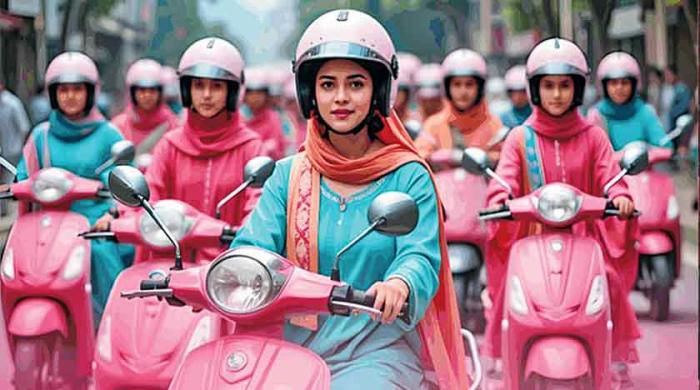
Pink electric scooters scheme
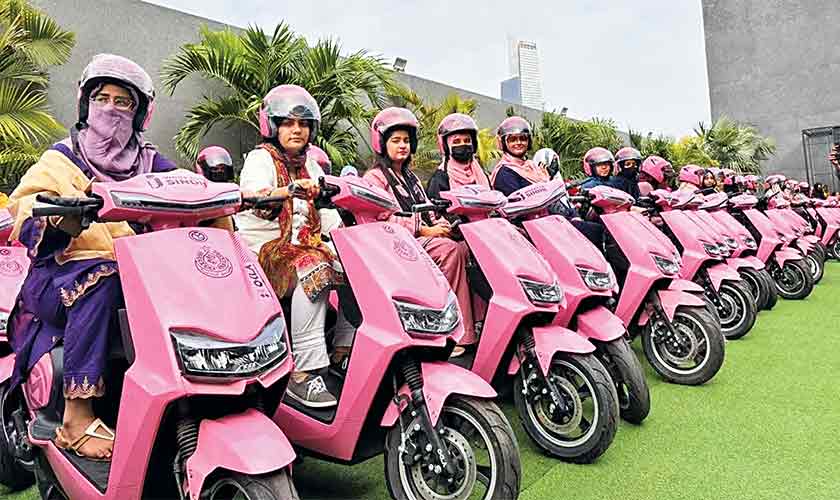
Reflecting this spirit, the Sindh government has launched the ‘Pink Electric Scooters Scheme’ through the Sindh Mass Transit Authority, a landmark initiative aimed at empowering women and promoting eco-friendly transport solutions. The scheme provides free e-scooters to women, with special priority for widows, single mothers, students and working professionals.
The scooters are locally assembled in Pakistan through a joint venture between OKLA, a Chinese electric vehicle manufacturer, and Ravi Sundar, a leading Pakistani automotive company. With the Pink Scooty Scheme, women are not only being given safe transport but are also being positioned as central figures in the country’s journey toward sustainability and gender equity.
The initiative stands as a reminder that inclusive policies and innovative partnerships can bring about transformative change. Imagine a world where young women can confidently navigate their city without the fear of harassment or the long waits associated with public transport. This independence will reduce dependence on family members, cut down waiting times and offer significant savings on daily travel expenses. For women across Sindh, these scooters are more than vehicles; they are pathways to empowerment, safer cities and a future where mobility belongs to everyone.
Shifting Gears
In light of the Paris Climate Agreement, Pakistan’s Nationally Determined Contributions (NDCs), and the Electric Vehicle (EV) Policy approved by the Government of Pakistan, there is an urgent need to transition from conventional petrol and diesel vehicles to hybrid and electric alternatives.
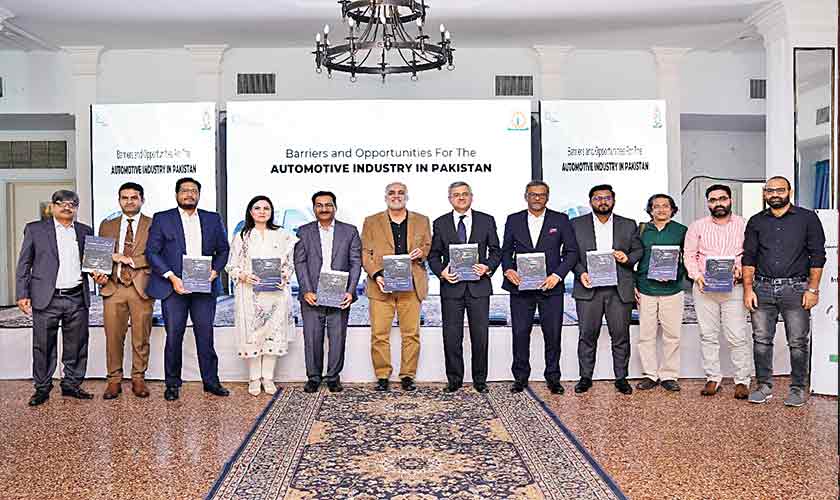
Recognising the importance of this issue, experts and automotive industry leaders gathered at an event organised by Indus Consortium to discuss green mobility through consistent policy implementation, investment in charging infrastructure and financial incentives to support the adoption of electric and hybrid vehicles. The event, held recently in Karachi, brought together participants from government, private companies, academia, financial institutions and civil society.
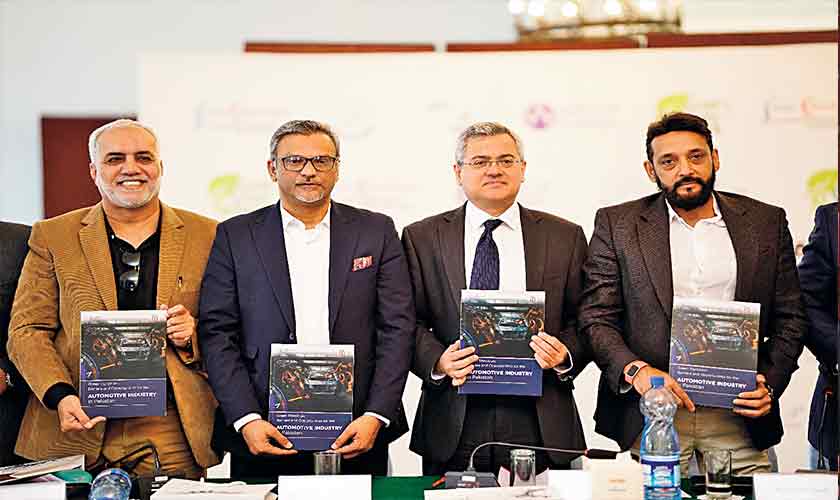
The event also marked the launch of a research study titled ‘Green Transition – Barriers and Opportunities for the Automotive Industry in Pakistan’, conducted by the Indus Consortium in collaboration with the Federation of Pakistan Chambers of Commerce and Industry (FPCCI).
Key recommendations from the study included establishing a national task force for EV policy implementation, developing a nationwide charging infrastructure with reduced electricity tariffs, and integrating hybrid vehicles into the country’s broader electric mobility strategy. Financial institutions were advised to offer green car financing with lower interest rates, while insurance firms were encouraged to provide discounted premiums for environmentally friendly vehicles.
At the event, Ali Asghar Jamali, CEO of Indus Motor Company (IMC), highlighted his company’s initiatives in carbon reduction, stating that IMC had installed the largest rooftop solar panels and introduced hybrid electric vehicles (HEVs) to cut emissions. He emphasised that not only electric vehicles (EVs) but also hybrid and plug-in hybrid vehicles (PHEVs) should be part of the green vehicle spectrum.
Hussain Jarwar, CEO of Indus Consortium, pointed out that if financing and infrastructure barriers were removed, the New Energy Vehicle (NEV) Policy could serve as a successful business model similar to the country’s solarisation drive.
Aamir Allawala, former Chairman of the Pakistan Association of Automotive Parts and Accessories Manufacturers (PAAPAM), said the green transition would only yield benefits once localisation of parts for new energy vehicles begins. However, he cautioned that the disposal of EV batteries would become a major challenge in the coming years.
Presenting the study, Muhammad Armughan of FPCCI stressing the need for fiscal incentives, technology transfer and green financing to ensure a smooth transition. “Pakistan’s automotive industry contributes significantly to national emissions, but targeted interventions can reverse this trend,” he elucidated.
Speakers from the banking sector, including Rashid Azeem (UBL), Wajih Zaman (Soneri Bank), and Sadia Bukhari (Sindh Bank) aid that vehicle financing remains limited to Rs3 million. However, they noted that two- and three-wheeler electric vehicles would benefit from government subsidies, as the state plans to cover down payments and offer interest-free loans.
Other panellists included Fatima Majeed (Chairperson, Fishermen’s Cooperative Society), Mashood Ali Khan (former Chairman, PAAPAM), Prof. Dr Raza Ali Khan (NED University), Yasir Hussain (Climate Action Centre) and Bilawal Suhag (Head of Research, FPCCI).
Speakers agreed that achieving the NEVP targets would be challenging, agreeing that a gradual and practical transition towards green vehicles is a more realistic approach. They pointed out that the automotive sector is facing multiple barriers in its green transformation, including inadequate charging infrastructure, high upfront costs and the national grid’s continued dependence on fossil fuels.
Although achieving the target of 30 per cent of all new vehicle sales to be electric by the year 2030 presents challenges, a conducive policy and regulatory environment - along with financing support from banks, the commitment of the automotive industry to manufacture EVs, the development of charging infrastructure and affordable vehicle options - can make this transition possible.
A greener auto future
While Pakistan has announced ambitious EV policies and local manufacturing plans, progress is constrained by high vehicle costs, infrastructure gaps and limited consumer awareness. Without accelerated policy implementation and increased investment - particularly in charging infrastructure - the nation risks falling short of its decarbonisation and mobility transformation goals.
“For Pakistan, embracing e-mobility is not just an environmental nicety, it’s a crucial step toward sustainable development. The transition won’t happen overnight, but every charging station installed and every electric vehicle on the road is a step towards that cleaner, safer future,” says a report by the Climate Action and Policy Initiative (CAPI). The wheels of change are already in motion, and accelerating e-mobility may well drive Pakistan to a new horizon of sustainable development.
Erum Noor Muzaffar is the editor of You! magazine. She can be reached at [email protected]