Print Story
X




Looking back at the history of world diplomacy and how time has shaped its modern contours
| D |
iplomacy did not start at a single moment in time; it is as old as organised human societies. It developed and evolved along with human settlements and their transformation from tribes to states as and when different groups needed to communicate, negotiate and avoid conflict on resource capture, territorial expansion and extension of influence. The earliest use of diplomacy goes back to Mesopotamians, where ancient settlements exchanged messengers and negotiated alliances. One of the first recorded diplomatic agreements is the Treaty of Kadesh, reported to have been signed between the Egyptian Pharaoh Ramesses II and the Hittite King Hattusili III.
City-states, states and empires developed permanent contacts, ultimately leading to stationing of embassies. William Dalrymple writes in The Golden Road that what Greece was first to Rome, then to the rest of the Mediterranean and European worlds, India was to South East and Central Asia; even to China during this period, radiating its philosophies, political ideas and architectural forms, not through conquest but sheer cultural sophistication through diplomatic missions.
The establishment of permanent embassies as part of modern diplomacy began in Renaissance Italy in places such as Venice. These missions were formalised after the Congress of Vienna, which established rules and norms most of which are still in vogue. Held after the final defeat of Napoleon Bonaparte in Waterloo, it aimed to restore stability and balance of power in Europe after years of revolutionary and Napoleonic wars. It established diplomatic principles of legitimacy, balance of power, principle of collective security, compensation and containment of any power to dominate the others. This order helped maintain relative peace in Europe for nearly a century, until WWI.
Diplomacy between WWI and WWII played a crucial but ultimately ineffective role. While it aimed to preserve peace after the catastrophic war, it failed due to weaknesses, mistrust and rising aggression. The harsh penalties imposed on Germany backfired by creating resentment and instability. The League of Nations was meant to prevent future wars through collective security and diplomacy. The league promoted dialogue and peaceful dispute resolution but lacked enforcement power or mechanism to forcibly stop transgression from diplomatic principles. The appeasement policy of the UK and France towards aggressive Nazi Germany to avoid war encouraged further aggression.
The measures reported to have been conceded by Iran in pre-war negotiations with the United States also seem to have amounted to appeasement. Omani foreign minister, privy to talks, reported “significant, important and unprecedented progress” in indirect US-Iran negotiations, hinting that a potential nuclear deal was within reach. This means that in its endeavour to avoid war, Iran was ready to give up so much that the Trump administration was emboldened to expect even more from it. This should be compared to North Korea, which maintained resistance during the first Trump era and was able to thwart aggression in his second tenure.
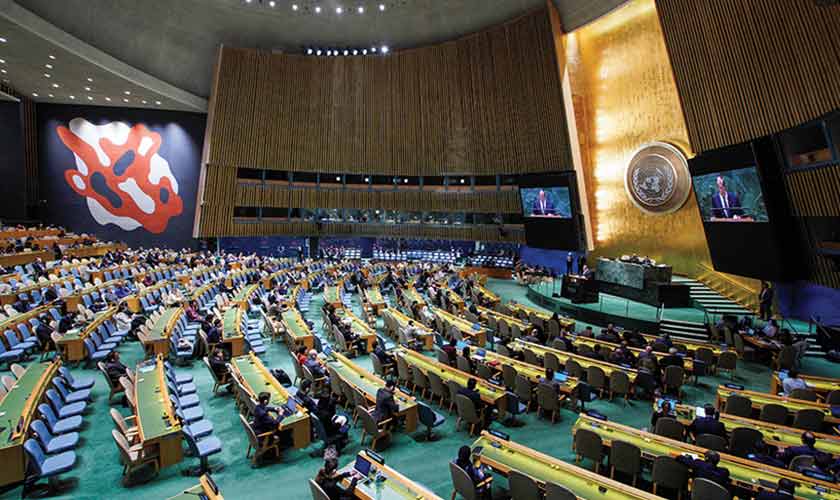
The United Nations has played a crucial role in modern diplomacy by providing a global platform for dialogue, conflict resolution and cooperation among states after the catastrophic devastation of WWII. It has provided various forums like the United Nations General Assembly, where all member states can discuss global issues, raise concerns and debate policies for negotiated settlement of disputes. The deployment of peace keeping missions in conflict zones have monitored ceasefires and stabilised conflict zones by combining diplomacy with on-ground conflict management. The UN has promoted treaties and legal norms. The International Court of Justice settles legal disputes between states.
However, some recent developments have laid bare the limitations of the UN because its decisions can be blocked by veto powers in the Security Council, thus lacking enforcement strength. Resultantly, it is dependent on the cooperation of powerful states.
The UN has transformed diplomacy into a structured, global and multilateral process. While not perfect, it remains the most important institution for maintaining international peace by employing diplomatic means. Its achievements include supporting decolonisation; preventing another world war; promoting human rights; and advancing global health and development. Therefore, despite limitations, it remains the cornerstone of modern international cooperation and diplomacy.
Jim Sciutto, a CNN journalist, wrote in The Return of Great Powers, that John Kelly who served in the Trump administration as secretary of homeland security was reported to have said that “A second term with him [Trump]—particularly when he would not be worrying about re-election—would fundamentally be a catastrophe for us.” Francis Fukuyama’s end of history thesis seems to have proven wrong. History did not end; it barely paused, and is on its way to change the global order. Global powers are once again asserting dominance on the world stage. As their push for power escalates, a new order is expected to affect everyone on the globe. The realities of the present, post-post-Cold War era, are engendering a global, even nuclear, arms race with the potential to obliterate the entire world.
In his famous book, Diplomacy, Henry Kissinger writes that “diplomacy is the art of restraining power,” meaning that power is not only meant to be exercised but also controlled wisely. He also argues that “international relations are not conducted in a vacuum but in a world of competing national interests.” The national interests are not only ever-evolving; they can also be far-fetched. The war against Iran, for instance, has been described by Israel and the US as being in their ‘national interest.’
History has shown us that war is in no one’s interest.
The writer heads the History Department at University of Sargodha. He has worked as a research fellow at Royal Holloway College, University of London. He can be reached at [email protected] His X handle: @AbrarZahoor1.