Print Story
X




The divide between idea and form has long shaped how art has been understood
| “I |
deas alone can be works of art; they are a chain of development that may eventually find some form. All ideas need not be made physical.”
– Sol LeWitt
An idea is like an omelette: several components, a process to be followed, but once prepared, it acquires its own identity, separate from its making. Though you can still taste some ingredients, it has a distinct flavour and form of its own. Contrary to popular presumption, ideas are not invented; they are arrived at through a long and hazardous journey. As soon as an idea generates a piece of art, it merges with form, a blend not different from that of body and soul.
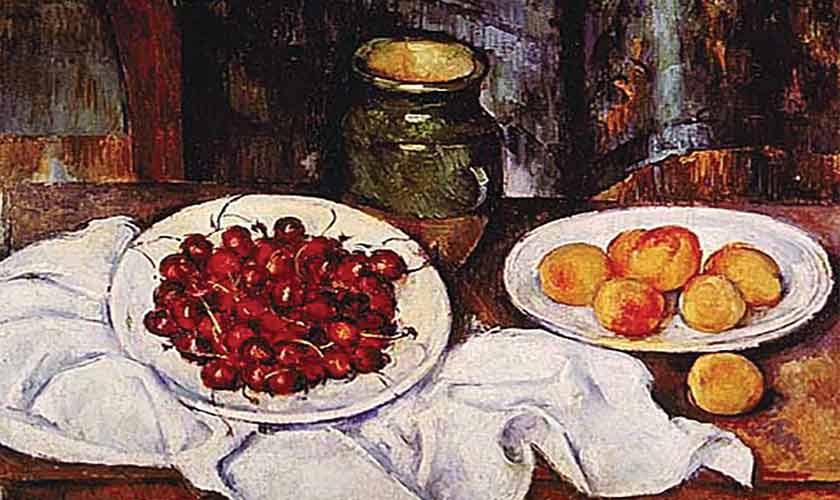
In most cases, ideas evolve with material engagement, yet we tend to delink the two. In some discussions on art, you hear segregation of idea-led work and the rest: a distinction as ludicrous as classifying people as either made of spirit or flesh. In this tradition, work involving naturalistic subjects - portraits, figurative compositions, landscapes and still lifes – is often regarded as pictorial, lacking an idea. In the Pakistani context, where social divisions on the basis of class, race, religion, ethnicity, language, gender and politics are strong, this tendency has crept into art too. A painting of vases, fruits and vegetables composed by Chardin; a canvas depicting a barn, huge trees, a stream, a few animals and lush fields created by Constable; a self-portrait by Rembrandt; or a surface painted by Rothko are thus works lacking concepts - mere visual concoctions.
This binary distinction between idea and form, and the supremacy of one against another, or even the relevance of the other, has been a constant feature of Modernism, which is often dismissive of the subject, understood as a traditional narrative. Impressionist painters wrenched themselves from the burden of a theme/ narrative and rendered what they saw in front of them: light, colour, water, clouds, cities and fields: optical phenomena that cannot be pinned to complex ideas. Their canvases were depictions of their perceptions. American Abstract Expressionists were more interested in grasping the action (like Jackson Pollock) or relying on marks, shapes and colour (Barnett Newman and others) that apparently do not mean anything.
In literature, the practitioners of French Nouveau Roman, including Alain Robbe-Grillet and Georges Perec, pushed a form of writing loaded with the depiction of detail, like a painter’s eye recording their surroundings, in place of a narrative. However, today one realises that there was always a narrative, subject and idea in every work created by painters or novelists who aimed to liberate art from extraneous links. Frank Stella, in his 1966 interview with Glaser for ARTnews, explained his paintings: “What you see is what you see.” Yet we unearth more than what was intended by Stella and other artists and writers.
Even in still life paintings of Dutch masters, which were normally treated as compelling representations of domestic/ kitchen items, John Berger traced the desire of the affluent merchant class that showed off its wealth through its possessions. Likewise, today, when we look at the Impressionists’ canvases, we find ideas of urbanisation, scientific theories of light and the impact of photography in works, supposedly merely optical. Reading a novel by Robbe-Grillet, you pick meanings that maybe were not consciously intended by the author to be communicated.
Once we segregate art into idea and observation, we are doomed to a flawed appreciation at best. Every work of art carries an idea, even if it is not presented, projected or consciously articulated by its maker. Artists, like all humans, are thinking individuals. The act of choosing a site with a number of trees, several mud houses and an electricity pole in the background carries some layers of meaning. This may be deciphered later, because a work of art does not necessarily begin with an idea; it may take shape during the process, emerge later. It may be discovered or unearthed after several centuries.
As soon as an idea generates a piece of art, it merges with form, a blend not different from that of body and soul.
Every work of art, then, contains an idea. But how is it to be decoded, and who is capable of, or authorised, to do so? That is a difficult question. An artist’s ideas often remain transitory, more like fleeting flirtations than fixed intentions. A well-known case is that of Paul Cézanne, who sought to paint nature after Nicolas Poussin, yet what he produced bears little trace of that aim. His real contribution lies in the geometry of image-making that transformed painting after him. There is perhaps no painter today who has not, in some way, passed through Cézanne.
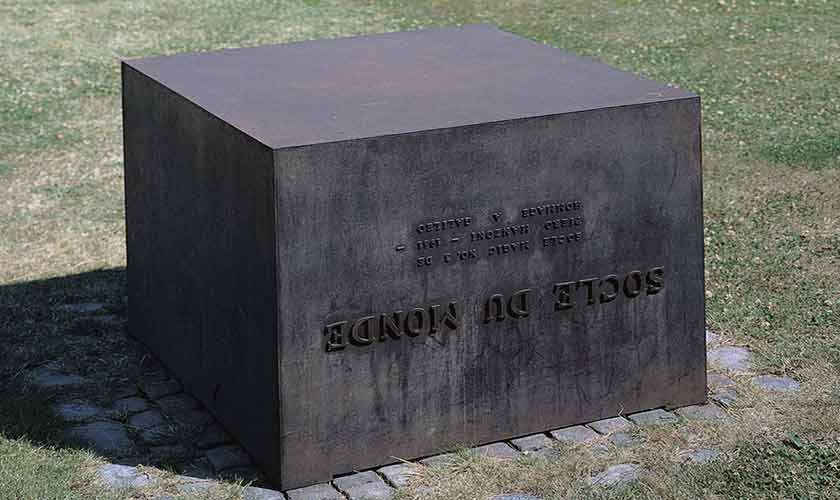
For some contemporary artists, however, ideas occupy the central place in their creative practice. Joseph Kosuth, Piero Manzoni, Joseph Beuys, Hans Haacke and John Baldessari, often described as conceptual artists, prioritise ideas. Still, the pictorial aspect of their work remains compelling. The materiality of the object is not absent, nor is aesthetic pleasure abandoned.
In contemporary Pakistani art, Ayaz Jokhio has emerged as a practitioner who engages more with ideas than with visual appearance alone. As ideas themselves shift, often rapidly, his style, concerns and imagery change over time. Questions around the relationship between handmade painting and photography; the distinction between the front of an image and its reverse; the readability of an image as compared to text; and the debate on authenticity have been evident in his work from his graduation in 2001 to the present day.
The present is a difficult word, for it risks consigning the past to the bin of history. A close examination will reveal that several significant artists have produced work in which ideas took precedence over imagery. Rasheed Araeen’s act of throwing discs into the waters of Karachi; Salim Mansur’s works from 1984 exploring artistic identity; and Iqbal Geoffrey’s installations and performances all foreground the primacy of ideas.
Geoffrey, at an early stage in Pakistani art, probed whether painting is a visual object or a means of transmitting ideas. In an exhibition at the Pearl Continental Hotel, Lahore, he placed labels next to non-existent canvases, “this painting has gone for a swim,” or “the painting went for a walk,” and so forth.
In the art of Iqbal Geoffrey, the idea takes precedence over the visual, sometimes dispensing with the image altogether. In one work, he invited an audience to Victoria Miro Gallery at a specified time and declared that whatever was on display, by another artist, would become his work for a fixed duration, say from 4:00 pm to 6:00 pm. One may read in this a subtext of originality and appropriation, a critique of the mainstream and of former colonies’ attempts to enter it, as well as a questioning of that very mainstream.
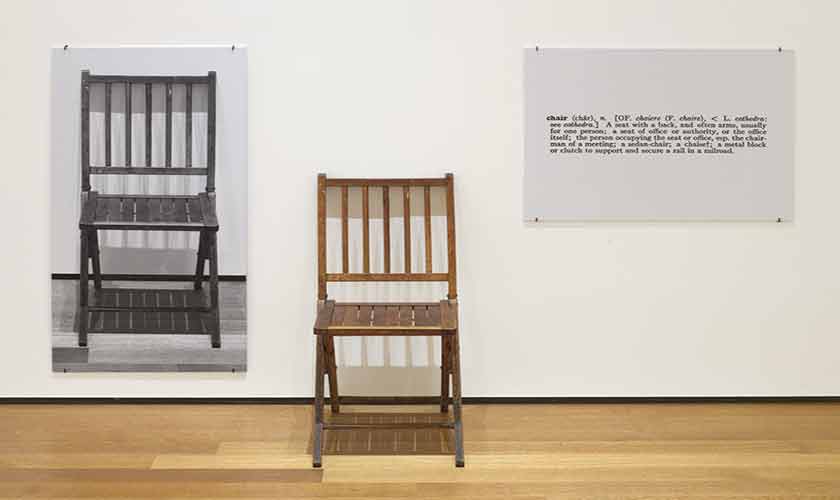
In Geoffrey’s practice, the idea is not merely a formal element but, as in the work of Hans Haacke, invokes political realities. For an exhibition at Khoj Artists’ Initiative, he sent Invisible Rain From Lahore, a work consisting solely of a concept that addressed the barrier between India and Pakistan, the travel restrictions between the two countries and the extension of imaginative limits of art as an idea.
Ideas, whether consciously engaged with in artworks or remaining latent, are important because, as noted in a response from California Institute of the Arts to a Pakistani artist’s admission letter, “it is the idea that takes a work to the realm of art.”
The writer is a visual artist, an art critic, a curator and a professor at the School of Visual Arts and Design, Beaconhouse National University, Lahore. He can be contacted at [email protected].