Print Story
X




As geopolitical tensions in the Middle East continue to evolve, India faces complex choices. Energy security, diaspora interests, defense partnerships and regional connectivity all intersect in this volatile landscape
| I |
n a sharply-worded article, Indian National Congress president Sonia Gandhi has mounted her strongest critiques yet of the Narendra Modi-led government’s foreign policy, accusing it of sacrificing India’s long-standing diplomatic balance in favour of political spectacle and ideological alignment with Israel.
Gandhi laments that New Delhi’s nuanced and carefully calibrated engagement with West Asia has been replaced by what she describes as “muted responses” and an “ambiguous stance” during moments of international crisis. She says this ambiguity does not strategic restraint and is instead a sign of moral and diplomatic abdication.
For decades, she says, India maintained a delicate balance between Israel and Iran. Successive governments, including those led by Congress and previous BJP leaders, pursued engagement with both nations, recognising their respective strategic and economic importance. India’s relationship with Israel involved defence and technological cooperation; its ties with Iran were rooted in civilisational links, energy security and geostrategic considerations.
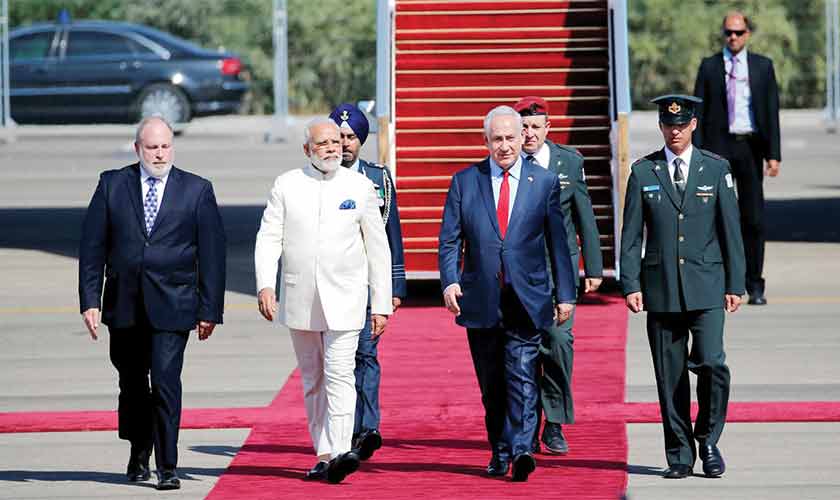
Gandhi says this equilibrium has been disrupted under Prime Minister Modi. She points to Modi’s high-profile visit to Israel — the first ever standalone visit by an Indian prime minister — without a corresponding stop in Iran at the time, as a departure from consistent practice. Previous Indian leaders, she said, had ensured parity in their engagements, carefully balancing visits and rhetoric to avoid signalling favouritism.
Gandhi says such diplomatic gestures matter. They shape perceptions and redefine alignments. In appearing to privilege one partner over another, she warns, India risks alienating a long-standing regional ally and narrowing its own strategic options.
A key pillar of Gandhi’s criticism is Iran’s historical support for India’s strategic interests. She recalls how, in 1994, Iran played a critical role in blunting pressure against India at the Organisation of Islamic Cooperation. While Pakistan was seeking to internationalise the dispute, she says, Tehran’s intervention helped India avoid diplomatic isolation in the Islamic world.
Beyond diplomacy, Iran has been central to India’s connectivity ambitions. The development of the Chabahar port and India’s involvement in infrastructure projects near Zahedan have been seen as crucial components of a broad strategy to access Afghanistan and Central Asia while bypassing Pakistan. These initiatives were designed not merely as economic ventures but as strategic footholds in a geopolitically sensitive region.
Gandhi says that in appearing to distance itself from Iran, the Modi government risks undermining years of painstaking diplomatic and economic investment. She says this shift has left a vacuum in India’s regional partnerships and weakened its leverage.
The opposition leader is particularly critical of what she describes as New Delhi’s “muted response” to the killing of Iran’s supreme leader. She contends that India’s silence at a moment of major geopolitical upheaval signals not prudence but submission.
Gandhi says the equilibrium has been disrupted under the Modi government. She points to Modi’s high-profile visit to Israel only a day before the start of the Iran war as a departure from the traditional Indian practice.
Gandhi says the Modi government’s reluctance to articulate a clear and principled position has damaged India’s claim to an independent foreign policy. Ambiguity, she says, when not backed by credible strategic reasoning, becomes indistinguishable from moral cowardice.
India, she recalls, has traditionally prided itself on strategic autonomy. This allowed it to navigate Cold War rivalries and later global realignments without becoming subordinate to any bloc. By aligning ostentatiously with Israel and downplaying its engagement with Iran, the Modi government, she says, has risked being perceived as partisan rather than principled.
A recurring theme in Gandhi’s critique is the alleged prioritisation of optics over substance. She characterises Modi’s engagement with Israel as grandstanding exercises aimed at domestic political messaging rather than carefully measured diplomacy.
Public displays of camaraderie, high-visibility visits and celebratory rhetoric, she says, may resonate with certain domestic constituencies but can complicate sensitive regional relationships. Diplomacy, she says, demands subtlety and quiet negotiation, not theatrical gestures.
Gandhi also says that while other major powers have chosen to tread cautiously in the volatile West Asian landscape, India’s visible tilt risks being interpreted as a tacit endorsement of controversial actions. Such perceptions, she warns, could constrain India’s room to maneuver in international forums and reduce its ability to act as a credible interlocutor.
At the heart of the article is a concern about strategic autonomy. She says India’s foreign policy establishment has emphasised first, non-alignment and later multi-alignment.
Gandhi worries that this tradition is being eroded. She suggests that the government’s approach signals a readiness to subordinate long-term national interest to short-term political convenience. In her framing, diplomacy cannot be reduced to personal rapport between certain leaders or domestic political symbolism; it must be anchored in institutional continuity and strategic foresight.
She has also raised concerns about the implications of the new policy for India’s global standing. If India is perceived as abandoning a balanced approach in favour of selective alignment, its credibility as a neutral voice in multilateral platforms will diminish. This, she says, will limit its ability to influence outcomes on issues ranging from regional security to global governance reform.
Supporters of the Modi government argue that India’s foreign policy has evolved to reflect changing global realities. This includes closer ties with the United States and shared security concerns with Israel. Some critics caution, however, that abrupt shifts can result in unintended strategic costs.
Gandhi has sought to frame the issue as one of principle rather than preference. In her narrative, the essence of Indian diplomacy lies in its independence — the capacity to engage with diverse actors without appearing beholden to a single axis of power.
As geopolitical tensions in the Middle East continue to evolve, India faces complex choices. Energy security, diaspora interests, defense partnerships and regional connectivity all intersect in this volatile landscape.
Sonia Gandhi’s critique underscores the stakes involved in recalibrating long-standing diplomatic relationships.
The author works for The News. He can be contacted at [email protected].