Print Story
X




Does living in a place named ‘Krishan Nagar’ make the people there any less Muslim? Or does it simply make them the keepers of a story that is being slowly, brick by brick, forgotten?
| W |
hen in Lahore, my heart blooms like a daisy in response to the city’s lively pulse. Though stationed in another province, I find myself drawn back every week, undertaking a cross-country commute just to breathe in its atmosphere.
Recently, a friend dropped me at the intersection of Nabha Road and Old Anarkali. For a few minutes, I simply stood there, letting the aroma of freshly crushed green chilies and ground black pepper rekindle my love for Lahori street food. I glanced at my watch: it was 8-ish PM. Nearby, an auto-rickshaw driver leaned against his vehicle, scouting the crowd for passengers.
To confirm my route, I asked him for the way to Krishan Nagar.
“Get in! We’ll be there in the twinkling of an eye,” he insisted, swinging the door open.
I politely declined, promising to catch him next time, and began the 10-minute walk towards the Civil Secretariat.
As I followed the wall of the stately Secretariat building, I was informed that that path led to Islampura — the modern name for what was historically, and correctly, Krishan Nagar.
My mood shifted instantly. This local impulse to rename the neighbourhood felt like a mirror image of the radical wave seen across the border, in India; an attempt to erase diversity and manipulate national identity by scrubbing away the past. I wondered why we fear the ghosts of our own geography.
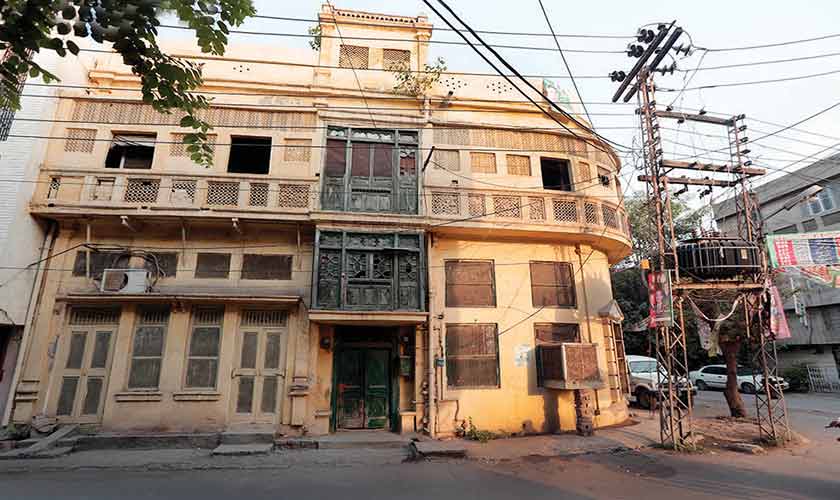
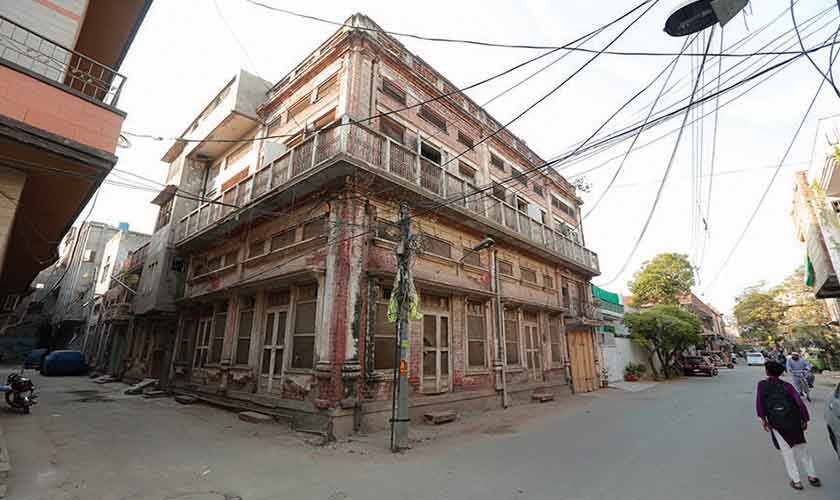
Established in 1930, Krishan Nagar was originally home to predominantly Hindu government employees. After Partition, most residents moved to India, leaving behind homes with distinctive façades and inscriptions. I had come to see if any of that soul remained.
On Haider Road, I approached a motorcyclist waiting outside a pharmacy. “I want to see the old buildings,” I told him. “The ones from before the Partition.”
He looked puzzled. “I was born and raised here,” he said, pointing to his own home a few yards away. “The kind of buildings you’re looking for are mostly gone. We’ve reconstructed our house, too. People are either rebuilding or moving to the new housing societies.”
He suggested I try Umar Road.
Umar Road felt like a city within a city. Despite being only 2.5 kilometres from one of South Asia’s largest bazaars, it boasted its own thriving marketplace. Young shopkeepers shouted prices over the din of the crowd.
I eventually met a tall man with silvering temples tending a stall of teapots. A resident of Umar Road himself, he gave me a faint, knowing smile. “I live here, but I’m telling you, there isn’t much left to look at. You’ll have to hunt through the backstreets.”
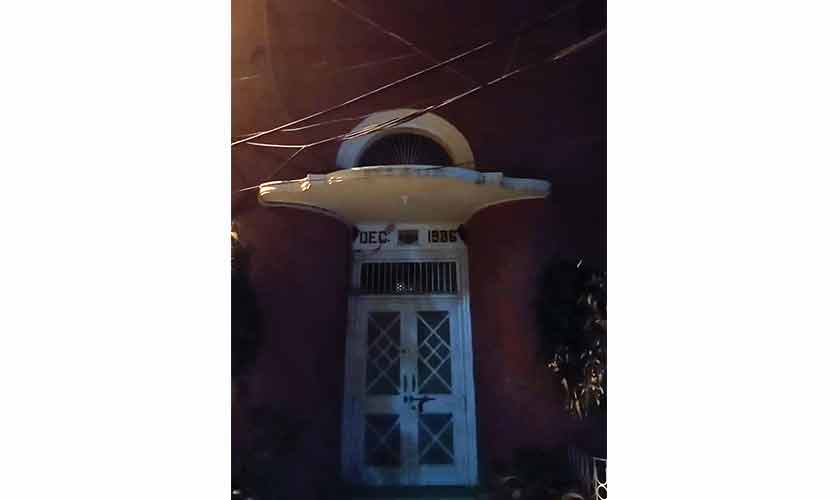
By 9 PM, I finally found them. Tucked away among the modern concrete were a handful of houses in various states of decay, yet bearing their original marks. Above one entrance, a stone carving read: “Dec, 1930.” Another bore an Urdu inscription in Arabic script dated 1967.
They looked like they were pleading to be preserved. Yet, all around them, the sound of progress was deafening. Sacks of cement and gravel were strewn across every street; the relentless reconstruction was in full swing.
As I began the journey out of the neighbourhood’s twists and turns, I spotted a commercial bank. The sign didn’t say Islampura; it proudly listed its branch address as Krishan Nagar.
I felt a small, quiet surge of satisfaction. The wave of renaming had not yet fully penetrated the official record. Or, so I thought.
Passing the stately Government College for Women, its walls draped in ancient creepers, I wondered: Does living in a place named ‘Krishan Nagar’ make the people here any less Muslim? Or does it simply make them the keepers of a story that is being slowly, brick by brick, forgotten?
Usama Malick is a storyteller with an M.Phil in English