Print Story
X




Cover-Up captures the fierce spirit of the now 88-year-old journalist Seymour Hersh
| O |
n January 26, The Daily Show host Jon Stewart, in his closing monologue on the shooting and killing of 37-year-old US citizen Alex Pretti by federal immigration agents in Minneapolis, declared, “They’re lying. We saw it. And that’s how brazen they lie when they know we’ve seen the truth… Imagine how they lie when there’s no evidence to contradict them.”
Stewart’s monologue was meant for the Trump administration.
According to the BBC “the Department of Homeland Security said the agents fired in self-defence after Pretti, who they say had a handgun, resisted their attempts to disarm him.”
The Guardian in its January 26 editorial wrote, “Contrary to scurrilous claims by senior members of the Trump administration, he [Alex Pretti] was holding a phone, not a gun, before he was overpowered.”
With a still from a mobile phone footage showing Pretti holding a phone in his hand, face to face with a federal immigration agent, Stewart continued: “Because there is nothing more dangerous to a regime predicated on lies than witnesses who capture the truth.”
When journalist and filmmaker Laura Poitras asked investigative journalist Seymour M Hersh (referred to as Sy) what would have happened if there hadn’t been any photographs of the torture and abuse by US military at Iraq’s Abu Ghraib prison, his response was almost reflexive.
“If there hadn’t been [any] photographs? No story.”
This would have sounded cold, insensitive even, had it not been for the fact that in 2004, Hersh wrote a series of stories for The New Yorker exposing the Abu Ghraib prison abuse scandal as photographs detailing the horrors of the torture, abuse and humiliation of Iraqi prisoners sent shockwaves around the world.
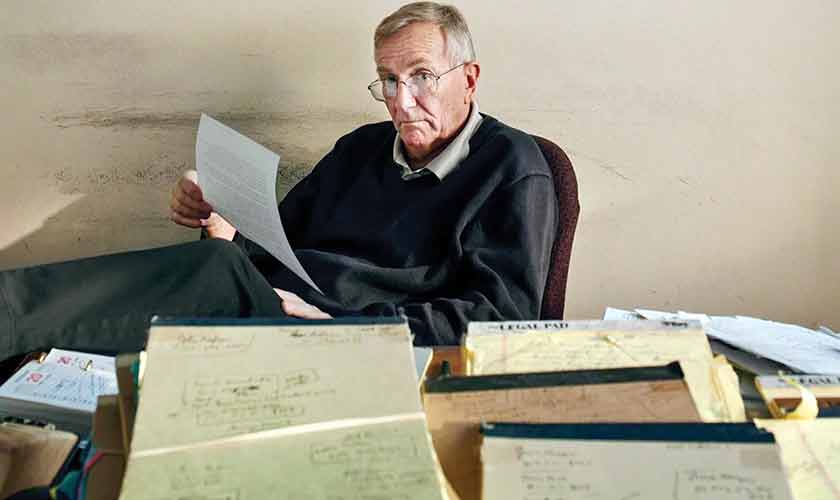
Hersh is the subject of Cover-Up, a documentary by Poitras and Mark Obenhaus, capturing the fierce spirit of the now 88-year-old journalist.
Released on December 26 on Netflix, the nearly two-hour long film runs like a political thriller charting the legendary journalist’s life. Using archival footage, Hersh’s handwritten notes and in-person interviews of Hersh, his colleagues and a previously anonymous source, the documentary ties up the scatter with a piercing soundtrack that urges attention at the right moments.
The responsibility to uncover the truth and challenge official narratives runs as a consistent theme.

Hersh’s November 1969 exposé of the My Lai massacre in Vietnam by the US Army earned him a Pulitzer the following year. Hersh says he had felt a general unease. “There was this massive truth out there… I didn’t see a way to get to it.”
Sure enough, he found his way. Following a tip, and having made several calls, jotting down accounts, he travelled to Fort Benning where he finally got hold of a soldier who was being investigated for murdering Vietnamese civilians. Picked up by 30 newspapers, Hersh’s story said:
“The Army is completing an investigation of charges that [Lt Calley] murdered at least 109 Vietnamese civilians…
“The Army calls it murder; Calley, his counsel and others associated with the incident describe it as a case of carrying out orders.”
In an interview with BBC Hardtalk in 2018, marking 50 years of the My Lai massacre, when asked how the story had affected him, Hersh said, “Oh my God, I would cry. There were things I didn’t write about,” he said while mentioning some of the horrific details.
Hersh had stumbled into journalism and fallen in love with being a reporter. He knew his strengths. Hersh’s scepticism, almost annoyance, at being the subject of a story is obvious.
Frustrated with the concern that his notes may have exposed more than he would have wanted to before the filming crew, Hersh walks away from the project at one point. “I’d like to quit. You know too much about what I’m doing. You know too many people.” There, the cameras stop rolling.
Some exchanges between Hersh, Poitras and Obenhaus are hard to miss. Punctuated with respectful silence—as Hersh blurts out his frustration, “What is this doing in there!” suggesting the crew might have gotten hold of notes bearing details of his sources.
Asked why he keeps doing ‘the work,’ Hersh shrugs his shoulders, “You can’t just have a country that does it and looks the other way. If there’s any mantra to what I do, that’s it.”
At another instance, upon Poitras’ inquiry suggesting he talk about sources, Hersh snaps back. “Let’s put it this way: you’d love to talk about sources… I’d love not to talk about sources.”
Obenhaus, who has previously worked with Hersh on three documentaries, clarifies the intent. “Not specific sources but types of people you get.”
“I don’t psychoanalyse those who talk to me just like I don’t psychoanalyse myself.”
“It’s complicated to know who to trust… I barely trust you guys.”
No wonder then that he took 20 years to agree to Poitras’ 2005 ask to make a film about him.
Hersh’s irritation is mostly grounded in journalistic integrity. He remains hawkishly concerned about protecting his sources.
It was a call from Camille Lo Sapio, previously an anonymous source, that tipped Hersh about photographs showing torture at Abu Ghraib on her laptop which she had lent to her former daughter-in-law, who was then posted in Iraq.
Hersh’s views about the Iraq War were no secret.
Amy Davidson Sorkin at The New Yorker was his editor on the Abu Ghraib stories. “Right before the invasion of Iraq, he just called up and was full Sy raging at the heavens… he thought it was such a mistake.”
“The photographs were horrifying,” Hersh recalls. CBS had the photographs but couldn’t air it under government pressure. Before Hersh’s own story was to come out he decided to make a call. “I called up the producer and said if you don’t do it Thursday, on Sunday we’re going to run the report with pictures and say we are doing this story because a major network called CBS did not fulfil its obligation.”
CBS’s 60 Minutes finally did a show on Abu Ghraib. Later that same week, Hersh’s story came out.
At The New York Times, Hersh had kept pushing the limits. When he began reporting on corporations, it was the “beginning of the end at NYT,” Hersh says.
His partner in the investigation, Jeff Gerth, sensed that the editors were nervous. “The New York Times had never done a serious investigation on corporations,” Gerth says. This meant being asked by editors at the last minute to bring in an extra source on everything.
“The biggest trouble I had was managing Sy at a newspaper that hated to be beaten but didn’t really want to be the first,” was how Bill Kovach described the dynamic with Hersh at NYT, where he was an editor.
The NYT missed the Watergate story. “It was a story that we were alone on for seven months,” Bob Woodward, the investigative reporter who broke the Watergate story along with Carl Bernstein for The Washington Post, recalls. When Hersh was asked to follow up, he did a story on the cover up for the Watergate break-in. Woodward called him up, “I said, ‘Thank you, it’s [been] lonely.’”
Hersh recalls Woodward’s call. “He said we had to get The Times into the story… we couldn’t believe how dumb you were. Thank you…”
Declassified phone calls of President Richard Nixon and his national security advisor and secretary of state, Henry Kissinger, feature prominently in the documentary revealing how Hersh’s journalism got under their skin. Kissinger exercised enormous reach within the NYT, leaving Hersh “knocked out by the power the guy had in the paper.”
At one point in the film, an old clip of Hersh’s interview summarises the dilemma: “I think what you have in America is not so much as censorship but self-censorship by the press.”
Hersh eventually left The New York Times. There was no farewell party.
The unpacking of Hersh’s spectacular body of work manages to uncover some layers of the person behind the byline. “I have learned not to worry too much about what others think... because I was always writing stories that got people mad.”
It wasn’t just stories that angered people. Hersh also saw the limits of daily journalism and moved to writing books. “Every book I did got people mad,” he says.
“What if the source got it wrong and it’s a single source?” Poitras asks. “Time after time I am told things that turn out to be right,” he replies.
What if the eagerness to get a story consumes the authenticity of the process? Like the time when Hersh got hold of letters allegedly showing correspondence between Marilyn Monroe and President John F Kennedy, only to discover they were forged? “I always thought that the day I don’t chase a story like that is the day I’m dead,” he responds.
What about misjudgment? Hersh didn’t think Bashar-al Assad was “capable of doing what he did”—using chemical weapons against civilians. “Let’s call that wrong… very much wrong,” Hersh confesses in a matter-of-fact tone.
Sorkin, his New Yorker editor, agrees. “It’s definitely a cautionary tale for journalism but also for Sy.”
Asked why he keeps doing ‘the work,’ Hersh shrugs his shoulders, “You can’t just have a country that does it and looks the other way. If there’s any mantra to what I do, that’s it,” he says.
The writer is a staff member.