Print Story
X




Tracing how the language of exception normalises the stripping of humanity from entire societies
| “T |
he war on terror is mimicking terror.”
– Professor Mehmood Mamdani
One of the most brutal realities of the Auschwitz camps was that those imprisoned there were stripped of their humanity. Under Nazi logic, they were excluded from the category of the human altogether. A similar mechanism operates in contemporary discourses of terrorism, which erase certain people and societies from accepted definitions of humanity. This carries profound psychological, political and moral consequences for ordinary life.
Through exclusionary definitions imposed by power, individuals from particular religious and ethnic groups are recast as non-human, portrayed as vessels of demonic or extremist ideas. Such framing leads to the systematic dehumanisation of entire cultures and communities. Once people are denied their humanity, their eradication becomes easier to justify: they are treated not as human beings but as objects, trees, rocks or animals, that can be removed without moral consequence.
A recent example illustrates this logic with disturbing clarity. The Israeli Knesset convened a meeting to discuss a proposed bill considering whether Palestinian prisoners accused of terrorism should be executed by lethal injection or hanging. Israel’s far-right national security minister, Itamar Ben-Gvir, attended the meeting wearing a lapel pin shaped like a noose. The symbolism was unmistakable. It echoed archaic Roman legal practices in which the excluded ‘other’, someone without political status or legal protection, could be killed with impunity. In terms of Giorgio Agamben, this reflects the condition of homo sacer: a life reduced to ‘bare life,’ expendable and unprotected by law.
The re-emergence of this notion of ‘bare life’ in the modern era has been enabled by the global dominance of neoliberal ideas of the human, which define belonging through exclusion. Unlike earlier historical periods, including modernity, in which ‘others’ were contested, negotiated with or absorbed, neoliberalism increasingly expels difference altogether, casting certain lives into a condition of non-humanity.
The Korean-born German philosopher Byung-Chul Han describes this process as ‘the expulsion of the other.’ By removing alterity from everyday life and experience, he argues, societies come to live under what he calls the ‘terror of the same.’ To preserve this illusion of sameness, violence is inflicted on those marked as ‘different.’ The state of Israel offers a stark example of such an attitude.
What has been lost, Han suggests, is the capacity to encounter difference meaningfully, to learn from alterity and to allow it to shape knowledge and wisdom. This erosion has been accelerated by the intersection of communication ideology, techno-capitalism and neoliberal power. As a result, the very structure of experience has shifted. Empathy grounded in understanding has steadily disappeared.
Han’s book, The Expulsion of the Other: Society, Perception and Communication Today, offers a sobering account of what happens to both individuals and societies when alterity is systematically erased under late capitalism.
To treat people inhumanely, they must first be recast as non-human. This is achieved by excluding the ‘other’ from the very definition of humanity. After October 7, Israel’s defence minister, Yoav Gallant, declared, “We are fighting human animals, and we are acting accordingly.” The logic is familiar and dangerous.
A comparable framework underpinned the sanctions imposed on Iraq after the first Gulf War in 1991. Enforced by a US-led coalition, these measures did more than establish no-fly zones over northern and southern Iraq. They created what can be described as a zone of non-being, where human death was rendered equivalent to animal death. It was within this moral vacuum that former US secretary of state Madeleine Albright infamously described the deaths of half a million Iraqi children as “worth it.”
In a similar vein, the ‘bare life’ of Palestinians is routinely denied human empathy. Under the rule of exception and the expulsion of the other within the neoliberal international order, Palestinian resistance in Gaza is denied moral equivalence with historical struggles against occupation, including the Warsaw Ghetto Uprising by Jewish fighters against Nazi rule. The asymmetry is not accidental; it is produced by a system that determines in advance which lives deserve grieving and which do not.
Yet even under the global dominance of neoliberalism and its regime of sameness, the experiences of those rendered non-human continue to surface through the cracks. Despite Israel’s attempts to hermetically seal its spaces of exclusion from the outside world, memories of ‘bare life’ persist. They endure in accounts from prisons and detention camps scattered across the Negev Desert, including Ketzi’ot (Ansar III), Nafha, Ramon, the Beersheba Prison Complex and the military detention facility at Sde Teiman.
These memories will outlive the noise generated by war, propaganda and the knowledge machinery that sustains the liberal order of exception. History offers a sobering parallel. The genocide of Jews during the World War II produced what came to be known as the memories of Auschwitz, memories that continue to shape global conscience. The destruction of Gaza will likewise generate its own archive of trauma: memories and spectres that will haunt the moral imagination of the modern world for decades to come.
The growing disregard for a rules-based international order by powerful states makes it difficult to avoid a bleak conclusion: weaker societies are treated like flies by predatory powers, swatted aside for sport. The imbalance is stark and increasingly normalised.
Because of his association with Nazism, as well as his anti-liberal and anti-semitic positions, Carl Schmitt was banned from teaching at German universities after World War II. Schmitt’s critique of liberalism rested on what he saw as its fundamental denial of the friend-enemy distinction, masked by claims of neutrality. Ironically, in its post-Cold War ‘course correction,’ neoliberalism appears to have absorbed this critique rather than rejected it.
In a distinctly Schmittian turn, the world’s sole superpower has rallied its allies around the construction of ‘terrorist enemies,’ presented as existential threats to sovereignty. The proposed remedy, advanced by a coalition of liberal states, has been the so-called ‘war on terror,’ pursued with scant regard for international law. What is framed as defence is, in practice, an assertion of unchecked power.
Schmitt famously defined the sovereign as “he who decides on the exception.” Viewed this way, sovereignty in the contemporary world no longer resides with those who make laws, but with those who suspend or limit them. The tragedy is that modern states, including liberal democracies, choose to suspend the law precisely when it is most needed.
We are living, increasingly, in what might be described as post-normal times. Powerful states behave abnormally because the abnormal has become routine. The state of exception, once understood as temporary, now operates as a permanent condition in both national and international politics. In this sense, Schmitt’s unsettling claim rings true: “The exception is more interesting than the normal case. The latter proves nothing; the exception proves everything.”
The consequences of this rule of exception are visible across the globe, in the death and destruction wrought in Gaza, Yemen, Libya, Sudan, Syria, Lebanon, Mali, Nigeria and Ukraine. The logic is the same in each case: law is suspended, violence is normalised and accountability deferred indefinitely.
The most recent manifestation of this tendency is the illegal attack on Venezuela, accompanied by the abduction of its president and his wife under the pretext of ‘narco-terrorism.’ Such actions no longer appear as aberrations but as symptoms of an international order in which exception has replaced rule and power has eclipsed law.
The narrative of terrorism has come to obscure, rather than clarify, the forces that produce it. In the post-9/11 world, the term has been repeatedly deployed to legitimise violence carried out by states. It functions as a label imposed by powerful nations on entire societies, often with the aim of erasing them from political and moral consideration. It is within this framework that Gaza is reduced to rubble using the most sophisticated weapons supplied by Western states, justified as a defence of ‘civilisation’ against supposed barbarians at the gates.
This violence is sustained by the convergence of corporate interests, moral rhetoric and the military-industrial complex within a neoliberal vision of the state. The result is destruction on a planetary scale. The alignment of terrorism discourse with capitalism has produced what is often described as disaster capitalism, a term coined by the Canadian journalist Naomi Klein to describe a system in which wars are waged to dismantle societies. Trauma and devastation disorient populations, creating conditions in which political and economic restructuring can be imposed. Klein refers to this process as ‘shock therapy.’
The term has its origins in psychiatric practices of the 1950s, where electroshock was used in attempts to erase memory and reshape personality. In contemporary geopolitics, the same logic is applied at the level of states and societies. Iraq offers a stark example. The 2003 invasion was explicitly named Shock and Awe, signalling not only military domination but also psychological rupture.
To remake other societies, powerful nations follow a familiar sequence: naming first, maiming later. Before violence is unleashed on those deemed barbaric or dangerous, foundational ideas, humanity, compassion, dignity, loyalty and honour, are systematically stripped away. This is achieved not only through bombs but also through one of the most effective weapons of modern warfare: sanctions.
Since the 1990s, the catastrophic effects of sanctions on Iraqi civilians have been widely documented. Yet the full scale of their economic, political and psychological damage is difficult to grasp without living among those subjected to them. From personal experience, I have seen how sanctions push societies into conditions where survival overrides humanity, reducing life to its barest form.
I lived in Syria from 2023 to 2025. I had earlier visited the country in 2009. At that time, Syria fell in the medium human development category, with an adult literacy rate of around 86 percent. The economy was growing and the society was comparatively open and tolerant. What struck me most during that visit was the absence of beggars and the visible cleanliness of public spaces. Poverty levels before the conflict were estimated at around 10 percent. Syrians, in my experience, were among the most well-dressed people I had encountered anywhere.
The contrast between that society and what remains after years of war, sanctions and isolation illustrates the devastating consequences of policies enacted in the name of security and civilisation. It is here, in these broken continuities, that the true cost of the terrorism narrative becomes visible, not in abstract rhetoric, but in the slow unravelling of social life.
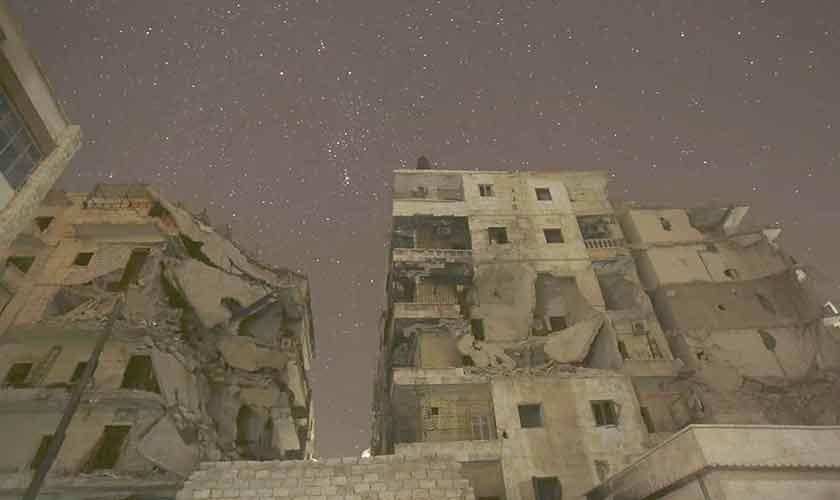
I returned to Syria in 2023. It was unrecognisable. Cities now greeted visitors with long stretches of battered buildings, scarred and hollowed out. After 13 years of civil war, the economy had collapsed. Millions have been displaced from their homes, inflation has spiralled, infrastructure lies in ruins and the social fabric has frayed. Sanctions imposed by Western powers have pushed an estimated 90 percent of Syrians into poverty.
Humanity, it is often said, is a luxury afforded by those with full stomachs. In Syria today, deprivation is visible in the faces, clothes and posture of ordinary people. Survival has replaced ideals. Many now eke out an existence stripped of meaning, clinging to whatever keeps body and life connected. In such conditions, abstractions like nation, identity, faith and humanity recede. What remains is bare endurance.
Desperation collapses moral distance. In extremis, people will seek help from anyone who holds power over their survival. History offers grim parallels. Prisoners in Nazi concentration camps, reduced beyond dignity, sometimes appealed to their guards. That is the point at which societies break.
It is precisely at this point of collapse that imperial power intervenes with further violence. Iraq offers a clear example. After its defeat in 1991, the country was subjected to prolonged sanctions and repeated bombing by a US-led coalition. This continued until the second invasion in 2003 completed its devastation. Syria has followed a similar trajectory. During the civil war, it endured regular Israeli airstrikes. Following the collapse of the Assad regime in December 2024, the scale intensified, with widespread bombing aimed at eliminating the remaining military capacity.
Sanctions are among the most inhumane measures enacted in the name of humanitarian concern. They dismantle everyday life while preserving a moral alibi for those who impose them. In effect, they strip people of agency and reduce existence to something perilously close to what survivors of Auschwitz described as Muselmann — a condition of life emptied of hope, dignity and will.
Yet much of the liberal intelligentsia remains defensive and reactive, unwilling to confront the rule of exception that expels entire societies from international law and from the category of the human. This silence helps normalise atrocities committed under the banner of the ‘war on terror.’
The writer is the author of Nomadic Meditations: Wandering in the History of Ideas. He may be reached at [email protected]