Print Story
X




Some traders allege that while their shops are being demolished several parking stands in the city are allowed to operate on encroached land

| A |
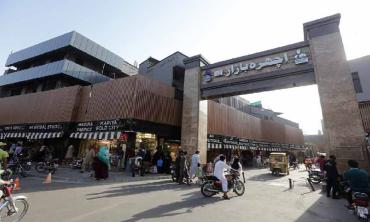
n operation to remove encroachments from the eight bazaars surrounding the historic Clock Tower of Faisalabad and establish a vehicle-free zone has been under way since the beginning of this year. However, as the year draws to a close, the authorities have yet to eliminate the encroachments and restore the cultural character of the area.
The half-hearted actions taken so far, along with barriers installed at the entry points of the bazaars, have resulted in persistent problems for local residents, traders and shoppers alike.
Recently, the Municipal Corporation declared several shops built along Circular Road from Gumti Chowk to Chiniot Bazaar illegal encroachments. A few of these shops have been demolished; the remaining shopkeepers have been directed to vacate the premises.
According to the deputy MC chief officer, Azmat Firdous, 14 shops were demolished after their owners failed to produce sale deeds or allotment documents.
She said that the verification of ownership documents submitted by other shopkeepers was under way. Further action would be taken after a decision by the competent authority.
Speaking to The News on Sunday, Muhammad Sajid, the owner of one of the shops declared illegal, said he had purchased the shop nearly 20 years ago. He said he had paid Rs 6 million for it.
“I have a registered sale deed. However, I am now being told that this land is part of municipal drain and that the khasra number mentioned in my documents is incorrect,” he said.
He said that while the administration wanted to demolish his shop, it had taken no action against illegal parking stands operating under the District Bar’s supervision on roads and footpaths around the district courts on the opposite side of Circular Road.
“Such if the law for the weak. For the powerful, it is something else. The double standards are causing resentment. If the government wants to enforce the law, it should apply uniformly,” he added.
Council of Pakistan Newspaper Editors deputy secretary general, Tanveer Shaukat, told TNS that, besides the shops on Circular Road and illegal parking stands run by the District Bar, places like Chenab Club and Minerva Club, patronised by the city elite including some senior government officers, have also encroached on state land worth billions of rupees.
“No one has dared look in their direction during the ongoing anti-encroachment drive,” he said.
He agreed that if the operation remained limited to demolishing some shops, it would reinforce the perception that there is one law for the elite and another for lesser citizens.
Referring to past operations, he recalled that when then-Commissioner Tasneem Noorani and Deputy Commissioner Naseem Sadiq carried out an anti-encroachment drive along the canal and under overhead bridges in the Abdullahpur area, some shopkeepers from Circular Road had approached the High Court. However, the court rejected their plea, ruling that ownership rights could not be established if sale deeds were issued illegally or in collusion with government officials.
He emphasised that, while action against illegal shops on Circular Road was necessary, it must be accompanied by similar action against encroachments and illegal occupations by powerful groups across the city.
Besides the shops on Circular Road and illegal parking stands run under the District Bar, social clubs such as Chenab Club and Minerva Club, patronised by the city elite class including some senior government officers, have also encroached on state land worth billions of rupees.
It is pertinent to note that, since 2019, parking stands operating under the control of the District Bar administration on public roads and footpaths surrounding the Faisalabad District Courts have been a major obstruction to traffic flow and pedestrian movement.
These parking stands are located around key government offices, including the offices of the deputy commissioner, assistant commissioner, chief traffic officer, the District Accounts Office, the District Health Authority and the District Council.
Citizens have repeatedly complained that parking fees at these stands are three to four times higher than those charged by the Faisalabad Parking Company. Despite these complaints and repeated public identification of the issue, no government department has ever taken action against these parking stands.
Deputy Chief Officer Azmat Firdous said that the MCF was leading an anti-encroachment drive across its jurisdiction, targeting both movable and immovable encroachments.
She said that the Circular Road matters related to Revenue Department. The MCF neither registers property nor allots land.
Regarding the DBA parking stands, she said that enforcement responsibility lies with relevant authorities: the AC City, Traffic Police and Faisalabad Parking Company. The MCF has a regulatory role.
She added that the corporation’s current priorities include removal of encroachments, establishing model handcart bazaars, relocating cattle, providing street lighting and implementing beautification projects around the Clock Tower.
In the context of recent anti-encroachment operations on Circular Road, TNS also sought Assistant Commissioner City Adil Umar’s comments but did not receive a response.
Former member of the Faisalabad Parking Company’s Board of Directors Rana Fiaz Ahmed stated that numerous public complaints were received regarding these illegal parking stands, but the administration has been reluctant to act due to fear of backlash from lawyers.
“I raised the issue multiple times during board meetings of the Faisalabad Parking Company and demanded that these parking stands be shut down. Neither the board members nor any government department had a satisfactory answer,” he said.
A senior lawyer speaking on condition of anonymity said that the operation of parking stands by the Bar not only violates municipal and traffic regulations but is also illegal under the Legal Practitioners and Bar Councils Act, 1973.
He said the law allows Bar Associations to collect only membership fees from their members and receive donations for lawyers’ welfare.
“The Act does not permit Bar associations to engage in commercial activity like awarding contracts for parking stands or managing them. Under the law, Bar associations are not even authorised to auction or manage their canteens,” he added.
Rai Saif-ur Rehman Bhatti Advocate, the District Bar Association president, said that the parking stands operated under the District Bar were auctioned this year for Rs 300 million.
“In March, the deputy commissioner informed us that an anti-encroachment drive was under way in the city and asked the District Bar to hand over the management of parking stands to the administration in order to improve the traffic flow,” he said.
Bhatti said, despite the closure of the District Bar-managed parking stands, there was no significant improvement in traffic conditions. “On our request, the deputy commissioner restored the DBA parking stands in September,” he added.
He acknowledged that the District Bar lacks legal authority to operate the parking stands. “The authority rests with the deputy commissioner. He may withdraw the permission any time,” he said.
Bhatti said that the income generated from the parking stands was used exclusively for lawyers’ welfare. “In case of a lawyer’s death, Rs 1 million is provided to the bereaved family. The fund is also used for the education and financial support of deceased lawyers’ children and to help lawyers facing financial hardship.”
Responding to allegations of overcharging at the parking stands, he said the DBA takes such complaints seriously. “Whenever we receive a complaint, we make every effort to address it. If somebody is collecting excessive fee in the name of the District Bar, citizens should report it to the DBA or the relevant authorities. I am completely against overcharging.”
He also said that he was opposed to encroachments and had offered to cooperate with the deputy commissioner. “If a lawyer is found involved, I am ready to stand by and ensure action against them,” he said.
In response to a question, Bhatti said that the parking stands should not be considered commercial activity. “All the revenue is spent solely on lawyers’ welfare. Normally, such activities are funded through government grants. Permission was granted to the District Bar to operate parking stands so that funds could be generated for lawyers’ welfare without burdening public resources.”
However, information obtained under the Punjab Transparency and Right to Information Act, 2013, shows that the parking stands operated under the District Bar are illegal.
Unless encroachments are removed across the board without fear or favour, the anti-encroachment drive risks becoming yet another case of selective justice.
The writer has been associated with journalism for the past decade. He tweets @naeemahmad876