Print Story
X




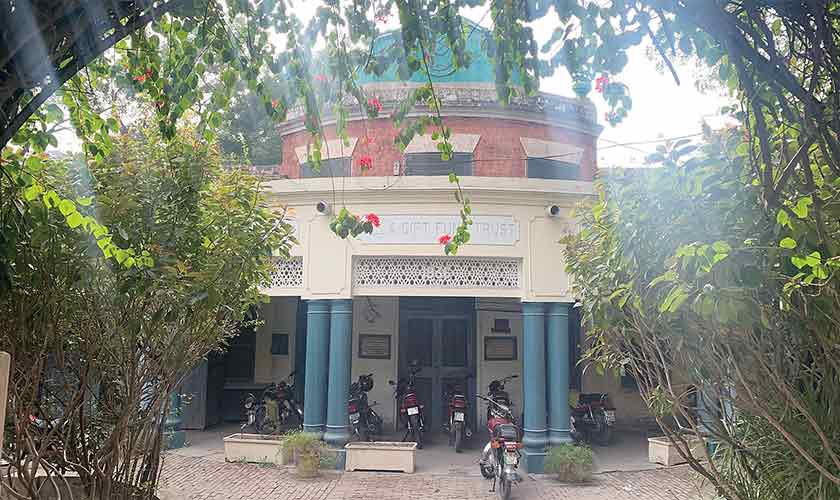
The Killa Trust Fund Building, a colonial-era heritage site, is in a state of disrepair
| T |
housands of people visit Faisalabad District Courts every day. Yet very few are aware that a century-old cultural heritage site on its premises is falling apart.
The Killa Gift Fund Trust Building was declared a protected cultural heritage site, a decade ago.
The building is crumbling due to years of neglect, lack of maintenance and administrative indifference. The educational scholarships, once awarded to local farmers’ children through this trust, have also been discontinued.
As the number of lawyers rises and new multi-storey chambers encroach upon the area, the deteriorating Killa Gift Fund Trust Building is a silent reminder of its fading legacy. It once towered over the city’s skyline in all its glory, drawing the attention of every passerby.
This trust was the only one of its kind in all of Pakistan and India. It was established with funds collected during World War I to support the British Army that were later redirected to promote education by awarding scholarships to the children of local farmers.
For nearly a century, thousands of students benefited from these scholarships. Many of them went on to hold senior positions and prominent roles in society.
Today, the Killa Gift Fund Trust Building stands abandoned and vulnerable — a heritage site waiting for someone to restore its dignity.
Saleem Jahangir Chattha, a former president of the District Bar Association who also served as a trustee of the Killa Gift Fund Trust in 1982, recalls that his late father, Chaudhry Sharif Ali Chattha, also a former president of the District Bar Association, too, had served as a trustee.
Speaking to The News on Sunday, Saleem Chattha says that in 1914 the British government had imposed a war tax on farmers, calculated per “killa” (roughly an acre) of land.
“In the then Lyallpur district more than 1.6 million rupees was collected. After the war ended, the British government ordered that this amount be returned to the farmers,” he said.
He added that Deputy Commissioner AA MacDonald wrote to the then-governor of the Punjab, Sir Michael Francis O’Dwyer, suggesting that, instead of returning the money, the amount be placed in a fixed bank deposit and a trust be established to provide educational scholarships to the children of local farmers.
“The government approved the proposal, issued a notification and deposited the entire amount into the bank account of the newly-created Killa Gift Fund Trust.”
According to Chattha, the fund grew steadily over the decades as beneficiaries who secured employment would often return the full scholarship amount, allowing it to be reinvested into the trust’s capital.
MacDonald personally oversaw the construction of the Killa Gift Fund Trust Building on more than two kanals of land. The building was inaugurated on July 19, 1936 by the Multan Division commissioner, CV Salisbury.
“The historic structure has survived but it is now in a state of decay, due to neglect and lack of maintenance,” Chattha said.
He noted that, for many decades, the trust had received hundreds of scholarship applications annually and awarded stipends to 500-600 students, every year.
“Girls received scholarships from Class six onwards with hostel expense, while boys became eligible from Class 11. Students pursuing higher education— in engineering, medical, or other disciplines—were given larger stipends, including hostel allowances.”
Chattha said over a century, hundreds of thousands of students had benefited from scholarships worth billions of rupees through this trust.
“The principal amount remained intact and continued to earn interest. The trust never incurred administrative expenses, as trustees managed all operational matters voluntarily - even the tea they took was paid for by the trustees themselves,” he remarked.
He revealed that scholarship payments had been suspended since 2019 and that various groups were trying to illegally occupy the trust’s building. This had placed both the trust and its historic premises in serious jeopardy.
As the number of lawyers rises and new multi-storey chambers encroach upon the area, the deteriorating Killa Gift Fund Trust Building is a silent reminder of its fading legacy. The ancient trees surrounding it seem to mourn an era when this building towered over the city’s skyline in all its glory, drawing the attention of every passer-by.
“When I learnt that some groups had set their sights on the property and wanted it allotted, I wrote to the governor of the Punjab and the deputy commissioner of Faisalabad.”
He said he had now appealed to Chief Minister Maryam Nawaz Sharif and Governor Sardar Saleem Haider Khan to intervene to revive the scholarship programme and preserve the historic building as cultural heritage.
“The governor is the patron-in-chief of the trust. He must take personal interest in restoring this institution for public good - for the welfare of farmers and for improving educational opportunities for children. Many children of farmers, today, struggle to continue their education beyond matriculation. If this trust becomes active again, deserving children could secure admissions in better institutions and build brighter futures.”
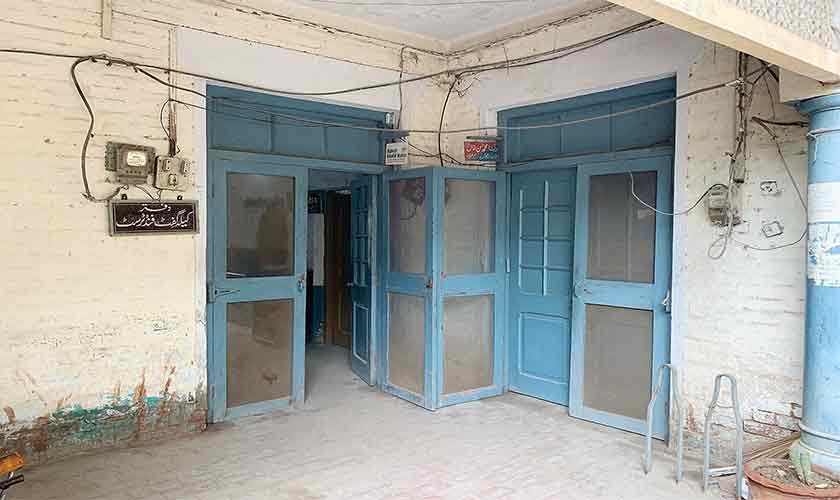
The office of Lyallpur Akhbar, Faisalabad’s oldest weekly, has also been located in the Killa Gift Fund Trust Building for nearly a century.
The newspaper’s current chief editor, Zahoor Ahmad Dar, too, is worried that the building is in a state of severe disrepair. “The roof leaks every time it rains,” he said.
“The roof has accumulated three-to-four-foot mud over decades. There are fallen leaves, debris and waste. Behind our office, a large tree has grown into the wall, further weakening the roof,” he said.
Dar said that he, the Trust’s only employee, Sagheer Ahmad, and the additional deputy commissioner (Revenue) had repeatedly requested repair and maintenance, but there had been no progress so far.
“The Trust’s sole employee, too, is working illegally. He is aligned with some group trying to occupy the building. He has approached me several times asking me to hand over our office to him on rent,” he claimed.
Most of the rooms in the building, he said, had been taken over by influential individuals for nominal rents. He said they were trying to evict Lyallpur Akhbar from the two rooms it occupies.
“The canteen attached to the building and the shops along Circular Road are worth millions of rupees. These have been rented out at throwaway prices with the connivance of the administration. Those running these businesses are now trying to build more structures. They want permanent possession instead of paying market-rate rent.”
Chattha added that no one was willing to disclose where the Trust’s substantial income was going, raising serious concerns about mismanagement.
To seek clarity, TNS contacted Sagheer Ahmad, the only clerk present in the Killa Gift Fund Trust office. However, he refused to provide the names or contact details of the current trustees or any information regarding the Trust’s financial and administrative affairs.
A Right to Information request under the Punjab Transparency and Right to Information Act 2013 was also submitted to the chairman of the Trust—the deputy commissioner—but despite the lapse of the stipulated period, no information was provided. The matter is now pending before the Punjab Information Commission.
The deteriorating condition of the Killa Gift Fund Trust Building and the suspension of its century-old scholarship programme represent more than administrative negligence—they reflect the loss of an invaluable cultural and educational legacy.
With millions of rupees unaccounted for and influential groups attempting to occupy its premises, the Trust faces a crisis that threatens both its heritage and its purpose. Unless the Punjab government, district administration and concerned authorities intervene with urgency, Faisalabad risks losing not only a historic landmark but also a fund that once empowered deserving students.
The revival of this Trust is not just a matter of preservation; it is a responsibility owed to the past and a promise that must be upheld for future generations.
The writer has been associated with journalism for the past decade. He tweets @naeemahmad876