Print Story
X

| A |
curly haired philistine found herself parked in my driveway for reasons only known to her. I went outside to walk my dog and she sped off. Turning back to glance over her shoulder. A tacit admission: I see you see me see you.
“Haye bechari,” she said to her accomplice, the man who was driving the retreating reconnaissance vehicle, it’s probably very uncomfortable to feel watched. Two weeks before that, one of the ladies who lives in my building threw a Sunday brunch, ostensibly to get to know the neighbours, when normally no one who lives in the building ever sees each other. Sometimes I feel like no one lives here.
The usual lady-party Lahori chitchat was afoot; do you know her, do you know them. The hostess interjected, “Everybody knows everybody in this city. It’s really just 5-6 families pretending to be 30 or 40 families.” She laughed. “In the end you find out they’re all cousins.”
The population of Lahore is around 14.8 million. There is no realistic way for any human to be able to visually recognise even 0.01 percent of that population, let alone know them. But the “everyone knows everyone” motif is a common one. The institutions of this city are controlled and run by a handful of families, and as any newcomer to the city quickly learns, extend favours to the right people.
Don’t fraternise with the milling crowd (those who refer to themselves as the “intelligentsia,” rather than as elites of not very high intelligence) and become a pariah. And so it is, that at every festival event, business, media or academic institution (even hospitals and medical labs), you have to know the right people and be in with the IN crowd. If not, who will hire you? How will you rent a house? Or make a career or a name for yourself? How will you eat? Live? What will you do in case of emergency, medical or otherwise?
The control of all platforms and institutions by a handful of people creates a self-containing bubble, impervious to outsiders and any external perspectives. This creates an elite that not only fully dismantles any chinks of meritocracy but also evades contagion from the reality of the city outside the Italian stained glass windows.
You have to know the right people and be in with the IN crowd. If not, who will hire you? How will you rent a house? Or make a career or a name for yourself?
“I used to go to London in the summer; now I leave to escape the smog,” says the hostess of the Sunday brunch, whose own luxury SUV pumps the air with 4 or 5 families’ worth of diesel.
Of course, I in my solitary apartment, shielded by the hypocrisy of my own privilege, can afford to contemplate the streets of Lahore, longing perhaps for a more pastoral setting as literary types often do. As I venture out onto the balcony to water my dragon-fruit plant, I notice another literary type, one of those that you’d see regularly at the LLF or Faiz Mela or what have you, looking up at me. The nod of her head a tacit admission: I see you see me see you.
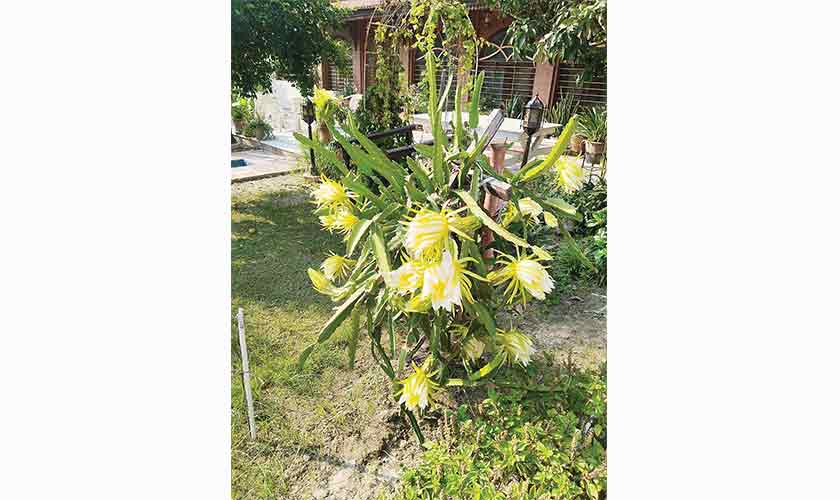
There are two dragon-fruit growing, they are ripe enough to be plucked. From the apex of each of them, a wilted dragon-flower dangles listlessly. I think about how I had to pollinate each flower by hand, as my mother (the owner of the mother-plant) told me to do. The dragon flowers are large and menacing, the male part of the flower (containing the pollen) sticks out of the centre like a smaller flower. The dragon flower only blooms at midnight, and there is a very short window for pollination. The flower dies if the fruit grows. And so it is. As above, so below.
I pluck both dragon-fruit and go and put them in the fridge. I scribble a small wish for the plant’s health and longevity and bury it in the soil with a little water. It is a cactus and does not need much water.
The curly haired spy tells her accomplice to drive away; that they have been spotted. My mother tells me I’m paranoid. I think about how the spy and I probably have much more in common than most of the people who live in this sprawling, overpopulated city; and how, in another life, and with different allegiances, we could even have been friends.
Amar Alam is a writer and sitarist based in Lahore. She can be found on Instagram @amar.alam_literally