Print Story
X




An NCA Triennale collateral exhibition gathers more than 40 artists to celebrate the craft of printmaking
| A |
s a publisher, prints and printmaking have always held a special place in my heart. This laborious technique was the gateway to the dissemination of knowledge across the world. Manuscripts no longer needed to be copied out by hand; illustrations depicting strange, exotic creatures could travel far and wide, allowing the world to become smaller and more connected, making art and literature (and thereby thought) more accessible for the everyman. Printmaking also aligns with my other fascination: primal mark-making. Impressions: Traces. Touch. Revival an art exhibition focused entirely on the medium of printmaking, thus became an unmissable event.
Curated by Saad Ahmad and held at Kaleido Kontemporary as a collateral to the NCA Triennale, the show is a celebration of printmaking in Pakistan. It brings together a group of early-career artists who are shaping contemporary printmaking in the country, connecting them, through the work and the show, with those who have established practices. Moreover, Impressions is a conduit to properly introduce (rather, reintroduce) printmaking to the public at large, as misconceptions about the form abound.
Printmaking – with its various techniques – essentially allows the artist to create multiples of their artwork. The practice can be traced back to Han Dynasty China, when wooden blocks were used to create prints on silk and other cloths; drawing out prints on paper came later. Our contemporary understanding of printmaking can arguably be traced back to 15th-century Europe, particularly Germany, where intaglio and woodcut techniques took hold. The invention of the Gutenberg press furthered the spread of this form, allowing ideas to be disseminated widely, at a previously unprecedented scale. By the 16th Century, Albrecht Dürer’s woodcuts, etchings, dry-point and metal engravings were influencing and shaping the world of printmaking. Over the last couple of centuries, new techniques have been developed across the world. Lithography and digital printmaking continue to keep the medium alive.
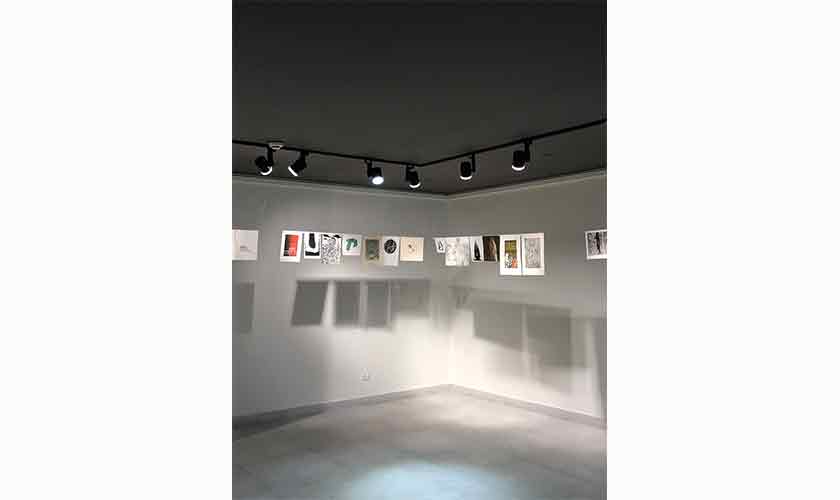
At Impressions, we see how printmaking remains a favoured medium for a wide array of artists in Pakistan. Entering the show, the first thing you notice is the staggering breadth of work on display. With over 40 artists participating, the curation is truly a celebration of the medium as a range of techniques is presented: etching, linocut, lithography, intaglio, collagraphy, woodcuts, dry-point, photo transfer and mono-prints.
The second thing is the size; most of the works are small, which not only allows more work and more techniques to be shown together, but is also an appreciation of the precision required to produce a print. From individual prints to those produced as part of collaborative projects at Inkster Print Studio (a printmaking studio run by Saad Ahmad that furthers the practice and invites artists to work in community), as well as works from the studio’s own collection, ensure the central conceit of the show, to revel in the diversity of this art form.
Unlike most art exhibitions, Impressions is not concerned with thematic considerations. Here, print is front and centre; the imagery is secondary. Naturally, though, themes emerge. Interior lives, architectural elements, esoterica, warped natural and creatural elements are some of the preoccupations of the contemporary printmaking community.
Works that have stayed with me include depictions of the natural and animal world: Musawir Shabbir’s delicate etching of a dog (Godsent); Amna Suheyl’s Poe-like linocut, complete with ravens (Chaubara); Yashfa Raza’s eerie, gnarled and contorted trees (Elsewhere). Others spoke to me of loneliness and solitude included Nisha Ghani’s Muntazir and Saad Ahmad’s Untitled etching, both portrayals of a lone female figure. Fatima Sughra’s collagraph Loose evoked a sense of loss and erasure. Manoj Kumar’s Biophilic, etchings on paper of primitive cell-like forms, moved me with their raw, scientific abstraction.
It was also a delight to see work by more established artists such as Laila Rahman, Afshar Malik, Hasnain Awais and Farazeh Syed. Many of the artworks were executed as projects with the curator Saad Ahmad’s Inkster Print Studio. While the curation of the show is commendable, at once showing the breadth and depth of printmaking in Pakistan, I do wish there were more wall text to better identify the work and understand each artist’s individual approach to the medium.
Saad Ahmad, whose own practice is centred on observation and memory, says that this show is just the beginning. He says that in the process of putting together this show, he was amazed by the diversity of themes and approaches to printmaking currently being practiced in Pakistan. He hopes to make this the first impression for an ongoing series of collaborations and projects that emphasise the medium, as well as the community of printmakers that has organically formed around the Inkster Print Studio (and without).
Lahore’s art world is currently abuzz with frenetic energy to commemorate the NCA Triennale and 150 years of the institution (since its inception as the Mayo School of Arts). Numerous collateral events are taking place at galleries across the city that show the entrenchment of the NCA community in the Pakistani art sphere. While most such exhibitions are focused on theme-based work or simply the work of various artists, Impressions stands out for its focus on one discipline. The thought and care behind the show is apparent and is an insight into the deep respect and admiration that not only the curator, but the participating artists have for printmaking.
The show is on till 23rd November at Kaleido Kontemporary.
The writer is a literary editor, publisher and photographer from Lahore. He is the co-founder of The Peepul Press and managing editor at The Aleph Review.