Print Story
X




About prominent artists and intellectuals who operated from within state institutions to shape Pakistan’s aesthetic and literary landscape
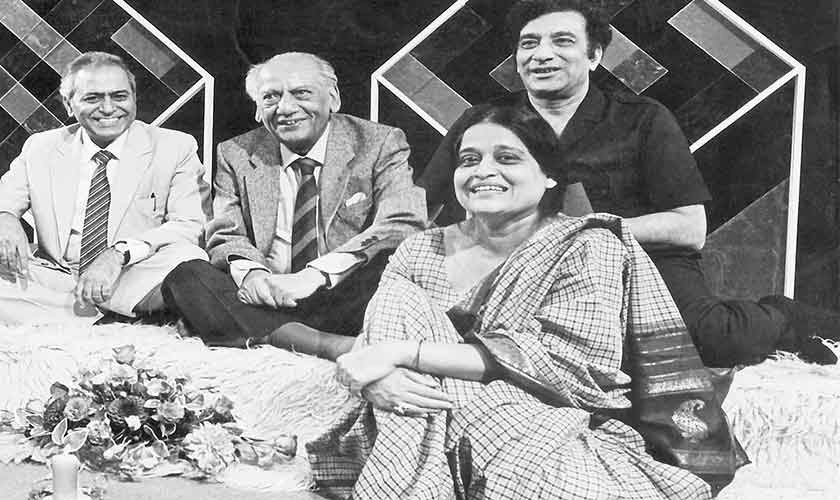
In the two decades following independence, Pakistan witnessed a state-sponsored effort to construct a national cultural identity amid geopolitical turbulence and internal ideological contestations. Central to this process were a group of prominent artists and intellectuals who, their reputations as radicals notwithstanding, operated from within state institutions to shape Pakistan’s aesthetic and literary landscape. Among the most consequential of these people were Faiz Ahmed Faiz, Shakir Ali and Zubeida Agha. Each of them played a significant role in institutionalising modern art, literature and cultural policy. Each of them had a radical public image — Faiz as a revolutionary poet, Shakir as a modernist educator and Zubeida as a prominent artist in the vanguard of abstraction. Simultaneously, they occupied key roles in state institutions. This paradox—of radicals embedded within a bureaucracy—speaks to the contradictions of cultural policy in Pakistan, where the state sought legitimacy through cultural production, even as it often distrusted the intellectuals producing it.
Faiz’s transformation from a Marxist poet and trade unionist to a key figure in the state’s cultural machinery embodies the paradoxes of post-colonial cultural policy. As secretary and later vice president of the Pakistan Arts Council (1959-62), Faiz positioned the institution as a hub for progressive writers, musicians and visual artists. Under his leadership, the council became a meeting ground for critical voices. Many of them challenged the orthodoxies but also found patronage under a state institution.
Faiz’s subsequent appointment under Zulfikar Ali Bhutto as adviser on culture to both the Ministry of Culture and the Ministry of Education (1972-74) further blurred the line between dissidence and bureaucracy. These roles enabled him to embed a progressive aesthetics into national policy—an alignment made possible by Bhutto’s populist socialist rhetoric. Even during earlier stints—such as his honorary role in the Ministry of Information during the 1965 war—Faiz had used poetry and the media to nudge national sentiment, crafting a literary nationalism that could simultaneously oppose imperialism and reinforce state authority.
Despite his occasional alignment with state agenda, Faiz’s international engagements (ILO, WPC, and later, as editor of Lotus) confirm his enduring trans-nationalist and anti-authoritarian commitment. His relationship with the Pakistani state was thus never fully reconciled. It was marked instead by mutual utility and periodic estrangement.
Shakir Ali’s appointment as principal of the National College of Arts in 1958 marked a decisive turn in the history of art education in Pakistan. With European academic training and a grounding in modernist theory, he was the natural choice to helm a reformist agenda in Pakistan’s leading art school. Under his leadership, the college’s curriculum was restructured to incorporate international modernism, indigenous crafts and architectural studies—laying the groundwork for an institutional culture that viewed art not as a decorative pursuit, but as a vehicle for intellectual inquiry and national progress.
Shakir’s role extended beyond pedagogy. He became a key interlocutor between artists, the bureaucracy and the emerging cultural public sphere. His interactions with the Pakistan Art Council, various ministries and curators such as Zubeida Agha often involved negotiating institutional representation for Pakistani artists at home and abroad. A number of his students—artists trained under his tenure—would go on to define the Pakistani art scene for decades.
As secretary and later vice president of the Pakistan Arts Council (1959-62), Faiz positioned the institution as a hub for progressive writers, musicians and visual artists. Under his leadership, the council became a meeting ground for critical voices.
What differentiates Shakir from Faiz and Agha is the degree to which he enacted institutional change from within a singular educational framework. If Faiz shaped policy and Agha curated national aesthetics, Shakir trained the very hands and minds that would produce Pakistan’s modern visual identity.
Zubeida Agha occupies a unique position in this trio—not only as one of Pakistan’s first modernist painters, but also as an early female cultural bureaucrat. Appointed executive director of the Contemporary Art Gallery in Rawalpindi in 1961, she became responsible for curating state-sanctioned exhibitions and advising the Ministry of Education on acquisitions for national and diplomatic collections. Correspondences from the early 1960s reveal her role in selecting works—including those by Shakir Ali—for loan to the Commonwealth Relations Office in London, reflecting the strategic deployment of art as cultural diplomacy.
Her bureaucratic authority was further legitimised by the President’s Pride of Performance award in 1965, and her eventual presence in the permanent collections of the Pakistan National Council of the Arts. Unlike Faiz—whose cultural work often oscillated between confrontation and collaboration—Agha’s career trajectory demonstrates a steady co-option into the state’s cultural apparatus. However, her early modernist innovations—initially met with scepticism—suggest a quiet radicalism that predated the state’s aesthetic embrace.
What makes Agha’s bureaucratic legacy notable is how it institutionalised a female presence in Pakistan’s patriarchal state structure. Her curatorial decisions not only shaped the canon of Pakistani art, but also set precedents for how women could hold cultural authority in national institutions.
Despite their differences in medium, personality and public reception, Faiz, Shakir, and Agha were united by a shared commitment to art as a force for nation-building. They each navigated the uneasy space between radicalism and bureaucracy, helping to shape a cultural policy that was at once state-sponsored and ideologically contested.
Their differences remain instructive. Faiz retained the strongest oppositional stance—his exile under Zia testifying to the limits of the state’s tolerance for radical cultural figures. Shakir embodied institutional compromise—reforming the art school system from within, even as his aesthetic modernism remained politically muted. Agha’s trajectory lay somewhere in between: a pioneering modernist who became a gatekeeper of the state’s cultural diplomacy, without Faiz’s ideological volatility or Shakir’s pedagogical reach.
The careers of Faiz Ahmed Faiz, Shakir Ali and Zubeida Agha underscore the entangled relationship between art, politics and bureaucracy in post-colonial Pakistan. Each used their position in state institutions to advocate for a vision of culture that was progressive, modernist, and nationalist—yet each negotiated this role in markedly different ways. Their legacies invite us to rethink the binary between radicalism and complicity, and to recognise how cultural bureaucrats played a central role in shaping not only artistic production but also the moral and political imagination of the post-colonial state.
The writer is a visiting senior research fellow at the Department of Anthropology, University of Texas