PESHAWAR: Speakers paid rich tribute to late Prof Syed Ghayyur Hussain for working tirelessly throughout his life for the promotion of Persian language and literature in Khyber Pakhtunkhwa.
The stalwart Pakhtun advocate of Persian language and literature passed away last month after a protracted illness. He was laid to rest in his native town of Astarzai in Kohat.
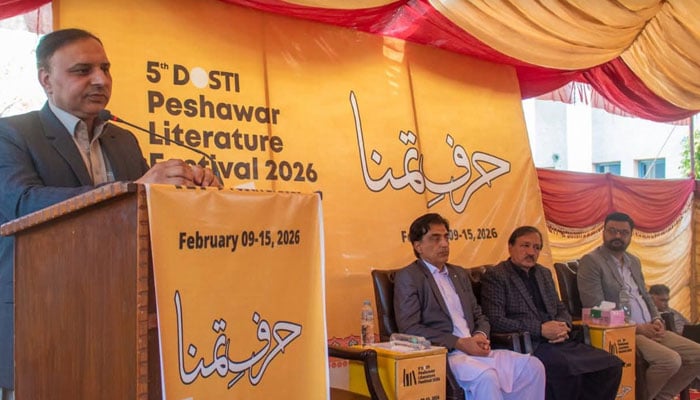
The ongoing 5th Dosti Peshawar Literature Festival 2026 dedicated a special session to the late Persian scholar in recognition of his lifelong services to the promotion of Persian in KP.
Academicians and literati, including Dr Aslam Meer, Prof Dr Shaheen Umar, Dr Salman Bangash, Dr Minhajul Hassan, Dr Said Haneef Rasool, Dr Antal Zia, Assistant Professor Sikandar Tangi and Raja Kashif were on the panel.
They paid glowing tribute to Prof Ghayyur for his devoted services to Persian language and literature.
Other academicians and research scholars shared as well their impressions to remember the scholar who supported all those who wished to learn and serve the Persian language.
Among them were Prof Dr Fakhrul Islam, former head of the Pakistan Study Centre, University of Peshawar; Dr Muhammad Adil, Director of the privately-run Gandhara Hindko Academy, Peshawar; Muhammad Ziauddin, a noted research scholar of Hindko and General Secretary of the Gandhara Hindko Board; and Dr Shaukat Mehmood, Associate Professor of Urdu at Government Superior Science College, Peshawar.
Dr Aslam Meer said Prof Ghayyur would always be remembered for his invaluable services to the promotion of Persian in KP.
"After moving from Lakki Marwat to Peshawar for service, I developed a passion for literary Persian. This quest led me to Sir Ghayyur," recalled the scholar, who has dedicated his doctoral thesis to Prof Ghayyur.
"Sir Ghayyur would select verses from classical Persian poetry and explain them in detail, which greatly benefited the small class of five students of which I was a part," he recollected.
Remembering his late teacher, he said: "Sir Ghayyur did not merely teach Persian; he inspired his students. Rather than delivering conventional lectures, he made his classes engaging by narrating anecdotes. His teaching style was largely anecdotal yet deeply enriching. He helped scores of students in their MPhil and PhD studies and was, in many ways, an institution in himself."
According to Dr Aslam Meer, the number of Prof Ghayyur s students ran into the thousands across KP, creating a strong desire among them to explore Persian literature.
He termed his passing a grave loss to the literary circles of Peshawar and KP as a whole and resolved, along with his colleagues, to carry forward the legacy of Prof Ghayyur.
Prof Dr Fakhrul Islam said, "Prof Ghayyur was a great promoter of the Persian language, and it would be hard to find anyone who could truly replace him."
"Persian served as the court language in the subcontinent for a long time and has left a deep impact on our religious literature. There was a time when people would quote Persian words and poetry to demonstrate excellence, much like English is used today.
Almost 60% of Allama Iqbal’s poetry is in Persian. Several important books, including those by Saadi and Hafez Shirazi, are also in Persian," the academician pointed out.
Dr Fakhrul Islam said there once was a Department of Persian Studies at the University of Peshawar, but it no longer exists.
"It was the late Ghayyur Sahib who stepped forward on his own to promote Persian after the closure of this department. He was associated with the Cultural Centre of the Islamic Republic of Iran in Peshawar, where he taught Persian and also served as a liaison officer. After leaving the centre, he continued his efforts to promote the language on a self-help basis," he added.
"If today we have people who possess knowledge of Persian, much of the credit goes to Prof Ghayyur Sahib. I suggest that his students should join hands and prepare a comprehensive plan of action to further promote Persian," he said.
Prof Dr Shaheen Umar, Principal of Government Frontier College for Women, Peshawar, said: "It is tragic that someone with such deep passion for Persian and Iqbaliyat is no longer with us."
"Sir Ghayyur was my teacher in 2004, when I studied Persian under his guidance. He was devoted to the Persian language and to the thought and poetry of Allama Iqbal," she said.
Dr Shaheen Umar described late Prof Ghayyur as a gentle and gracious personality. "After retiring from the Iranian Cultural Centre, he taught Persian at Shaheed Benazir Bhutto Women University, where he continued to inspire students with his knowledge and dedication. He treated his elders, students and everyone around him with great respect, kindness and affection. His passing is an irreparable loss for his students and for all those who value Persian language and Iqbaliyat," she added.
Dr Shaukat Mehmood, Associate Professor of Urdu from Bannu and a teacher at Government Superior Science College, said late Prof Ghayyur had the rare ability to befriend people at the very first meeting.
"Anyone with an interest in Urdu naturally seeks some knowledge of Persian. Sir Ghayyur was always eager to assist researchers and students of Persian. His speech and diction were unique and captivating. His absence will be deeply felt, and no one will truly be able to fill the void left by him," he said.
Dr Muhammad Adil, Director of the Gandhara Hindko Academy, Peshawar, said: "Sir Ghayyur fostered bonds among people from different cultures and languages. He connected people from diverse schools of thought at functions arranged at the Khana-e-Farhang."
"He provided the platform of the Khana-e-Farhang for the promotion not only of Persian, but also of Urdu and other Pakistani languages such as Pashto and Hindko," he added.
Muhammad Ziauddin, a research scholar of Hindko, said the Prof Ghayyur was a great proponent of Persian language and literature.
"Anyone seeking help with research on classical Persian poets and other classical works would never be disappointed after consulting Ghayyur Sahib," he said.
"He would arrange the required material by consulting the Adeeb Peshawari Library and even contacting literary figures to ensure that everyone interested in any aspect of the Persian language was properly facilitated," said the scholar, who specialises in documentation, has authored several Hindko books, and also oversees the affairs of the Gandhara Hindko Academy.