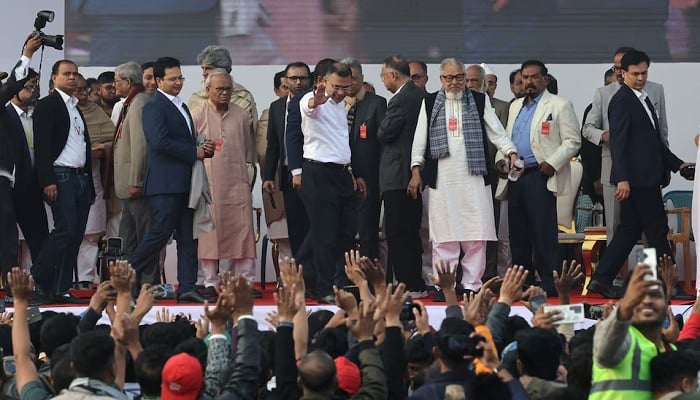
DHAKA: A student-driven political party that emerged from the protests leading to the fall of former prime minister Sheikh Hasina has entered into an electoral alliance with Jamaat-e-Islami ahead of February’s parliamentary polls, triggering divisions within its own ranks.
Since last year's uprising, the National Citizen Party (NCP) has cast itself as a centrist, reformist alternative to nepotism and two-party dominance, but as the election nears, it is struggling to turn street power into voter support.
NCP chief Nahid Islam said on Sunday the party had decided to achieve greater unity, adding that the final list of candidates would be announced today (Monday). Other NCP figures have described the alliance as a pragmatic step in a fragmented political landscape.
But the decision to join forces with JI has already prompted internal ructions.
Tasnim Jara, a doctor who left a career in Britain to join the NCP, becoming a leader in the party, resigned on Saturday and said she would contest the election as an independent candidate. Several other members have also quit.
Critics of the NCP's move said it undermined the party's founding ideals.
"The moral support I had for the NCP will no longer exist due to this ideological mismatch," said one university student, asking not to be named.
The partnership comes amid broader political realignments, with the Bangladesh Nationalist Party (BNP) — aligned with ailing former Prime Minister Khaleda Zia and effectively led by her son, acting chair Tarique Rahman — regaining momentum following Rahman's return after nearly 17 years in exile.
The February 12 election will be held under an interim administration headed by Nobel laureate Muhammad Yunus, who took charge after Hasina's ouster and is seen as crucial to restoring political stability after nearly two years of turmoil.