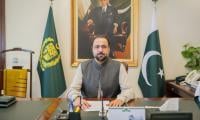
ISLAMABAD: After the US decline to entertain Pakistan’s request for a $10 billion Liquidity Support Program, Minister for Finance Muhammad Aurangzeb said that Pakistan had secured $3 billion through the launch of a Eurobond and was in a “comfortable position” on its external accounts. He also confirmed that Islamabad got a $3 billion rollover from the Kingdom of Saudi Arabia (KSA) but did not share its exact timeframe.
“With or without $10 billion from USA, we are in a comfortable position with regard to our external accounts,” Minister for Finance Muhammad Aurangzeb stated while replying to a question about the refusal of Washington for entertaining Pakistan’s request for $10 billion support after attending the Senate Standing Committee on Finance meeting here at the Parliament House on Wednesday.
Earlier, the USA had ruled out the possibility of $10 billion support to Pakistan. Aurangzeb said it was neither a credit line nor guaranteed but it was a request made for the Liquidity Support Program. “If this support is provided, it will be fantastic, but if it does not come through, we can comfortably manage our external account” he added.
To another question regarding the rollover of $3 billion, which was granted by the KSA for a few months, the minister replied that it was done by the KSA but refused to share its duration.
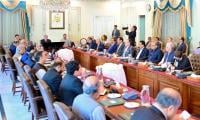
Earlier, the Senate Standing Committee on Finance and Revenues held its meeting under the chairmanship of Senator Saleem Mandviwalla here at the Parliament House on Wednesday. Federal Secretary Finance Imdad Ullah Bosal briefed the Senate panel and stated that Pakistan’s gross external financing repayments stood at $21.5 billion, including $17 billion as principal and $4 billion as interest payment. There is an amount of $7.3 billion in the shape of bilateral rollover, said secretary of finance, but he did not share its details.
The sources said that there is $4 billion in SAFE deposits from China, $3 billion from KSA and the remaining $300 million from Kuwait. The KSA has given deposits of $8 billion, out of which they had granted a $5 billion rollover for a medium-term period till 2028. On the remaining $3 billion, KSA has possibly granted a one-year rollover for FY27.
Imdad Ullah Bosal said that excluding the rollover of $7.3 billion, the remaining external debt repayment stood at $14 billion out of which commercial refinancing was standing at $3.2 billion. Pakistan may not opt for securing this commercial refinancing because of its cost. The Finance Ministry says that the government had repaid $5 billion so far in five months and only $6 billion will be repaid in the remaining seven months of the current fiscal year. The secretary finance also apprised the committee that the debt servicing cost had ballooned by 28 percent in FY23 mainly because of devaluation of the rupee against the dollar.
The Minister for Finance and Revenue, Muhammad Aurangzeb, briefed the committee on the Annual Borrowing Plan, highlighting the projected public debt of Rs86.7 trillion, additional borrowing of Rs6.86 trillion and gross financing requirements of Rs28.65 trillion.
The committee was informed that public debt had declined from 75.1 percent of GDP in FY2023 to 68.6 percent in FY2026. The government also apprised the committee of its efforts to maintain macroeconomic stability, retire short-term debt, improve the debt profile and enhance Pakistan’s credit ratings to secure financing at lower costs. It was further informed that the country would comfortably meet approximately USD 5 billion in debt-servicing obligations over the next six months while maintaining foreign exchange reserves of USD 21.5 billion.
Taking up the difficulties faced by parliamentarians in obtaining foreign exchange for personal travel, the Chairman of Senate Panel, Saleem Mandviwalla, asked the SBP representative to convey the message to the governor of SBP to stop this “nonsense”. He directed the State Bank of Pakistan to review the existing procedures, including Politically Exposed Persons (PEPs)-related clearance requirements and the mandatory personal appearance of parliamentarians before exchange companies despite submission of valid passports, tickets and visas.