TEL AVIV/TEHRAN: The US and Israel are preparing plans for a possible attack on Iran in early November, after the US midterm elections, a person briefed on the US and Israel’s war planning told NPR on Thursday. Iran said it is prepared. The person, who spoke to NPR on condition of anonymity to discuss the preparations, said Israel had initially planned to strike Iran in mid-October, about two weeks before Israeli elections on Oct. 27, but President Trump objected.
According to the person briefed, the US is now amassing forces in the region to be ready to attack by early November, after the US midterm elections, but that these preparations could also be part of a campaign to pressure Iran to reach a diplomatic deal. US midterm elections take place on Nov 3.
Separately, citing senior US officials, the ‘New York Times’ reported that the US and Israel have “developed specific plans” for a “short but intensive operation” in Iran that would include targets such as nuclear facilities, energy infrastructure and the country’s arsenal of missiles and drones.
One official told the newspaper that the goal would be to force Iran into making “diplomatic concessions” by further weakening its economy, as negotiations to end the conflict have gone nowhere. The US has also maintained a blockade of Iranian oil exports in the Strait of Hormuz that has sapped Tehran’s oil revenues.
Other outlets have reported similar plans in recent weeks. In early October, Axios reported that the Pentagon has instructed US Central Command “to conclude preparations for resuming major combat operations in Iran.” There are currently two US aircraft carrier strike groups in the Arabian Sea, with a third expected to arrive by late November. On October 15, Trump told the right-wing broadcaster Newsmax that he was considering a strike on Pickaxe Mountain, near the Natanz. Israeli Prime Minister Benjamin Netanyahu, who is seeking reelection, is campaigning on a threat to topple Iran’s regime.
The outlet also reported dozens of Israeli Air Force fighter jets conducted a sortie on Monday, flying as far as the Iranian border, according to Israeli and U.S. officials. The exercise involved dozens of fighter jets and refueling aircraft, the sources said. It followed a flight path consistent with a potential strike against Iran, passing through Syrian and Iraqi airspace. As the aircraft approached the Iranian border, they turned around and returned to Israel, the sources said.
Some U.S. sources said they had the impression that Israel was hoping the Iranians would fire at the aircraft, providing a justification for launching strikes against Iran.
As oil prices crept up to their highest levels since May, US President Trump accused Iran of lying about the situation in the Strait of Hormuz in order to drive up costs. “Iran is doing everything they can to drive up the price of oil prior to the US Midterm Election,” Trump wrote on Truth Social. “They are even making up fake hits, mines, and everything else, because more Oil is coming through the Hormuz Strait now than it did even prior to the beginning of the Conflict.”
Separately, Trump said Washington is doing “very well militarily and financially” against Tehran, describing the war as “a little conflict against Iran”, Al Jazeera reported. Speaking to reporters at Joint Base Andrews, Trump was asked whether he had given up on negotiating with the Iranians. “No, I think we’re not negotiating with — we are going to have something one way or the other. It’ll happen fairly soon,” he said. “Most people seem to think it’s after the election, and we’re going to see what happens,” he added. “But I will say this: what we’ve done with Iran is amazing.”
Meanwhile, Iran’s Foreign Minister Abbas Araghchi told Iranian state media. “We are just as prepared for diplomacy as we are for war. Any scenario is conceivable, including the possibility of an attack by the US and Israel.”
Iranian state media also quoted a security source saying that if Iranian officials or civilian infrastructure were attacked, Iran would retaliate by targeting US interests in the region, as well as the infrastructure and assets of countries participating in the war. Iran’s Revolutionary Guard Corps (IRGC) has threatened that if the US and Israel resume attacks, data centres and underwater internet cables in the Gulf could be targeted. Deputy for Political Affairs of the IRGC Yadollah Javani said that Iran was prepared to destroy internet cables running under the Strait of Hormuz.
Ali Asghar Shafieian, a media adviser to Iranian President Masoud Pezeshkian, told DW that although the US retains a significant technological and military advantage, Tehran’s strategy is based on preserving the regime’s hold on the country rather than matching US strength.
The IRGC Navy said four vessels were hit and caught fire in the Persian Gulf after being detected transferring oil cargo between ships, while three other vessels suffered incidents and fires after striking mines west of the Strait of Hormuz. The statement said IRGC Navy monitored and pursued the four violating vessels before discovering them engaged in ship-to-ship oil transfers in the northern part of the Persian Gulf. It added that all four vessels were hit simultaneously and were burning.
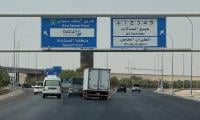
Meanwhile, Saudi state oil company Aramco has told staff to evacuate its headquarters in Dhahran, near Dammam. The instruction to staff to evacuate the building and work remotely follows a wave of Houthi attacks. Earlier on Wednesday evening, two people including a Saudi and an Indian national were killed and eight injured in an attack on King Fahd International Airport in Saudi Arabia’s eastern oil hub of Dammam. The Indian embassy in Saudi Arabia confirmed the incident. Airport operations had resumed, and air traffic had returned to normal, the authority said.
The Saudi-led coalition announced it downed drones in the areas of Riyadh and the holy city of Madina, as Yemen’s Houthis carry out daily attacks on the kingdom. “Interception and destruction of four drones in the regions of Riyadh and Madina,” said Turki Al-Malki in a post on ‘X’, the spokesman for the fighting the Iran-backed group.
In yet another development, oil prices rose as escalating tensions in the Middle East. Brent crude futures climbed $1.29, or 1.2%, to $110.11 a barrel as of 00:34 GMT, while US West Texas Intermediate (WTI) crude rose 97 cents, or 1%, to $98.12 a barrel.
A new report by the International Monetary Fund says disruptions to energy production, shipping, tourism and trade this year have delivered substantial shocks to countries in the Gulf, even as higher oil prices offset some of these losses for energy exporters. The international lender says Iraq, Kuwait and Qatar are all expected to experience contractions of around 16 percent to their economies this year. The economies of Saudi Arabia and the United Arab Emirates are also in recession this year.