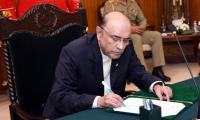




ISLAMABAD/ PESHAWAR/CHARSADDA: Following a meeting between President Asif Ali Zardari and Prime Minister Shehbaz Sharif, the federal government has decided to take a constitutional option in Khyber Pakhtunkhwa, deciding in principle to impose an emergency in the province, with the federal cabinet expected to approve the move today (Sunday), according to sources.
The federal cabinet has also been summoned to meet today, where approval for imposing an emergency or governor’s rule in the KP is expected to be sought, the sources said. Separate sessions of both houses of parliament — the Senate and the National Assembly — have been summoned on Tuesday (Oct 13).
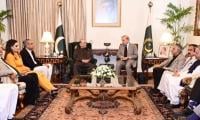
Meanwhile, according to a statement issued by the President’s Secretariat, the meeting between the president and prime minister was held at the Aiwan-i-Sadr where they discussed the overall political and security situation in the country. The meeting was attended by Deputy Prime Minister Ishaq Dar, PM’s Adviser on Political Affairs Rana Sanaullah, Interior Minister Mohsin Naqvi, Law and Justice Minister Azam Nazeer Tarar, Federal Minister Ahad Cheema and Attorney General Mansoor Usman Awan. Senator Sherry Rehman, Syed Naveed Qamar, Senator Saleem Mandviwalla and Dr Asim assisted Zardari during the meeting.
The meeting also agreed to convene separate sessions of the National Assembly and the Senate on Tuesday.
Meanwhile, all preparations have been completed to impose an emergency or governor’s rule in the KP. According to Geo News sources, the homework regarding administrative changes, including deputy commissioners and secretaries, has been completed, and a list on the postings of regional and district police officers has also been prepared.
Sources say that a proposal to initially impose an emergency in 12 districts of the province is also under consideration. Whether or not to impose an emergency or governor’s rule depends on the negotiations between the opposition and government delegations.
Sources say that formal negotiations between the government and the opposition are not taking place, but behind-the-scenes and secret contacts continue.
Meanwhile, JUIF chief Maulana Fazlur Rehman met the prime minister at the PM House along with a delegation comprising Maulana Lutfur Rehman, Senator Kamran Murtaza and Senator Maulana Ataul Haq Darwish. According to Geo News sources, Maulana Fazlur Rehman proposed resolving the issue through negotiations instead of governor’s rule or an emergency. The prime minister briefed Maulana Fazlur Rehman in detail about the government’s stance on the negotiation process.
According to sources, the prime minister informed Maulana Fazlur Rehman about the details of negotiations and said that the government had made every effort to resolve all matters through mutual understanding, and that the government would try to take all decisions by exhausting all constitutional options available.
According to sources, Maulana Fazlur Rehman has asked the federal government for time to consult with the opposition and PTI, and he has also made contact with the opposition and PTI leadership.
The PM Office did not issue any statement after the meeting which lasted for nearly 90 minutes.
Deputy Prime Minister Ishaq Dar, Minister for Law and Justice Azam Nazir Tarar, Minister for Information Attaullah Tarar and Special Assistant to PM Rana Sanaullah were also present.
Later, PTI Chairman Barrister Gohar Ali Khan and former NA Speaker Asad Qaiser met Maulana Fazl on his return from the PM House. There was no word from either side regarding the meeting, but it is understood that Maulana Fazl apprised the PTI leaders about his meeting with the prime minister. The JUIF spokesperson said that Maulana Fazl also took the PTI leaders into confidence before leaving for the PM House.
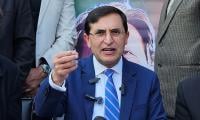
Meanwhile, speaking at a news conference here, along with Prime Minister’s Coordinator Ikhtiar Wali Khan and MPA Jalal Khan, Federal Minister for Information and Broadcasting Attaullah Tarar grilled Pakistan Tehreek-e-Insaf’s (PTI) leadership over “bad governance and the deteriorating law and order” in the KP over the past 13 years. He claimed that the KP provincial government was given Rs700 billion under the National Finance Commission for development projects. “You (KP rulers) neither upgraded the Counter Terrorism Department (CTD), nor established forensic labs, nor installed safe city cameras, which should be installed in the merged districts and all the entry-exit points of districts.”
The minister said, on the other hand, the PTI was spending this money on organising protests and long marches. “You don’t even give half an hour to discuss terrorism in the province, but you organise six-hour meetings to spread turmoil and vandalism,” he charged.
Tarar contended that the KP was once a cradle of peace and pride for the nation, but the current provincial government has pushed the region into the Stone Age, depriving citizens of basic facilities and developmental opportunities. The PTI, he alleged, had trapped millions of people in the province in a bid to get its leader (Imran Khan) released from jail. “You trapped them in poverty, in disease by not providing adequate health facilities, in ignorance by not providing educational opportunities and in non-development by not improving infrastructure.”
Tarar alleged that the KP government had held the people of the province captive to terrorists, as they facilitated terrorists in settling in the country. He accused the PTI again of being the TTP’s ‘B team’ and said that was why they do not condemn terrorists.
Speaking on the occasion, Ikhtiar Wali alleged corruption is on the rise across the KP, while public funds have been used for political and social media campaigns. He said that over the past 13 years, the provincial governments in the province had failed to establish a single university or provide basic civic amenities to the masses. The healthcare system in the province, he claimed, is in bad condition, while police personnel are forced to confront terrorists without having modern equipment.
He continued that the development of erstwhile tribal districts remained severely neglected, and the provincial government has pushed the public toward destruction under the guise of a so-called revolution. Jalal Khan alleged the PTI leadership failed to play a constructive role in countering terrorism in the province and instead spread anarchy. He expressed the resolve to rescue the province and its citizens from rampant corruption and administrative failure of the PTI leadership.
Separately, consultations continued on Saturday over the law and order and political situation in the KP as Federal Minister for Kashmir Affairs and Gilgit-Baltistan Amir Muqam discussed the lingering tension in the province and possible future measures amid reports of more lawmakers going missing. KP Governor Kundi has remained active over the past few days since the PTI launched its long march for the release of party founder Imran Khan.
“The federal government will continue to take all possible measures to strengthen security, protect the people of KP and support the province’s development. The future of KP cannot be sacrificed at the altar of political ambition,” said Faisal Karim Kundi after a meeting with Amir Muqam, who is also the provincial president of Pakistan Muslim League-Nawaz (PMLN).
“Met Federal Minister Amir Muqam to discuss the security and political situation in Khyber Pakhtunkhwa. Our people have paid an unbearable price in the war against terrorism. They cannot be held hostage to the politics of anarchy and agitation,” the governor said. He added that at a time when the province was facing serious security challenges, those responsible for violence must be answerable to the people of KP. He said the province did not need further political activities that undermined security and endangered lives. He also commended the people of KP for standing with peace.
They reiterated that the federal government would continue taking all possible measures to restore lasting peace, strengthen security and accelerate public welfare and development initiatives in the province. The two leaders also observed that the KP people had grown frustrated with terrorism and what they described as political elements promoting instability. They reaffirmed the federal government’s commitment to ensuring peace and stability in the province.
Meanwhile, more PTI lawmakers were reported to have gone missing from their residences in different districts. According to the party leadership, nine MPAs, including three provincial ministers, and eight MNAs had been ‘picked up’ in recent days. Provincial Minister Fazal Shakoor was reportedly the first to be picked up from Chamkani in Peshawar, after which more lawmakers were reportedly picked up.
According to the President’s House in Islamabad, Governor Kundi and Federal Interior Minister Mohsin Naqvi met President Zardari. The president was briefed on the country’s overall security situation. The president was briefed specifically on the deteriorating law and order situation in the KP.
Meanwhile, speaking to the media in Peshawar, PTI Chairman Barrister Gohar Khan said that the current political situation was a moment of reflection for all parties. “In effect, governor’s rule currently prevails in the province. Due to the federal government’s intervention, the province has weakened despite the existence of a provincial government. No other province in the country is being subjected to such intervention; this is being done only because we have the mandate in the province,” he said.
There is a disagreement over the mechanism for eliminating terrorism, which could have been resolved. Imposing governor’s rule and emergency in the province is not the remedy for this. If there is a situation warranting an emergency or governor’s rule, then convene a meeting of the federal or provincial apex committee and find a solution to the problem, he added.
Barrister Gohar Khan said that elimination of terrorism should be carried out through action under the National Action Plan and all political parties should also be heard so that the people take ownership of it. An emergency or governor’s rule will worsen the situation. Our long march was for six demands; our demands are constitutional and legal, he said.
“The country’s political leadership must act with foresight and avoid steps that increase tension. At this time, Khyber Pakhtunkhwa cannot bear further experimentation. Our 8 MNAs and 9 MPAs have been picked up or are missing,” he said.
Meanwhile, PTI Secretary Information Sheikh Waqas Akram strongly rejected the allegations levelled by Federal Minister Attaullah Tarar, Ikhtiar Wali Khan and Jalal Khan against the KP government. He described their statements as politically motivated, misleading and based on a selective presentation of facts.
Responding to their press conference, the PTI leader said that rather than engaging in repeated political attacks against the KP and its elected government, the federal representatives should acknowledge the province’s contributions to national security, public welfare, education and development, while fulfilling the federation’s outstanding financial obligations.
Strongly rejecting allegations that the provincial government had abandoned the families of martyrs, he said the KP had established a substantial financial assistance programme extending beyond its own police personnel to the families of martyrs of the Pakistan Army and Frontier Constabulary. He noted the KP government has released Rs1.833 billion in financial assistance for the families of martyrs, with compensation reportedly provided to 905 families. Under the compensation policy, Rs3 million is allocated for each martyred officer and Rs2 million for each junior commissioned officer, non-commissioned officer and soldier.
Employment opportunities under designated quotas in the police and other law-enforcement organisations are also being provided to eligible family members.
“To accuse a government of abandoning the families of martyrs while it is extending financial assistance to families of those who sacrificed their lives in the service of Pakistan is a serious distortion of facts,” he claimed. He paid tribute to the sacrifices of Pakistan armed forces, police, Frontier Constabulary and other security personnel, emphasising that their families deserve enduring institutional support, dignity and recognition rather than being drawn into political controversies.
Regarding the security situation, Waqas Akram acknowledged that terrorism remained a serious challenge in the KP but stressed that the province was bearing a disproportionate share of the human and financial burden of confronting a threat to the entire country.
Citing provincial budgetary figures, he stated that the recurring police budget, reported at Rs121 billion in 2024-25, had been increased to Rs173.8 billion for 2026-27. The allocation for weapons procurement had reportedly risen from Rs3.3 billion to Rs14.5 billion. He said that approximately 8.8 percent of the provincial budget was allocated to policing, while nearly 140,000 police personnel were serving across the KP. He continued that the province has approximately one police officer for every 292 residents, compared with approximately one for every 541 residents in Punjab.
Waqas Akram maintained that these allocations reflected the provincial government’s commitment to strengthening policing, counterterrorism capabilities and public security. He emphasised that combating terrorism required effective coordination between federal and provincial authorities rather than political point-scoring over a national security challenge.
Rejecting charges that the PTI had failed to establish universities during its tenure, Waqas Akram cited the Higher Education Commission figures indicating that 16 public-sector universities had been established or upgraded to full university status in the KP since 2013.
He referred to the University of Chitral, University of Buner, Women University Swabi, Women University Mardan, University of Lakki Marwat, Abbottabad University of Science and Technology, University of Agriculture Swat and University of Shangla among the institutions reflecting the expansion of higher education. He said that while financial sustainability and educational standards must remain subjects of continuous scrutiny, it was misleading to disregard the expansion of higher education across previously underserved districts.
Highlighting tourism development, Waqas Akram pointed to investments in road infrastructure, tourist facilities, tourism policing and visitor assistance services, particularly in Swat and other major destinations. He cited official provincial figures reporting more than 1.267 million tourist visits during a five-day Eid-ul-Azha period, describing the figures as an indication of KP’s tourism potential and its contribution to local employment and economic activity.
On the alleged misuse of funds for the merged tribal districts, Waqas Akram challenged the federal government to disclose the complete record of financial commitments, transfers and outstanding obligations relating to these areas. He said that the merged districts had continued to await an appropriate share under the NFC arrangements for approximately eight years, while the provincial government had been compelled to finance substantial responsibilities from its own resources. According to the provincial figures cited by Waqas Akram, Rs54 billion in compensation relating to Temporarily Displaced Persons (TDPs) remains outstanding against the federal government, with the relevant federal payments reportedly suspended since 2022. Despite these constraints, he said the KP had spent Rs3.9 billion in 2023-24, Rs4.6 billion in 2024-25 and Rs19.84 billion in 2025-26 on the relevant responsibilities, while allocating Rs17 billion for 2026-27. “The federal government cannot disregard its own financial obligations and then accuse the provincial government of failing to meet responsibilities for which adequate federal support has not been provided,” he said. Rejecting sweeping allegations of corruption and administrative paralysis, the PTI leader also referred to comparative provincial expenditure and administrative figures. He stated that the KP had allocated Rs6 billion for judicial development expenditure, compared with Rs5.2 billion in Punjab, Rs2 billion in Sindh and Rs0.9 billion in Balochistan. He cited figures indicating that since February 2024, the KP cabinet had held 60 meetings, compared with 50 in Sindh, 36 in Punjab and 23 in Balochistan during the corresponding period.
He maintained that governance should be evaluated through transparent financial records, institutional performance and measurable public outcomes rather than unsubstantiated generalisations.
Turning to the country’s economic situation, he questioned the federal government’s criticism of poverty in the KP while millions of Pakistanis continued to struggle with rising living costs, expensive electricity, high fuel prices and mounting household expenses. He said farmers were facing increasing agricultural input costs and concerns over crop prices, traders were struggling with difficult business conditions and salaried households were finding it increasingly challenging to meet essential expenses. “Before lecturing the KP people about poverty and prosperity, Federal Minister Attaullah Tarar should explain what meaningful economic relief the federal government has delivered to ordinary Pakistanis struggling with electricity bills, fuel prices, food costs and declining purchasing power,” he said.
Waqas Akram urged the federal government to prioritise the settlement of KP’s legitimate financial entitlements, including its share under the NFC arrangements, outstanding net hydel profit payments and other constitutional and financial obligations. He said that the sacrifices of KP people and security personnel should be acknowledged rather than diminished through political confrontation.
Meanwhile, the PTI welcomed the possibility of JUIF chief Maulana Fazlur Rehman’s role in easing political tension in the country, as he met Prime Minister Shehbaz Sharif. “It would be a welcome development if Maulana Fazlur Rehman plays a positive and effective role in alleviating the ongoing political tension and strain in the country; we would certainly welcome such a role,” the party said in a statement issued here.
The PTI maintained that at this juncture, the country is in dire need of political wisdom, restraint, serious and meaningful measures and dialogue not confrontation.
Meanwhile, the Peshawar High Court (PHC) on Saturday rejected a request to constitute a larger bench to hear a petition filed by three PTI MNAs, Shehryar Afridi, Shandana Gulzar and Asif Khan, concerning alleged obstructions during a long march and protection of their lives.
A bench comprising Chief Justice SM Attique Shah and Justice Ijaz Khan Sabi heard the petition and issued a written order, observing that the case was still at an initial stage and the petitioners’ counsel had been asked to present arguments on its merits. According to the order, instead of arguing the merits of the petition and request for interim relief, the counsel informed the court that he intended to file an application seeking the formation of a larger bench. The court rejected the request.
Meanwhile, the PHC sought a written reply from KP Chief Minister Sohail Afridi within 14 days in a contempt of court petition over the use of official resources during a long march.
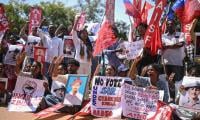
Meanwhile, addressing participants of the long march before his departure from Charsadda and later at Chamtar Adda and Manga Bazaar in Mardan on the seventh day of the march, KP Chief Minister Sohail Afridi reaffirmed his government’s commitment to protecting constitutional rights and the public mandate, warning that any attempt to impose governor’s rule or an emergency in the province would prompt people to mobilise towards Peshawar. “We have no desire for office or power but will defend our constitutional rights and public mandate at all costs,” he said, adding that intimidation and coercive tactics would not deter the movement. Afridi said the struggle had gone beyond questions of office and authority, adding that he was prepared to sacrifice not only his position but also his life for Imran Khan and the KP people. He announced that people from across the country would begin travelling to Swabi on October 11 under the leadership of their respective parliamentarians, while the next course of action would be announced there on October 13. Addressing those threatening to impose governor’s rule, Afridi said they should realise that the matter had moved beyond political office or retention of power. He urged party workers and supporters to remain steadfast, focused on their objectives and committed to the movement.
Decisions affecting the province’s future, he said, could not be imposed by disregarding the will and constitutional rights of its people.
He regretted that peace achieved through sacrifices had been undermined by decisions taken behind closed doors. He alleged that terrorism had been imposed on the province to serve vested interests and warned that such actions could have dangerous consequences.
Addressing participants at Chamtar Adda in Mardan, Afridi called on people from across Pakistan to reach Swabi on October 11 and assured them that the provincial government would welcome the participants and facilitate their stay. He added that oppressive tactics would not force the movement to retreat and claimed that the plan to be announced in Swabi would surprise political opponents. However, he urged participants to maintain peace and discipline, cautioning against attempts to provoke unrest or create opportunities for disruptive activities. He emphasised that the movement must remain within the bounds of the Constitution and law.
Meanwhile, the KP Police have issued operational guidelines for dealing with rioting and protest demonstrations amid the prevailing situation in the province, warning that those involved in violence, vandalism and attempts to disrupt law and order will face strict legal action.