ISLAMABAD: As Houthi forces escalate military and humanitarian tensions by targeting Saudi Arabia’s mainland, Pakistan said on Thursday that it remains committed to the Strategic Mutual Defence Agreement (SMDA) and the Makkah Joint Defence Agreement. However, it added that decisions on when, how, where and what force would be used against which targets, and in which modes, along with other operational details, require Pakistan to maintain some discretion at this stage.
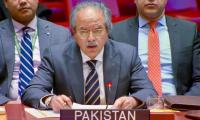
“Pakistan has, for a long time, been sharing this perspective that we would like to have peace and stability because this is in the interest of not only Pakistan and Iran but the entire region and beyond. The situation in the Bab al-Mandab is exceptionally serious and a matter of concern, and we need to bring peace to the entire region. The Houthis must also stop their activities, and in this regard, our discussions basically revolve around bringing peace and stability through dialogue and diplomacy, and not through coercive measures,” said Sajjad Haider Khan, Spokesperson at the Foreign Office, during the weekly media briefing.
Through SMDA, signed last year, there were some deployments of forces, and since it is an operational matter, Pakistan is reluctant to comment on details, but stresses that its efforts in Yemen have been that peace and security should prevail, there should be reconciliation and the situation should not impact the whole region, because in the context of a regional war between Muslim countries, this kind of a situation does not exist.
The spokesperson reiterated that the first objective of the Makkah Joint Defence Agreement, signed between Pakistan, Türkiye and Saudi Arabia on August 7, is a mutual defence agreement aimed at strengthening regional peace and stability; the agreement, while being purely for defensive purposes, is neither directed against any country nor does it formally constitute a new bloc.
“Our partnership with Saudi Arabia and Türkiye in the area of security and defence is well recognised, and it did not start yesterday. The Makkah Accord, in essence, formalises and further strengthens many aspects of the ongoing cooperation and existing long-term bilateral cooperation among these three countries. Inter alia, it aims to enhance the existing defence cooperation, including training and capacity-building, the exchange of best practices, learning from mutual experiences in defence technologies and research, as well as collectively deterring any acts aimed at destabilising regional security,” he said.
When asked specifically how Pakistan is balancing its relations with Iran and the US in the present scenario, the spokesperson responded, “We have good relations with both countries, and we do not examine one country’s relations through the lens of another country. We have independent relations, and this is not something that started recently but has existed for hundreds of years, even before the creation of Pakistan. We do not examine these relations in the context of competition. Because of the very good relations with both countries, and because of that, the mediation role has been entrusted to Pakistan, with the concurrence of all the countries.”
Pakistan played a great role in bringing the United States and Iran to the talks table, so how satisfied is Islamabad with the implementation of the agreement, the spokesperson was asked. “Well, these are two different sets of processes. One is bringing people together. Probably, I mentioned last time also that Pakistan not only brought the USA and Iran together, but it was after 47 years that these two countries were sitting in the same room, face to face. So, for us, that is a success, and for us, that was the beginning. It led to the Islamabad talks, which led to the Islamabad Memorandum of Understanding and, following that, we saw the signing ceremony in Burgenstock. This was very positive but, as they say in English, ‘the taste of the pudding is in the eating’, so we have to see the implementation also. Pakistan keenly follows the agreed Islamabad understanding and our understanding is that if we follow through on the provisions given in the Islamabad MoU, peace and stability can be achieved,” he explained.
Pakistan has not as yet decided who would be assigned the role of the secretary general at the Makkah Defence Alliance but hinted it could even be a woman.
Prime Minister Shehbaz Sharif will lead Pakistan’s delegation to the high-level segment of the 81st Session of the UN General Assembly in New York next week, accompanied by Deputy Prime Minister/Foreign Minister Ishaq Dar, other federal ministers and senior officials. In his speech at the UNGA, the prime minister will highlight Pakistan’s perspective on regional and global developments, reaffirming the importance of dialogue, diplomacy, restraint and the peaceful resolution of disputes. “He will outline Pakistan’s priorities on sustainable development, climate change, counter-terrorism, Islamophobia, global economic challenges, UN reform and issues confronting the Global South, while drawing attention to the situations in Indian Illegally Occupied Jammu & Kashmir (IIOJK) and Palestine. During the visit, he will participate in high-level events and hold bilateral meetings with world leaders and the UN secretary-general, highlighting Pakistan’s commitment to multilateralism, the UN Charter, regional peace and international cooperation,” the spokesperson said.
Also, Pakistan categorically rejected India’s baseless and legally untenable assertions concerning the Pakistan-China Boundary Agreement of 1963 and the Pakistan-China Boundary Joint Commission. “The 1963 Agreement is a valid arrangement concluded between Pakistan and China. India’s claims regarding Jammu and Kashmir are equally untenable, as Jammu and Kashmir remains an internationally recognised disputed territory, whose final disposition is to be determined in accordance with the United Nations Security Council resolutions and the aspirations of the Kashmiri people,” reacted the spokesperson.
He said that it is a mockery of international law that India speaks of legality in an attempt to challenge the validity of Boundary Joint Commission and instead New Delhi must carry out its own introspection, especially regarding its illegal and unilateral decisions of August 5, 2019. “India must rescind these illegal decisions, which were in utter violation of the UN Security Council resolutions,” he added.
Pakistan has taken note of the measures announced by the United States concerning Mahan Air and is examining the matter through the relevant stakeholders. “Mahan Air operates flights to Lahore. To our understanding, Mahan Air operates to 18 destinations, with flights to nine different countries, including Thailand, China, India and others as well. We have three flights operating to Lahore. We believe that issues of concern are best addressed through dialogue and diplomacy and we remain committed to a mediatory role and the peaceful resolution of the Iran-US conflict at this stage,” said the spokesperson.
On Afghanistan, he said: “Our policy has been a peaceful Afghanistan, which is peaceful within as well as peaceful with the neighbouring countries. It is not only Pakistan that has this observation. I mean, China also has observations about the terrorist activities taking place, and the northern Central Asian countries are also not happy with the terrorist situation in Afghanistan.”
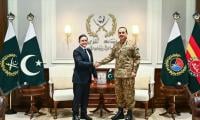
Meanwhile, Iran’s top diplomat held a telephonic conversation with Chief of Army Staff and Chief of Defence Forces (COAS & CDF) Field Marshal Syed Asim Munir. Abbas Araghchi and the Pakistani top general talked over the phone on Wednesday, Iran’s Tasnim news agency reported. They discussed and reviewed the latest regional developments and issues of mutual interest to both countries.
Earlier in the day, Araghchi met with his Chinese counterpart Wang Yi in Beijing, where the two sides discussed the regional situation and bilateral relations. He described his consultations in China as successful and said, “Today’s decisions will decide future strategic balance in the region, with immeasurable knock-on effects.”
Meanwhile, Deputy Prime Minister/Foreign Minister (DPM/FM) Ishaq Dar strongly condemned the Houthi drone attack on Taif, Saudi Arabia, which claimed the life of a Yemeni resident and injured a Saudi citizen and a Pakistani national, who is reportedly in critical condition.
In a statement posted on ‘X’, Dar said Pakistan was deeply concerned over the attack and condemned the provocation, which endangered innocent lives and threatened regional peace and security.
“We stand in full solidarity with the Kingdom of Saudi Arabia and its people,” he said.