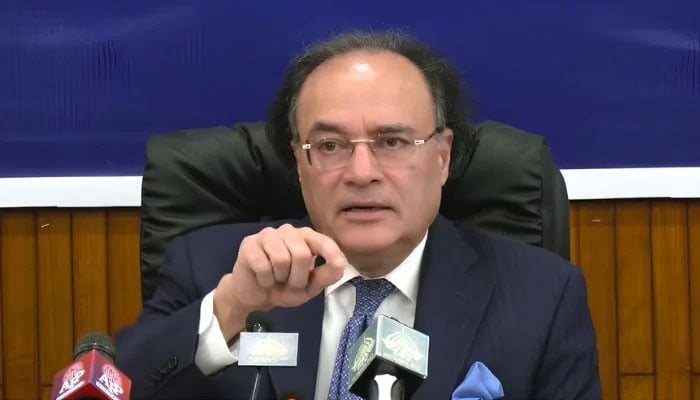
ISLAMABAD: After recording revenue collection of Rs13,010 billion by the FBR in the last fiscal year 2025-26, Federal Minister for Finance and Revenue Senator Muhammad Aurangzeb on Wednesday commended the Federal Board of Revenue (FBR) for successfully achieving the revised annual revenue collection target for FY2025-26, describing it as a landmark accomplishment made possible through teamwork, sustained reforms and the unwavering commitment of the entire FBR leadership and field formations.
Addressing a meeting at the FBR headquarters, attended virtually by Chairman FBR Rashid Mahmood Langrial, members of the FBR Board, senior officers and chief commissioners and chief collectors from across the country, the finance minister conveyed the prime minister’s congratulations to the entire FBR team for its dedication and hard work throughout the fiscal year.
Aurangzeb said the achievement should be viewed in the context of Pakistan’s broader reform journey over the past two and a half years, during which revenue collection had nearly doubled. He said the progress represented one of the most significant improvements in the country’s fiscal history, strengthening macroeconomic fundamentals and contributing to the lowest fiscal deficit and highest-ever primary surplus through strong revenue performance and prudent fiscal management.
He praised the Inland Revenue and Customs formations for delivering strong revenue growth despite substantial tariff relief, and lauded the FBR for disbursing Rs599 billion in tax refunds during the year, including a record Rs13.5 billion on the last day of the fiscal year. He also commended the coordination between the Finance Division and FBR during the preparation of the Federal Budget 2025-26, describing it as an example of effective teamwork and institutional reform.
Highlighting the government’s reform agenda, Aurangzeb said modern tax administration must prioritise taxpayer facilitation, transparency and public trust alongside revenue collection. He stressed the need for greater automation, technology-driven solutions and improved taxpayer services, while noting that the FBR’s new operating model would accelerate reforms focused on people, processes and technology, including the expanded use of artificial intelligence. He thanked parliament for supporting the required legislation and reaffirmed the government’s commitment to transforming the FBR into a leading public institution, while acknowledging the prime minister’s leadership in advancing tax reforms.
Addressing the meeting, Chairman FBR Rashid Mahmood Langrial thanked the finance minister for visiting FBR headquarters on the first day of the new fiscal year and for his continued support for the institution. He appreciated the close coordination between the Finance Division and FBR throughout the budget process, particularly during consultations with the IMF, provincial governments, coalition partners, parliamentary committees and other stakeholders.
The chairman said the professionalism, technical competence and collaborative approach of officers from the Finance Division and the FBR had enabled the government to successfully navigate complex fiscal and tax policy challenges, demonstrating the strength of Pakistan’s civil service in achieving national objectives. He added that ongoing modernisation initiatives, including technology upgrades, enhanced customs systems, artificial intelligence-based solutions and capacity-building programmes, would improve taxpayer services, strengthen compliance and modernise Pakistan’s tax administration.