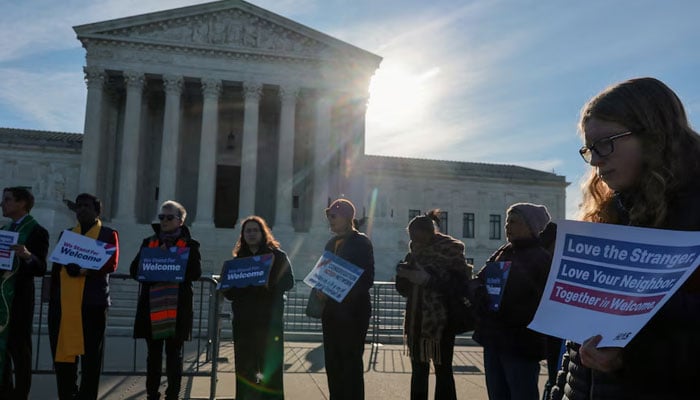
WASHINGTON: The US Supreme Court handed President Donald Trump a victory on Thursday by backing the federal government’s authority to turn away asylum seekers when officials deem US-Mexico border crossings too overburdened to handle additional claims.
The court, in a 6-3 ruling powered by its conservative justices, overturned a lower court’s finding that the policy violated federal law. The Republican president’s administration has said it may seek to revive the policy, known as “metering,” after it was dropped by Trump’s Democratic predecessor Joe Biden.
The ruling was one of two in immigration-related cases issued by the court on Thursday backing Trump.
The metering policy allowed US immigration officials to stop asylum seekers at the border and indefinitely decline to process their claims. It is separate from a sweeping policy to deny entry to asylum seekers at the border that Trump announced after returning to the presidency last year. That policy also faces an ongoing legal challenge.
Under US law, a migrant who “arrives in the United States” may apply for asylum and must be inspected by a federal immigration official. The legal issue in the current case is whether asylum seekers who are stopped on the Mexican side of the border have arrived in the United States.
Conservative Justice Samuel Alito, who authored Thursday’s ruling, wrote that the answer is “no.”
“In ordinary speech, no one would say that a person ‘arrives in’ a place — for example, a house, a city or a country — before the person enters that place,” Alito wrote. “The context in which the phrase ‘arrives in the United States’ is used in the immigration statutes at issue here supports an ordinary-meaning reading.”
Alito read a summary of his opinion from the bench, as is customary. Justice Sonia Sotomayor then read a lengthy summary of her dissenting opinion from the bench — an action that signals a justice’s strong opposition to a ruling.
Sotomayor, in a dissent that was joined by fellow liberal justices Elena Kagan and Ketanji Brown Jackson, wrote that Thursday’s ruling authorises US immigration officers to refuse to consider asylum applications by “physically blocking (applicants) from stepping foot onto US soil.”
“The consequences of today’s decision are predictable,” Sotomayor wrote.
“More people will die. More people will attempt to cross the border illegally, and some will make it while others will not. More people will be forced to walk along the US-Mexico border in dangerous conditions, trying to find a port that will inspect them. More people will turn back and be subjected to violence because of something they cannot or should not have to change about themselves, such as their race, religion, nationality or political opinion,” Sotomayor wrote.
In an unusual move, Alito then responded from the bench to Sotomayor with an additional defense of the ruling, saying there was much more he would have included in his opinion summary had he known that Sotomayor intended to air her dissent in court.
The other immigration-related ruling issued on Thursday also was authored by Alito. In that one, the court cleared the way for the Trump administration to strip hundreds of thousands of Haitian and Syrian immigrants of a humanitarian status that protects them from deportation. At issue was Temporary Protected Status for more than 350,000 people from Haiti and 6,100 from Syria.
James Percival, general counsel at the US Department of Homeland Security, welcomed Thursday’s ruling, saying it “opens up an important tool to continue securing our southern border.”
“We had to go all the way to SCOTUS to vindicate the principle that an alien is not ‘in the United States’ until he is, in fact, in the United States,” Percival said, using shorthand for the Supreme Court of the United States. “We have yet AGAIN been vindicated by the Supreme Court.”
Melissa Crow, a lawyer representing the plaintiffs, said the ruling “should sound the alarm for anyone who cares about human rights and the rule of law.”
The ruling, Crow said, “suggests the president may unilaterally override decades of established law and trample on people’s legal rights if doing so suits his political agenda.”
US immigration officials began turning away asylum seekers at the border in 2016 under Democratic former President Barack Obama amid a migrant surge. The metering policy was formalized in 2018 during Trump’s first term in office, with border officials authorized to decline processing asylum claims when the government decides it is unable to handle additional applications. Biden rescinded the policy in 2021.