JERUSALEM/TEHRAN: Air raid sirens sounded in Israel on Sunday as its military worked to intercept barrages of incoming Iranian missiles for the first time since an April ceasefire took hold in the Middle East war.
Iran’s powerful Revolutionary Guards called the attack a “warning” after Israel struck Beirut’s southern suburbs earlier in the day, threatening wider strikes in the event of repeated aggression.
Iran’s military central command said that Israel’s latest strike on the southern Beirut suburbs had “crossed all red lines”, demanding a halt to its campaign in Lebanon. “The Israeli army must stop its attacks on southern Lebanon and the suburbs, and if it expands its attacks to that region or responds to Iran’s action, it will face more devastating and regrettable blows,” said General Ali Abdollahi, the head of the Khatam al-Anbiya command.
The Israeli military said that Iran had committed a “grave mistake” by launching a barrage of missiles at Israel. It vowed to press ahead with its military campaign in Lebanon and said it would step up operations against Hezbollah.
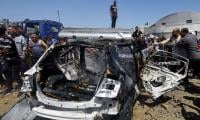
On Sunday, Israeli Prime Minister Benjamin Netanyahu’s office announced that the army had “struck a militant command centre in Beirut’s Dahiyeh district, in response to Hezbollah’s fire towards Israeli territory”. The raid killed two people and wounded 20 more, Lebanon’s health ministry said.
Iranian Foreign Minister Abbas Araghchi said he has spoken with officials from Pakistan, Turkiye and the UK “following Iran’s response to the repeated violations of the ceasefire in Lebanon” by Israel, Aljazeera reported.
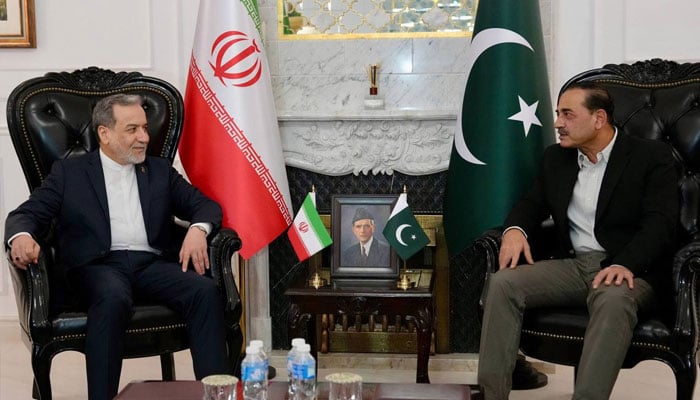
Araghchi said in a post on Telegram that he spoke with Pakistan’s army chief, Field Marshal Asim Munir, who has played a key role in US-Iran mediation efforts. He also spoke with British Foreign Secretary Yvette Cooper and Turkish Foreign Minister Hakan Fidan.
Araghchi also spoke to French and Qatari foreign ministers on Iran’s response against Israel and regional developments, Reuters reported.
Meanwhile, Interior Minister Mohsin Naqvi delivered a “special message” from the country’s top leadership to Iran’s Supreme Leader Mojtaba Khamenei, Iranian media reported on Sunday, amid Islamabad’s diplomatic push to help end the US-Iran conflict.
Naqvi landed in Tehran on Saturday for talks with senior Iranian officials, including Foreign Minister Abbas Araghchi.
Speaking to reporters after arriving in Tehran, Naqvi said he travelled to Iran to deliver a letter from Prime Minister Shehbaz Sharif and Chief of Defence Forces Field Marshal Asim Munir to Khamenei, Geo News reported.
The interior minister delivered the message during a meeting with Araghchi earlier on Sunday, with images published by Fars news agency showing him handing over a sealed brown envelope to the Iranian foreign minister.
The crucial communication comes amid heightened tension between Iran and the US, with recent tit-for-tat attacks threatening the fragile ceasefire, in place since April 8.
Islamabad has been acting as a key mediator between the US and Iran since hostilities erupted in the Middle East in late February.
Efforts to turn a ceasefire into a settlement have repeatedly stalled, while the war has rattled global markets and increased domestic pressure on US President Donald Trump ahead of midterm elections.
Tehran has repeatedly insisted any deal to permanently end the war must also halt the parallel conflict in Lebanon, where Israel is pursuing a campaign against the Iran-backed movement Hezbollah. Iran had warned in recent days that any new attacks on Beirut would trigger a “full-scale resumption” of hostilities.
Mohammad Bagher Ghalibaf, Iran’s parliament speaker and its chief negotiator in talks with Washington, accused the United States of having given a “green light” for the Beirut attack.
This and the ongoing US blockade of Iranian ports, he said, “turns the bases and assets of America and the (Israeli) regime in the region into legitimate targets. Our armed forces, as always, are free to act.”
The spokesman for the Iranian parliament’s national security commission, Ebrahim Rezaei, also threatened “a decisive and painful response”. “These rabid dogs must be disciplined... Look at the sky over the occupied lands tonight,” he said, referring to Israeli territory.
Mohsen Rezaei, military adviser to Iranian supreme leader Ayatollah Mojtaba Khamenei, had told CNN negotiations with the US “are at a deadlock, and Trump must break this deadlock”, calling for the release of some $24 billion in frozen Iranian assets. But Trump said in the same interview that he would not unfreeze Iranian assets before reaching an agreement with Tehran.
Iran’s Deputy Foreign Minister Kazem Gharibabadi said on Sunday that regional governments were “not in a position to demand reparations”, responding to reports the US could use Iranian assets to compensate regional allies for war-related damages.
Gharibabadi added in a post on X that Iran’s assets were “neither war spoils for Washington nor a payment fund for its allies”. A source familiar with the matter told Reuters on Saturday that the US will make Iranian assets available to Gulf allies to support rebuilding and repairs for future damage caused by Iran.
Meanwhile, US Central Command (CENTCOM) said overnight that it destroyed two Iranian drones “that threatened international maritime traffic in the Strait of Hormuz”.
A previous drone interception and strikes on Iranian radar sites had prompted Tehran on Saturday to fire a salvo of missiles at US allies Bahrain and Kuwait.
President Trump called for more “surgical” strikes against Hezbollah in Lebanon and said he is not demanding the conflict be included in a peace deal with Iran, in an interview broadcast Sunday. “I’d like to see a more surgical attack on Hezbollah. I think it should be more surgical,” Trump told NBC’s “Meet the Press,” according to a transcript of the interview recorded Friday.
“I’d like to see Lebanon have a better life,” he added.
Iran’s President Masoud Pezeshkian has warned of an appropriate response to “unfair criticism” directed at the government. “Our colleagues in the government have always been careful to ensure that the public’s peace of mind is not threatened, and I have consistently emphasized preserving unity and tolerance for differences,” the Iranian president said in a post on X. However, he added, when “IRIB and some media activists, under wartime conditions, direct unfair criticism at the government, we will be compelled to give an appropriate response. This is not in the country’s best interest”.
OPEC+ ministers decided Sunday to increase oil quotas by a total 188,000 barrels per day for July, in a move analysts said would be unlikely to have an impact on prices sent higher by the Mideast war.
Jorge Leon, analyst at Rystad Energy, said ahead of the expected increase that it “means very little while the Strait of Hormuz remains closed”.
The hiked production output was agreed Sunday in a video meeting of oil ministers from key OPEC+ countries Saudi Arabia, Russia, Iraq, Kuwait, Kazakhstan, Algeria and Oman, a statement from the organisation said.
The increase was similar to ones decided in previous months.
An Iranian court has rejected an appeal against a one-year jail sentence by director Jafar Panahi, who is now reportedly back in his homeland after winning top prize at last year’s Cannes film festival, his lawyer was quoted as saying Sunday.
A Tehran Revolutionary Court fully upheld the original December verdict of another court, although Panahi can still lodge a new appeal with a provincial court, lawyer Mostafa Nili told the website of Iranian daily Etemad.
The US is lobbying other countries on the UN nuclear watchdog’s Board of Governors to back a draft resolution demanding that Iran tell the agency what happened to its bombed nuclear sites and the enriched uranium stored there.
The US-drafted text, seen by Reuters on Sunday and circulated ahead of this week’s quarterly meeting of the 35-nation board, risks complicating talks between Washington and Tehran.
Fourteen weeks after President Donald Trump ordered an attack on Iran, the US military is adjusting to an unusual state of conflict that is not full-scale war, but also far from peace.
On ships and bases in the Middle East, US troops — some recovering from injuries — operate amid exchanges of fire with Iran every few days as the Navy blockades Iran’s ports. At home, the Pentagon is scrambling to bolster production of depleted munitions as families of service members cope with the stress of extended deployments.
“To maintain this constant state of ‘Level 10’ alert vigilance, to be ready to go at the drop of a hat, is a very stressful and difficult operational mission,” said one US official, speaking on condition of anonymity.
Joseph Votel, the former commander of the US military’s Central Command, described the current conflict phase as “a very, very dangerous period for us.” He said keeping troops ready during the ceasefire is no small challenge. “It puts on a lot of pressure on leaders to make sure that people are still at their edge,” Votel said.
Asked for comment, chief Pentagon spokesperson Sean Parnell said the US military stands ready to support deployed troops “in every way imaginable.”
“The Department of War is proud of our incredible troops. Their courage, readiness, grit, and unmatched professionalism are why they are the greatest fighting force in human history,” Parnell said.
Around 400 US troops have been wounded during the conflict, many of them with a traumatic brain injury. Over 90 per cent have returned to duty, the US military says. Thirteen service members have been killed in the conflict.
The Israeli military said Sunday it uncovered a sprawling tunnel network beneath the Beaufort castle in southern Lebanon, saying it was built to give Hezbollah a fortified strike hub just kilometres from Israeli territory. It said the tunnel network was funded by Iran and engineered to shelter hundreds of fighters.
Footage released by the military showed one narrow tunnel -- similar to those found beneath Gaza -- equipped with washrooms, trunks full of clothes, beds, a folded wheelchair and other household items.
Iran’s World Cup squad landed in Mexico on Sunday under the shadow of a bitter diplomatic row, after the United States refused to issue visas for some team support staff.
Iran coach Amir Ghalenoei complained on arrival at Tijuana airport that “we should have been here last week because a 12-hour time difference needs two weeks of adjusting.”
He added: “Usually in these tournaments, before technical matters, ethical and human considerations must be respected -- which I think for us it was not the case.”
US President Donald Trump said he would tell Israeli Prime Minister Benjamin Netanyahu not to strike back after Iran fired a salvo of missiles at Israeli targets, news outlet Axios reported.
Trump, who was spending the weekend at his golf club in Bedminster, New Jersey, had been briefed about the escalation between Iran and Israel, a US official told Reuters. The White House did not immediately respond to a request for comment.
“It’s certainly not going to help negotiations,” Trump told Fox News after the Iranian missile launches. “What I would suggest to Iran: You’ve shot your missiles, that’s enough, get back to the table and make a deal.” Asked about the earlier Israeli strike on Beirut, he said: “I’m not happy about it.”
He told Axios, “We are very close to a final deal with Iran, I don’t want it to blow up because of what is happening now.”
Saudi and Qatari foreign ministers discussed repercussions of latest developments on the region, Saudi foreign ministry said in a statement.
Iraq and Syria closed their airspace as a safety precaution on Sunday after their eastern neighbour Iran launched missiles across their territory towards targets in Israel.
In a brief statement, the Iraqi Civil Aviation Authority reported the closure of Iraqi airspace for 72 hours. Syria´s authority closed the country´s “southern air corridors” for 12 hours.