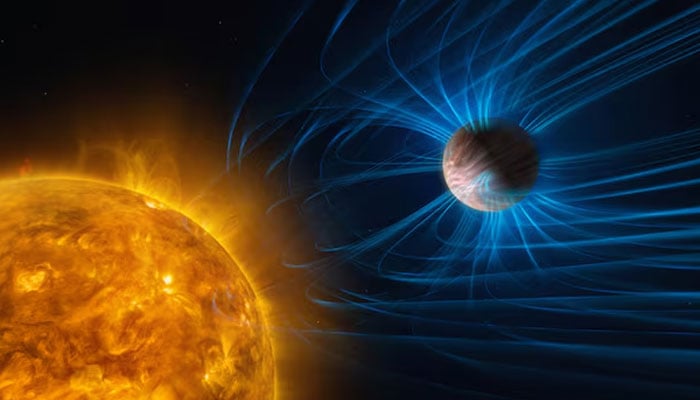
WASHINGTON: Based on the behaviour of winds on seven large and hot gas exoplanets, astronomers have obtained the strongest evidence to date that planets beyond our solar system possess magnetic fields, like Earthand five other planets in our solar system.
The finding, based on observations by telescopes in Chile and Hawaii, deepens the understanding of exoplanets by showing that at least some share an important characteristic present in all but two of the solar system’s eight planets. A magnetic field is an invisible force field generated by the movement of electrically conducting material deep inside a planet - a molten metal core - combined with the planet’s rotation.
While none of the gaseous exoplanets in this study are candidates for hosting life, a magnetic field could be one of the factors that helps make a rocky planet like Earth habitable.
These exoplanets each orbit very close to a large and hot star, with one side permanently facing the star and the other side perpetually facing away, as the moon does with Earth.
This type of planet is called a “hot Jupiter” because of a comparable size and composition to our solar system’s largest planet, though with a much higher temperature. The seven planets ranged in mass from roughly the same as Jupiter to more than three times as massive.
Strong winds blow from the hot “dayside” to the cold “nightside” on these planets. The orbital proximity of the planets to their host stars leaves them with scorching atmospheric temperatures on the dayside.