LAHORE: Pakistan is facing a paradox in the current migration landscape. There is a massive outflow of white-collar professionals to developed economies represents a permanent loss of human capital, while the cyclical, blue-collar migration to the Gulf Cooperation Council creates regular employment for the poor.
The migration wave witnessed during the past three years is fundamentally different from earlier periods. The country is no longer exporting only labourers, drivers, masons, electricians and technicians. Increasingly, it is losing doctors, engineers, accountants, IT specialists, researchers and other highly qualified professionals. Can the recent brain drain compensate for potential job losses and economic disruptions in the Middle East, where millions of Pakistani workers remain employed?
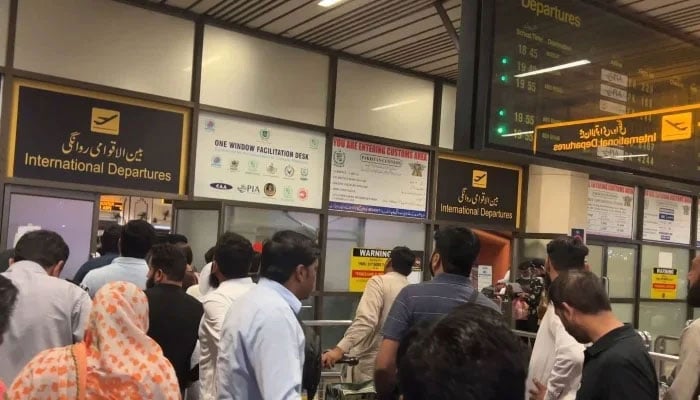
Official data from the Bureau of Emigration and Overseas Employment (BE&OE) shows that Pakistan continues to export manpower on a massive scale. More than 727,000 Pakistanis left for overseas employment in 2024, while nearly 687,000 had departed during 2025 up to November.
Yet beneath these impressive figures lies a worrying transformation. Recent official data cited by various reports indicates that over the last two years alone Pakistan lost around 5,000 doctors, 11,000 engineers and approximately 13,000 accountants. Healthcare professionals have been leaving in particularly large numbers, creating growing concerns regarding the country’s future capacity to provide quality medical services.
The crucial difference between today’s migration and the traditional Gulf labour model is permanence. Historically, a large proportion of Pakistani workers in Saudi Arabia, the UAE and other Gulf states migrated alone, leaving families behind. Their primary objective was to maximize remittances and eventually return home. Consequently, a significant share of their earnings flowed back into Pakistan.
The new generation of migrants is different. Doctors moving to the United Kingdom, Canada or Australia, software professionals relocating to Europe, and engineers settling in North America often migrate with the intention of permanent settlement. It will take a year or two so for now the remittances from them will remain high.
The structural compensation occurring is not in the number of bodies, but in the value of the capital returned. The 2025 data shows that remittance inflows from non-Gulf countries (the West and emerging Asian economies like Japan and South Korea) carry a significantly higher average dollar value per worker than traditional corridors. This suggests that while fewer people go to the West compared to the Gulf, those who do are capable of keeping Pakistan’s foreign exchange reserves afloat during current critical balance-of-payments crises, even if that capital doesn’t filter down into local employment generation.
The permanent brain drain to developed economies acts as an economic shock absorber at the state level (via high-value currency injections), but it fundamentally fails as a social safety net. It cannot replace the sheer volume of low-and-semi-skilled jobs provided by the Middle East. Pakistan faces a dual crisis of losing the minds it needs to build a modern economy, while remaining desperately dependent on a volatile Gulf labour market to keep its rural populace out of poverty.
Remittances undoubtedly remain invaluable. They support millions of households, strengthen foreign exchange reserves and reduce poverty. However, remittances alone cannot replace the institutional, scientific, technological and entrepreneurial contributions made by highly skilled professionals. A doctor who leaves represents more than lost remittances; it represents reduced healthcare capacity. An engineer who departs represents delayed innovation and industrial productivity. An IT specialist who relocates represents lost opportunities in the digital economy.
Pakistan must focus on retaining talent. Competitive wages, merit-based career progression, research funding, political stability, improved governance, quality public services and an environment that rewards innovation are essential. Otherwise, the country risks becoming increasingly dependent on remittances while simultaneously losing the human capital needed to generate sustainable economic growth.
The real challenge for Pakistan is not merely how many people leave. It is who leaves, why they leave, and whether the country can create conditions compelling enough for its brightest minds to stay.