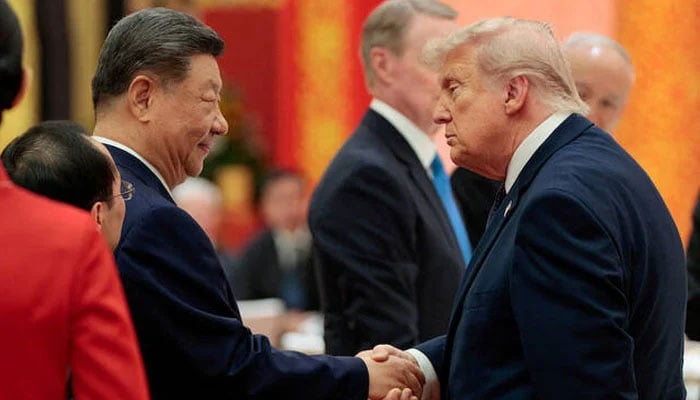
The recent visit of US President Donald Trump to China and his high-profile engagement with Chinese President Xi Jinping may ultimately be remembered as one of the defining geopolitical moments of this decade.
Beyond the diplomatic pageantry, state banquets, and symbolic optics, the summit carried a deeper strategic message: the world’s two largest powers are attempting to redefine the architecture of global power management.
Most significantly, President Xi reportedly described China–US relations as “the world’s most important relationship”, emphasising that the stability of the international order depends upon how Washington and Beijing manage their competition and cooperation. This statement was not merely ceremonial diplomacy. It was a direct acknowledgement that, despite tensions, both powers recognise that confrontation between them could destabilise the global economy and reshape the future of international politics.
The summit came at a time of immense geopolitical uncertainty. The Iran crisis, instability in the Strait of Hormuz, global supply chain disruptions and concerns over an economic slowdown have all heightened the need for strategic dialogue between Washington and Beijing. Reports indicate that discussions covered trade, energy security, AI, semiconductors and broader global stability.
What makes this visit especially important is the changing tone. Over the previous decade, US-China relations were largely defined by confrontation, trade wars, technology restrictions and military competition in the Indo-Pacific. However, the latest summit suggests an emerging realisation that absolute decoupling between the two powers is neither economically sustainable nor strategically manageable.
President Trump repeatedly highlighted his personal rapport with Xi Jinping, while Chinese state messaging emphasised “constructive and strategically stable relations”. Even though tensions remain unresolved, the summit demonstrated that both sides now view managed competition as preferable to uncontrolled escalation.
For Pakistan, this evolving geopolitical environment presents a major strategic opportunity. Pakistan occupies a rare diplomatic space in contemporary global politics. It maintains longstanding strategic relations with China while simultaneously rebuilding engagement with the US. Unlike many regional states that are forced into binary alignments, Pakistan has increasingly positioned itself as a country capable of maintaining functional relations with multiple competing powers simultaneously.
The renewed stabilisation between Washington and Beijing reduces the pressure on countries like Pakistan to choose sides. This is critically important for Islamabad’s economic and strategic future. Pakistan’s long-term development depends upon attracting investment, maintaining export access, expanding digital infrastructure, and strengthening regional connectivity. A highly polarised US–China confrontation would have complicated Pakistan’s balancing strategy. A more stable US–China equation, however, allows Pakistan greater diplomatic manoeuvrability.
The implications are particularly significant for the China–Pakistan Economic Corridor (CPEC). In previous years, US–China tensions often cast uncertainty over Chinese overseas investments and strategic infrastructure initiatives. But if Washington and Beijing enter a period of managed competition rather than direct confrontation, Pakistan could benefit from a less hostile environment surrounding regional connectivity and trade corridors.
Additionally, Pakistan’s geopolitical relevance has risen due to its geographic location between South Asia, Central Asia, West Asia and the Indian Ocean. At a time when both Washington and Beijing are increasingly concerned about energy routes, supply chain resilience and regional stability, Pakistan is becoming harder to ignore strategically.
The summit also carries profound implications for India. For nearly a decade, India positioned itself as a central pillar of American strategic efforts to counterbalance China in the Indo-Pacific region. New Delhi invested heavily in the narrative that Washington and Beijing were entering a prolonged strategic cold war in which India would emerge as the primary beneficiary. This assumption shaped India’s foreign policy orientation, security partnerships, and diplomatic messaging.
However, the Trump–Xi summit introduces uncertainty into that strategic calculation. If Washington and Beijing move towards a framework of selective cooperation and strategic coexistence, India’s utility as an anti-China balancing instrument may diminish. The geopolitical premium India enjoyed during periods of intense US–China hostility could weaken if both superpowers prioritise economic stabilisation and crisis management over bloc politics.
This does not mean that US–India relations will collapse. Far from it. The US will continue viewing India as an important regional power, economic market, and strategic partner. However, India may no longer enjoy the same level of strategic exclusivity it anticipated during the height of US-China tensions.
India also faces structural vulnerabilities that become more visible in a less polarised geopolitical environment. Its manufacturing ambitions continue to be constrained by infrastructure and supply-chain constraints. Its border tensions with China remain unresolved. Its diplomatic balancing between Russia, the West and regional partners is becoming increasingly complicated. And most importantly, if Washington seeks a more stable relationship with Beijing, New Delhi may find itself operating within a narrower strategic space than it expected.
In contrast, Pakistan’s diplomatic flexibility may become an advantage rather than a liability.
Islamabad has historically demonstrated an ability to engage multiple competing powers simultaneously, from Washington and Beijing to Riyadh, Ankara and increasingly Moscow. In an era moving towards multipolarity rather than rigid bloc confrontation, such flexibility becomes strategically valuable.
The larger message emerging from the Trump–Xi summit is that the world may be entering a new geopolitical phase, one not defined purely by confrontation, but by negotiated coexistence among major powers. The era of simplistic “with us or against us” diplomacy may gradually give way to more fluid alignments shaped by economics, technology, energy security, and regional pragmatism.
For Pakistan, this creates space to reposition itself not merely as a security state, but as a connectivity state, a bridge between regions, economies, and strategic systems.
For India, however, the challenge may be more uncomfortable. Its rise was partially predicated on becoming indispensable to Washington’s China strategy. If that strategy evolves toward accommodation rather than confrontation, New Delhi may have to rethink parts of its geopolitical assumptions.
Ultimately, the Trump–Xi summit reminds the world of an enduring reality: when Washington and Beijing decide to stabilise relations, the geopolitical shockwaves are felt everywhere, from the Strait of Hormuz to the Himalayas.
And in that changing landscape, countries that master strategic balance rather than strategic dependency will emerge stronger.
The writer is a public policy expert and leads the Country Partner Institute of the World Economic Forum in Pakistan. He tweets/posts @amirjahangir and can be reached at: [email protected]