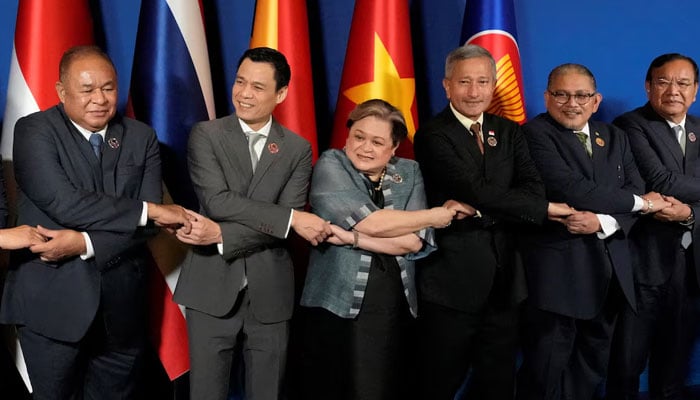
CEBU, Philippines: The fallout of the Middle East crisis took centre stage at meetings of the Southeast Asian bloc ASEAN on Thursday, with renewed calls for a united front in the face of serious challenges for its fuel import-dependent economies.
The bloc of 11 nations, home to nearly 700 million, is one of the regions worst-hit after the Iran war shut down the critical Strait of Hormuz, choking off energy supplies. The Philippines, current chair of the Association of Southeast Asian Nations, has pushed to expedite approval of a regional oil-sharing framework agreement. Economic ministers at the meetings in the Philippine city of Cebu “identified practical, concrete response measures” on strengthening energy and food security and committed to intensify coordination, the chair said in a statement.”ASEAN needs to strengthen our crisis coordination and institutional readiness,” said Ma. Theresa Lazaro, the Philippine foreign affairs secretary.
Diplomats and analysts say the energy issue will prove a test of the Philippines’ skills as chair, forcing it to shape a rare regional response while preventing ASEAN’s own conflicts from slipping down the agenda.
These include Myanmar’s civil war and last year’s deadly and still unresolved border dispute between Thailand and Cambodia, where a fragile ceasefire has held since late December.
In an effort to jumpstart engagement between Cambodia and Thailand, Philippine President Ferdinand Marcos Jr called a three-way meeting in Cebu with their prime ministers late on Thursday, which led to an agreement to advance the ceasefire and try to normalise ties.”It is best that we avoid conflict, It only brings losses and suffering,” Thai premier Anutin Charnvirakul said. “Now is the time for us to look forward and walk this path together towards peace.”
Troops remain deployed on both sides of the 817-km (508-mile) Thai-Cambodia border after two rounds of fighting in July and December, when territorial skirmishes quickly escalated into air strikes and heavy exchanges of artillery and rockets. The first clashes ended after a vaunted intervention by U.S. President Donald Trump, but his efforts to halt the second flare-up failed and the two sides weeks later agreed bilaterally to a truce, ending 20 days of fighting.
ASEAN, with a combined gross domestic product of about $3.8 trillion, has long struggled to coordinate its responses to crises, with meetings typically resulting in pledges to cooperate, rather than a clear strategy or binding agreements.
ASEAN leaders will on Friday call for good-faith negotiations between the United States and Iran and a halt in hostilities, according to a working draft of a statement seen by Reuters. It will also call for international law to be upheld and a reopening of the Strait of Hormuz, normally a conduit for a fifth of the world’s oil and gas supplies.
“We further stressed the need to preserve the unimpeded flow of energy and essential goods ... in order to safeguard economic stability and strengthen resilience across ASEAN,” the draft said.
The draft also urges swift progress to ratify an ASEAN fuel-sharing pact to ensure its “earliest possible entry into force”, on a voluntary, commercial basis.
Foreign ministers discussed the crisis in Myanmar, an issue that has long divided the bloc, with a new, nominally civilian government keen to re-engage with ASEAN after five years in the cold following a 2021 military coup. ASEAN has not yet recognised a recent election that was swept by a pro-military party, or indicated when the leadership of Myanmar, with former junta chief Min Aung Hlaing now president, can return to its summits.
In an interview with Reuters on Thursday, ASEAN’s secretary-general Kao Kim Hourn said foreign ministers had agreed to a virtual meeting to hear out their Myanmar counterpart “in the very near future,” but wanted to see progress on de-escalation, dialogue and aid access.
The army-backed government may have to work to convince ASEAN countries it is sincere about peace amid ongoing hostilities, after two recent amnesties and a reduced sentence and transfer to house arrest for ousted leader Aung San Suu Kyi. Little is known about the status or whereabouts of the Nobel Peace Prize winner and the Philippines called on Wednesday for the ASEAN special envoy to be given access to her, as a sign of Myanmar’s “genuine commitment to national reconciliation”.
Kao Kim Hourn also said momentum was building on a long-anticipated code of conduct to avert disputes between ASEAN states and Beijing in the South China Sea, and the bloc was sticking to its target of completion within this year. “There is real progress in negotiations,” he said. “We are able to reach more consensus on key issues.”