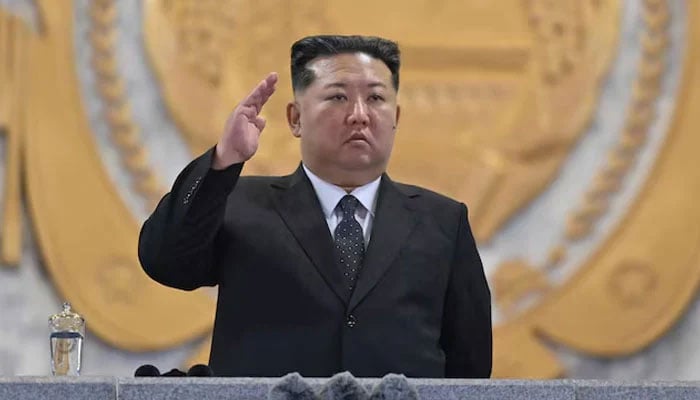
SEOUL: North Korea has deleted all references to uniting with South Korea from its constitution, a document reviewed by AFP on Wednesday showed, underscoring Pyongyang´s push for a more hostile policy towards Seoul.
North and South Korea remain technically at war because their 1950-53 war ended in an armistice, not a peace treaty. Pyongyang´s constitution had previously contained a clause stating that it aimed “to realise the unification of the motherland”. That reference no longer appears in the latest version, presented on Wednesday by a professor during a news conference at South Korea´s Unification Ministry and subsequently seen by AFP.
North Korean officials considered constitutional amendments at a major congress in March, where leader Kim Jong Un labelled Seoul as the “most hostile state”. The deleted clause used to say that the nuclear-armed nation would struggle for “national reunification on the principles of independence, peaceful reunification, and great national unity”.
The revised constitution, which the document indicated was introduced in March, also includes a new clause delineating North Korea´s territory. Using South Korea´s official name, it says that includes the area bordering China and Russia to the north, “and the Republic of Korea to the south”.
North Korea “absolutely does not allow any infringement on its territory”, it added. South Korea´s dovish President Lee Jae Myung has called for talks with the North without any preconditions, saying the countries are destined “to make the flowers of peace bloom”.
But the North has not responded to the Lee administration´s overtures and has repeatedly called the South its “most hostile” adversary. That language has echoed a constitutional amendment in 2024, when Pyongyang defined the South as a “hostile state” for the first time.
“By deleting references related to unification, North Korea appears to have codified the message that it will no longer seek to claim South Korean territory,” said Yang Moo-jin, a professor emeritus at Seoul´s University of North Korean Studies. In turn, Pyongyang “expects the South not to infringe on the North´s territory” he told AFP.
During the administration of South Korea´s hawkish ex-president Yoon Suk Yeol, the North blew up roads and railways linking it with the South and erected what appeared to be barriers near the border. Seoul´s military said in March this year that North Korea had resumed similar construction work in the area. Kim has vowed to boost his nuclear forces, and Pyongyang conducted four missile tests in April, the most in a single month for more than two years.