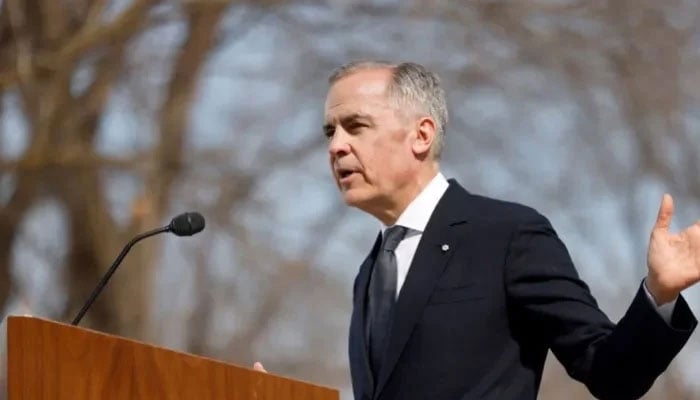
YEREVAN: Canada and Europe are not destined to submit to a more “brutal world”, Canadian Prime Minister Mark Carney said on Monday, urging closer ties as strongman politics roils the international order.
“We don´t think that we´re destined to submit to a more transactional insular and brutal world and gatherings such as these point to a better way forward,” Carney -- the first non-European leader to attend a meeting of the European Political Community (EPC) -- told the gathering in Yerevan.Carney was speaking as the first non-European leader to attend a meeting of the European Political Community, which opened amid high tensions in the strait of Hormuz and renewed doubts about the US commitment to Nato.
“We don’t think that we’re destined to submit to a more transactional, insular and brutal world, and gatherings such as these point to a better way forward,” he said. In a pointed suggestion that the era of American leadership was coming to an end, and explaining the symbolism of Canada’s attendance at a European political gathering, he said: “It is my strong personal view that the international order will be rebuilt, but it will be rebuilt out of Europe.
“We are demonstrating not just the strength of our values in defending a rules-based international order, but also the value of our strength,” he added. “The world is undergoing a rupture across several dimensions – integration is being used as a weapon by some and the rules are not constraining the hegemons.”
The EPC meeting, the eighth since the organisation’s inception, is taking place in Yerevan, Armenia, a venue chosen as a way of showing Europe’s determination to prevent the small Caucasus country from being dragged back into Russia’s orbit.
It is being held against a backdrop of fresh concern over the US’s commitment to Nato after Donald Trump’s surprise decision to announce the withdrawal of more than 5,000 troops from Germany, a move that has confirmed Europeans’ worst fears about the reliability of the transatlantic alliance.
Speaking in Yerevan, Keir Starmer, the British prime minister, said: “We cannot deny some of the alliances that we have come to rely on are not in the place where we would want them to be. There is more tension in the alliances than there should be.”
How leaders responded to tensions in the alliances was likely to “define what goes on for many years, arguably for a generation”, he added.
The French President, Emmanuel Macron, said: “Europeans are taking their destiny into their own hands, increasing their defence and security spending, and building their own common solutions.” The Ukrainian president, Volodymyr Zelensky, said Russia would face a crucial moment in the summer, which he termed “a moment to expand the war or move to diplomacy”.