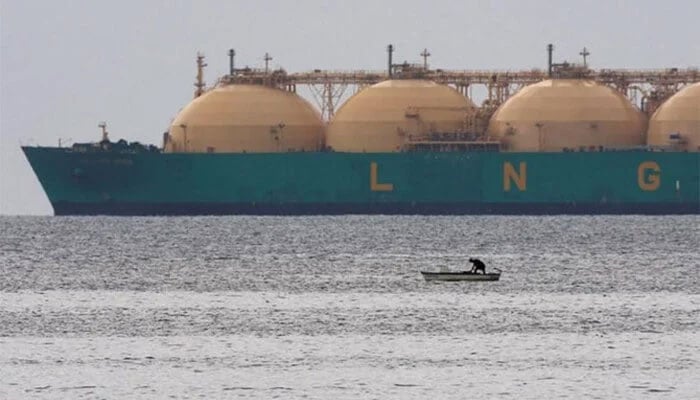
ISLAMABAD: Pakistan is moving quickly to secure two liquefied natural gas (LNG) cargoes from Qatar, with authorities actively engaged in diplomatic and operational coordination to ensure the safe passage of vessels currently positioned near the mouth of Strait of Hormuz.
According to well-placed officials in the Energy Ministry, the two ships are already loaded with LNG and waiting at the chokepoint as relevant authorities work to manage their crossover in consultation with Iranian counterparts.
Federal Minister for Petroleum Ali Pervaiz Malik earlier held direct discussions with the Iranian ambassador in Islamabad. These talks have been followed by consultation meetings between relevant Pakistani authorities and Iranian leadership to facilitate the safe crossover of the vessels into open waters en route to Pakistan.
The urgency of these efforts stems from tight supply margins, as the existing inventory brought in by the LNG carrier Seapeak Magellan is expected to meet immediate consumer demand for only the first 10 days of May. The Seapeak Magellan is docked at the Pakistan GasPort Consortium Limited (PGPCL) terminal, carrying around 140,000 cubic metres of LNG arranged by TotalEnergies at a price of $18.40 per MMBtu. The terminal is currently handling close to 300 MMcfd of re-gasified LNG (RLNG). From this supply, 250 MMcfd is being allocated to the power sector, supplemented by 150 MMcfd of local natural gas priced at RLNG rates, while an additional 45 MMcfd is being diverted to K-Electric power plants to support generation.
The backdrop to these shipments involves broader geopolitical disruptions in the region. Pakistan had previously attempted to import four loaded LNG cargoes from Qatar that became stranded following the US-Israel conflict with Iran. Iran had temporarily opened the Strait of Hormuz at Pakistan’s request to make talks with the United States result-oriented but closed the strait when the US refused to end the blockade. The stranded shipments highlighted Pakistan’s vulnerability to external chokepoints.
Despite these challenges, the Power Division confirmed that improved fuel diversification has helped avoid large-scale loadshedding, with only revenue-based load management continuing in certain areas. The availability of RLNG, combined with higher hydropower generation contributing around 6,000 MW, has played a pivotal role in stabilising the national grid. Energy planners emphasise that the timely arrival of two new Qatari cargoes remains critical to sustaining supply balance and meeting elevated demand during the early summer period.