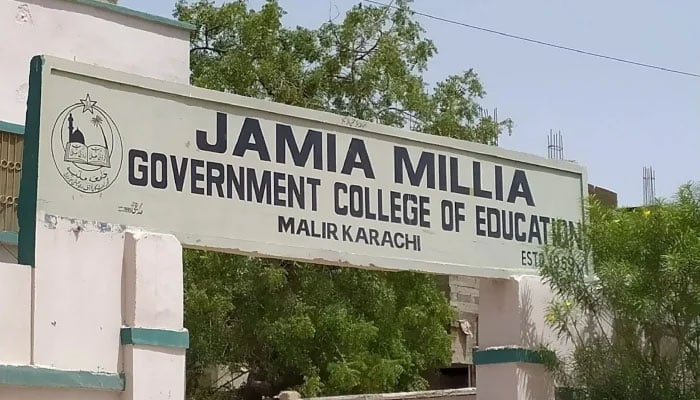
A detailed and comprehensive report has revealed serious instances of alleged land grabbing and illegal encroachments on the premises of Jamia Millia Government Degree College (Male), Malir, prompting the administration to seek urgent intervention from authorities.
According to the report, the institution, established in 1952, spans approximately 278,787 square feet. However, the absence of complete revenue records and improper land demarcation, particularly following nationalisation in 1972 has created vulnerabilities that have been exploited by land grabbers.
The report provides a detailed breakdown of the campus, which includes multiple educational institutions, hostels, a library, an institute of technology, a gymkhana, a swimming pool, staff quarters, and playgrounds, several of which have reportedly been subjected to encroachments.
It notes that the college has faced systematic land grabbing for years. In 2006, an attempt was made to occupy the playground under Survey No. 216, which was challenged in court and resulted in a stay order from the Sindh High Court. Despite this, fresh illegal construction reportedly began on April 13, 2026, in blatant violation of court directives.
The report further highlights that the college garage was illegally occupied during 2020-21, while part of the gymkhana (cafeteria) was encroached upon through unlawful construction. Additionally, certain individuals have allegedly built shops linked to nearby residential developments, raising concerns over commercial exploitation of public land.
Multiple cases related to the land dispute are currently pending in courts, with the college seeking to become a party in some proceedings. The Sindh High Court has already issued restraining orders against construction, yet violations allegedly continue.
In its recommendations, the administration has urged authorities to immediately halt illegal construction, retrieve encroached land, obtain verified revenue records, and initiate legal action. It has also proposed the involvement of law enforcement agencies, including Rangers and district administration, to carry out an effective clearance operation. The report warns that failure to act promptly could result in further loss of valuable public land, adversely affecting academic activities and causing irreparable damage to state property.