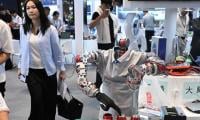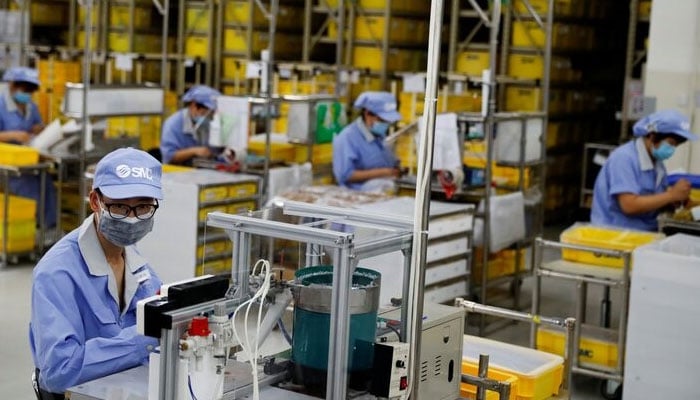
It is a well-established principle of economics a country’s production capacity determines its economic strength and level of development. Production capacity also plays a crucial role in rise and fall of empires. China understood these fundamental realities, invested heavily in manufacturing capacity, and transformed itself into a global manufacturing powerhouse — earning title of “world’s factory”. Recent data shows China now accounts for nearly 30pc of global manufacturing, up from just 1pc in 1970. This shift elevated China from a peripheral economy to centre of global economic system.
Following the initial success of its manufacturing base, China moved to modernise its production capabilities. These investments enabled China to become a global leader in advanced technologies, including clean energy, electric vehicles (EVs), mobile phones, and space technologies. Today, China is the largest producer and exporter of clean technology, accounting for over 80pc of solar panel manufacturing, 70pc of EV production, 72pc of wind turbine manufacturing, and 75pc of battery production. It has also developed world’s largest and most efficient industrial supply chain for rare earth metals. As a result, China now holds dual distinction of being both “world’s factory” and a “world laboratory”. At the same time, China modernised its agricultural sector, achieving self-sufficiency in many key food commodities.
Beyond establishing China as a global power, its production capacity has made it world’s largest trading partner, supporting sustained economic growth over a long period. However, global financial dynamics are rapidly changing. Globalisation and free trade have become contentious issues, with many countries — especially in the West — introducing barriers to trade.
In response, China has sought new drivers of growth, with domestic consumption emerging as a key priority. Policymakers have introduced targeted measures to strengthen role of domestic demand, including large-scale equipment upgrade initiatives and consumer goods trade-in programmes.
China has systematically accelerated consumption at all levels — households, services, and industry. In 2024, it launched large-scale programmes supported by 300 billion yuan in ultra-long-term special treasury bonds. In 2025, subsidies were expanded, with 300 billion yuan allocated for consumer goods trade-ins and 200 billion yuan for equipment upgrades. The list of eligible items was also broadened to include digital products. Preliminary data for first 11 months of 2025 shows these measures boosted household consumption beyond 2.5 trillion yuan (approximately $354.2 billion). Around 360 million households benefited, including 11.2 million vehicle buyers, 128.4 million home appliance purchasers, and 90.2 million buyers of digital products.
Online sales also recorded strong growth. During first 11 months of 2025, e-commerce sales increased by 5.7pc, reaching a total of 11.82 trillion yuan — more than one-quarter of China’s total retail sales. To further stimulate consumption, China is working to raise household incomes and strengthen its social safety net. In 2025, increased budget allocations were directed towards healthcare, childcare, eldercare, education, and transportation.
At the same time, China is investing in upgrading its service infrastructure, particularly in education, by improving physical infrastructure such as buildings and equipment.
On the industrial side, China continues to push for modernisation. It is encouraging industries to become more innovative and intelligent, improve energy efficiency, and expand use of renewable energy. State-Owned Enterprises (SOEs) are playing a leading role, with plans to invest more than 3 trillion yuan in industrial upgrades over next five years. This is expected to further stimulate domestic consumption by creating new markets.
Chinese policymakers are also focusing on market unification, a critical step in boosting consumer confidence and reducing excessive regional competition. Efforts are underway to strengthen integration of domestic markets.
The rise of domestic consumption in China will not only drive national growth but also create significant opportunities for global economy. With a population of 1.4 billion and a rapidly evolving middle class, China represents a massive and expanding market. By 2035, nearly one billion people are expected to move into higher income brackets, creating a trillion-dollar consumer economy. Global businesses stand to benefit greatly, especially as China continues to pursue an open economic policy through initiatives such as China International Import Expo (CIIE).
As a key partner through China-Pakistan Economic Corridor (CPEC) and longstanding strategic ties, Pakistan is well-positioned to benefit from these developments. Through agreements like FTA-II and China-Pakistan Action Plan 2025, Pakistan enjoys improved access to Chinese markets. In recent years, four additional protocols have been signed to enhance access for Pakistan’s agricultural products, opening up a market worth approximately $60 billion. However, to fully capitalise on these opportunities, Pakistan must strengthen its production capacity in both industrial and agricultural sectors.
Conclusion: China is rapidly emerging as a global centre of consumption. This transformation will create vast new markets, provide fresh momentum to global economy, and contribute to poverty reduction and shared prosperity worldwide.