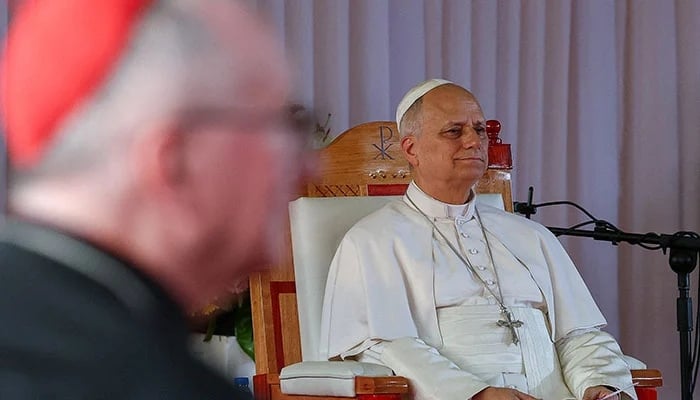
ABOARD THE PAPAL PLANE: Pope Leo XIV said on Saturday he regretted remarks he made were interpreted as a response to criticism from President Donald Trump, insisting he had no interest in debating the US leader.
An example was a speech about “tyrants” ransacking the world that he delivered in Cameroon on Thursday on the second leg of a tour of Africa, Leo told journalists as he travelled to Angola.
The remarks had been written well before Trump´s “comment on myself and on the message of peace that I am promoting,” he said.
“And yet it was perceived as if I were trying to start a new debate with the president, which doesn´t interest me at all,” Leo said.
“Much of what has been written since then has been more commentary on commentary trying to interpret what has been said,” he said.
Leo had blasted “tyrants” ransacking the world on Thursday while on a high-security visit to Cameroon´s northwestern city of Bamenda, the epicentre of a nearly decade-long English-speaking separatist insurgency that has killed thousands.
The remarks were interpreted by the US media in particular as a reference to Trump.
But they were written well before Trump´s criticisms, Leo said, adding “there´s been a certain narrative that has not been accurate in all of its aspects”.
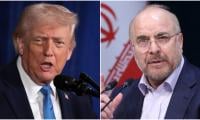
Trump had said on April 12 he was “not a big fan of Pope Leo”, and accused him of “toying with a country (Iran) that wants a nuclear weapon”.
He later doubled down on his comments to reporters with a post on Truth Social, saying: “I don´t want a Pope who thinks it´s OK for Iran to have a Nuclear Weapon.”
“Pope Leo is WEAK on Crime, and terrible for Foreign Policy,” the US leader said.After Trump´s Catholic Vice President JD Vance urged the Vatican to “stick to matters of morality”, Leo on Thursday said the world was “being ravaged by a handful of tyrants” and piled on more criticism of those who use religion to justify war.During his stop in Cameroon, Leo demanded the country´s leaders tackle corruption and condemned “those who, in the name of profit, continue to seize the African continent to exploit and plunder it”.
Like his calls for peace, Leo´s warnings against graft and exploitation are likely to strike a chord in Angola, where a third of the population live below the poverty line despite its vast fossil fuel reserves.
The country´s economy is heavily dependent on oil, leaving it exposed to price fluctuations, while rampant corruption has even spread to the family of former president Jose Eduardo dos Santos.
“There is a lot of suffering, a lot of poverty in Angola. I hope the pope will see with his own eyes the needs of the youth here,” said Antonio Masaidi, a 33-year-old engineer.
On Sunday, Leo will celebrate a giant open-air mass in Kilamba on Luanda´s outskirts, where facilities including a large food court are being built to host tens of thousands of worshippers.
In the afternoon, the pope will travel by helicopter to the village of Muxima, about 130 kilometres (80 miles) southeast of Luanda, home to a 16th-century church overlooking the Kwanza River that has become one of southern Africa´s most important pilgrimage sites.
A basilica is under construction in Muxima, where slaves were once baptised before being shipped out of Africa, as part of a multimillion-dollar government project to turn it into a major tourism destination.
“It is a historic moment of grace, a moment of profound emotion, with tears in our eyes and gratitude in our hearts,” the rector of the shrine, Father Mpindi Lubanzadio Alberto, told the Catholic news site ACI Africa.
On April 20, the pope is due to travel more than 800 kilometres from the capital to visit a retirement home in Saurimo and celebrate another mass before departing the following morning. Leo will then fly to Equatorial Guinea, the final stop of a whirlwind 18,000-kilometre journey that began in Algeria.