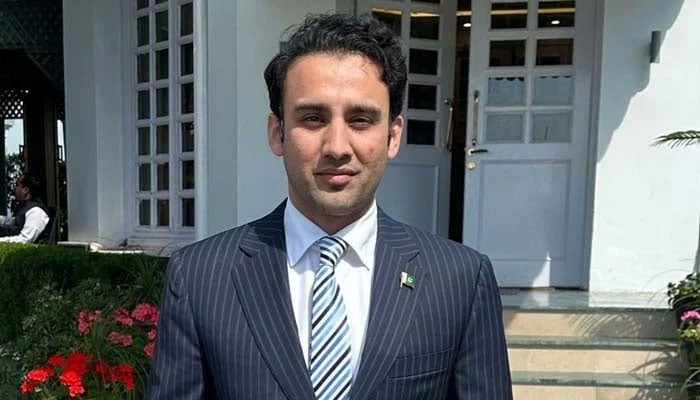
KARACHI: Bilal Bin Saqib, chairperson of the Pakistan Virtual Assets Regulatory Authority (PVARA), has outlined a long-term vision for Pakistan to transition from regulatory catch-up to becoming an active architect of future financial systems by 2050, a statement said on Saturday.
In an interview published in the Chartered Management Accountant Journal of the Institute of Cost and Management Accountants of Pakistan (ICMA), Saqib emphasised that Pakistan must prepare for 2050 financial systems not by regulating existing structures but by building foundational infrastructure for emerging technologies.
He noted that global finance is undergoing a structural transformation driven by the convergence of artificial intelligence, blockchain, and quantum computing, where traditional financial systems are gradually losing relevance, and protocol-based systems are becoming dominant. He further highlighted that geography is becoming less relevant in financial systems, while regulatory frameworks designed for earlier eras risk rapid obsolescence. Countries that invest in building new digital financial infrastructure today will define global financial leadership in the coming decades. He explained that financial systems are increasingly evolving into programmable ecosystems, requiring Pakistan to move beyond observation and actively participate in shaping future financial architecture.
Referring to discussions at the World Economic Forum in Davos, he pointed to a decisive global shift towards AI-native economies, where artificial intelligence is already driving real-time risk modelling, compliance automation, capital allocation, and next-generation payment systems. He added that AI is also transforming banking, trade finance, supply chains, and labour markets at a systemic level.
For Pakistan, he identified a major opportunity emerging from this transformation. AI-enabled payment rails combined with blockchain infrastructure can significantly improve remittance flows by making them faster, cheaper, and more secure, while enhancing value from diaspora earnings. Simultaneously, tokenization is progressing from pilot phases to real-world implementation, enabling fractional ownership of infrastructure, real estate and securities.
He stressed that the integration of AI into financial systems requires rapid regulatory evolution, positioning Pakistan as a potential early mover in digital finance innovation. Pakistan, he noted, already holds strong structural advantages, including high adoption rates, a young population, and technological readiness. The key challenge lies in converting this momentum into structured leadership in global financial systems.
A key regulatory milestone has been the issuance of no objection certificates (NOCs) to global crypto exchanges, aimed at bringing existing market activity into a formal regulatory perimeter. He clarified that millions of Pakistanis were already active on these platforms in an unregulated environment without oversight, reporting structures or formal accountability.
For citizens and small businesses, he highlighted that the most immediate benefit is greater clarity and confidence, replacing uncertainty with regulatory visibility. He clarified that this represents phase one and does not constitute full licensing. He further explained that the next phase will introduce stronger safeguards, including custody standards, segregation of client assets, capital adequacy requirements, governance frameworks, and formal dispute resolution mechanisms aligned with international best practices.
Balancing innovation with financial stability, he highlighted the inherent regulatory challenge of avoiding both excessive restriction and excessive openness. Overregulation risks pushing activity underground, while under-regulation may introduce systemic vulnerabilities.
His regulatory approach is grounded in proportionality, sequencing, and credibility, ensuring that regulation evolves in stages, beginning with visibility, followed by prudential safeguards, and ultimately consumer protection, while prioritising long-term trust over short-term popularity.
He further noted that Pakistan’s strategic direction requires formal licensing of virtual asset service providers, alongside strengthened institutional capacity and capability development across banks, compliance professionals, law firms, and fintech ecosystems. He also emphasised investor education and public awareness as essential tools to counter misinformation and build responsible market participation.
On international engagement, he confirmed active coordination with regulators in the United States, United Arab Emirates, Singapore and Europe, aimed at aligning Pakistan’s framework with global standards while adapting to domestic realities.
He identified infrastructure assets as the most practical entry point for tokenisation in Pakistan. Operational toll roads and power generation assets, with stable cash flows and clear ownership structures, offer strong potential for Tokenisation, enabling fractional ownership, unlocking capital, and expanding participation for retail investors and the diaspora.
He also called on Pakistan’s corporate leadership to assign executive responsibility for digital asset strategy in 2026, emphasizing preparedness rather than immediate adoption, as blockchain-based systems and programmable money continue to reshape global finance, trade, and treasury operations.
He cautioned that the future divide will not be between adopters and non-adopters, but between those who are prepared and those who are not.
He concluded that Pakistan’s strength lies in its adoption scale and youth-driven technological momentum. The key challenge is to convert this advantage into structured participation in global financial systems, positioning Pakistan not as a follower of change, but as an active architect of future financial systems.