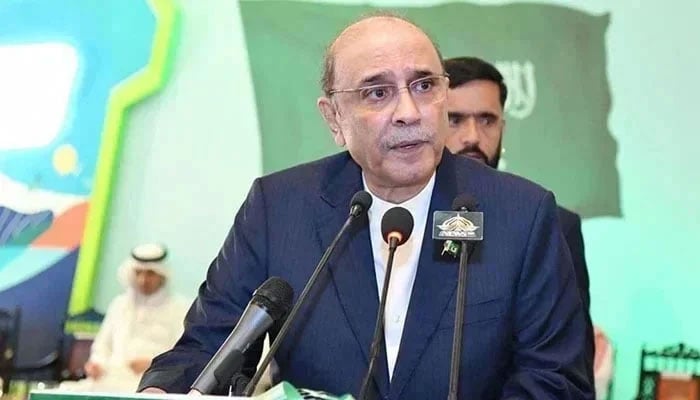
ISLAMABAD: Paying tribute to the architects of the Constitution, President Asif Ali Zardari said on Thursday the nation also remembers that this sacred document is the creation of parliament of the people, who are the actual masters of our destiny.
“The Constitution of the Islamic Republic of Pakistan, adopted on April 10, 1973, remains the central legal and political framework of our state and marked the first time that a directly elected parliament, based on adult franchise, gave the country a consensual constitutional order after more than a quarter century of uncertainty and earlier failed efforts,” he said in a statement on the eve of Constitution Day (10 April), which is to be observed today (Friday).
President Asif Ali Zardari said the process that led to its adoption was neither brief nor easy as it required sustained negotiation, restraint and agreement across political lines over the course of more than a year. He said the result was a federal, parliamentary and democratic Constitution endorsed by all political parties represented in parliament at the time. “That consensus remains one of its defining strengths,” he said.
Over the past five decades, Presidential Asif Ali Zardari said Pakistan has faced repeated military interventions, periods of authoritarian rule, terrorism supported from abroad, natural disasters, economic strain and the loss of national leaders, including through assassination and judicial actions. “Despite these disruptions, the Constitution has continued to provide continuity to the state and a basis for institutional recovery,” he said.
He said it is also a day to pay tribute to Shaheed Zulfikar Ali Bhutto, the principal architect of the 1973 Constitution, whose leadership brought together divergent political forces to achieve agreement at a critical moment in our history. “We also acknowledge the role of democratic political parties that have, at different stages, stood in defence of the Constitution when it was under strain,” he said.
He said, “On this day we also remember Shaheed Mohtarma Benazir Bhutto, who carried forward the struggle for democratic governance in difficult circumstances following the imposition of martial law, and whose efforts, along with other political leaders, led to the Charter of Democracy in 2006 and the eventual restoration of democratic rule. After her martyrdom, I chose to serve as a ceremonial head of state and returned executive powers to parliament that had been taken away under previous dictatorial dispensations,” he said.
For citizens, he said the Constitution is not an abstract but a living document. It shapes how institutions function in an everyday setting. The president said it governs how a case is heard in a court, how a public hospital is administered, how a student is treated in a classroom and how a citizen engages with a district office.
He said it also applies to larger matters, including how a federating unit resolves its disputes with another federating unit or with the federal government.
He said its consistent application determines whether services are delivered fairly, whether rights are protected in practice and whether public authority remains accountable. “It is also a day to reflect on the Constitution’s enduring role. Its relevance depends on its faithful application in institutions and daily governance,” he said.
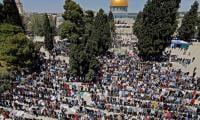
Meanwhile, President Asif Ali Zardari has condemned in the strongest possible terms the storming of Al-Aqsa Mosque (Al-Haram Al-Sharif) by Israeli occupation forces, calling it a violation of international law and an assault on the sanctity and historical character of the holy site. Referring to the April 6 incident involving an Israeli minister, the president termed the act a provocation and rejected any attempts to alter the established religious and legal status of Al-Aqsa Mosque.
He expressed concern over recent restrictions on access to the mosque, including during Ramazan and Eid, and noted that the regional situation, including the current conflict involving US-Iran, appeared to have been used to justify such measures.
The president called on the international community to take urgent steps to prevent such actions and reiterated Pakistan’s unwavering support for the Palestinian people and their right to an independent state with Al-Quds Al-Sharif as its capital.