WASHINGTON: US President Donald Trump said on Thursday he was “very optimistic” about a peace deal with Iran after their ceasefire, and that Israel was “scaling back” strikes in Lebanon.
Trump told NBC News in a telephone interview that Iran’s leaders were “much more reasonable” in private but added that “if they don’t make a deal, it’s going to be very painful.”
Vice President JD Vance is due to hold talks with Iran in Islamabad on Saturday. Israeli Prime Minister Benjamin Netanyahu had meanwhile agreed in a call with Trump on Wednesday to “low-key it” with Lebanon after devastating strikes on Wednesday, the US president said.
While the Trump administration and Israel have both said Lebanon is not covered by the ceasefire, Israel agreed “to be a helpful partner,” the official said.
President Trump said late Wednesday that US forces deployed near Iran would remain stationed in the area until a “real agreement” is reached. While he said a deal falling through was “highly unlikely,” Trump threatened to revert to “bigger, and better, and stronger” strikes if an agreement was not reached.
In a defiant statement, Iran’s new supreme leader Mojtaba Khamenei said that the Islamic republic does not want war with the United States and Israel, but would protect its rights as a nation, state television reported Thursday.
“We did not seek war and we do not want it,” he said in the message read out on state TV. “But we will not renounce our legitimate rights under any circumstances, and in this respect, we consider the entire resistance front as a whole,” he added, in an apparent reference to Lebanon.
Khamenei said Iran will seek retribution for attacks against it and “will take management of the Straits of Hormuz into a new phase.” He also vowed to avenge the deaths of his father Ayatollah Ali Khamenei and Iran’s “martyrs”.
Khamenei told Iranians that they must “not imagine that taking to the streets is no longer necessary” despite the announcement of the ceasefire. “Your voices in public squares are undoubtedly influential in the outcome of the negotiations,” he said, according to the message broadcast on state TV.
Iran’s President Masoud Pezeshkian said Israel’s strikes across Lebanon a day earlier “signal deception and non-compliance” and render negotiations “meaningless”. “Our hands remain on the trigger. Iran will never forsake its Lebanese brothers and sisters,” he added in a post on X.
While Iran’s parliament speaker said Lebanon was a key part of the two-week ceasefire with the United States, warning that violations would bring severe consequences, following massive Israeli strikes on Lebanon. “Lebanon and the entire Resistance Axis, as Iran’s allies, form an inseparable part of the ceasefire,” Mohammad Bagher Ghalibaf said in a post on X.
On Wednesday evening, US Vice President JD Vance referred to a “legitimate misunderstanding”. “I think the Iranians thought that the ceasefire included Lebanon, and it just didn’t. We never made that promise,” he said after a visit to Hungary.
Iranian officials however insist on the inclusion of Lebanon, pointing to a statement from mediator Prime Minister Shehbaz Sharif when the truce was announced. On Thursday, Ghalibaf said the Pakistani leader had “publicly and clearly stressed the Lebanon issue”. “There is no room for denial or backtracking,” he added.
The first non-Iranian oil tanker passed through the Strait of Hormuz on Thursday since a fragile ceasefire between Iran and the United States was announced, according to the MarineTraffic monitor.
The MSG, a Gabon-flagged oil tanker passed went through the strategic waterway Thursday loaded with around 7,000 tonnes of Emirati fuel oil, and is headed to Aegis Pipavav, India, according to MarineTraffic.
A dozen other vessels—including another laden oil tanker—appeared on Thursday to be on course to pass through, signalling no real change in daily traffic compared to the week before the ceasefire.
All vessels going through the strait were either coming from or going to Iran, or displayed ties with countries not hostile to Iran.
Iran will allow no more than 15 vessels a day to pass through the Strait of Hormuz under the ceasefire agreement it agreed with the United States, Russia’s state TASS news agency quoted an unnamed senior Iranian source as saying on Thursday.
European Commission spokesman Anouar El Anouni said that freedom of navigation in the Strait of Hormuz must be ensured with “no payment or toll whatsoever”, after Iran suggested it could charge for letting ships through.
US President Donald Trump has suggested that the United States and Iran could run the system in “joint venture”, though the White House has said the strait should be reopened immediately with no restrictions.
Israeli Prime Minister Benjamin Netanyahu said he is seeking direct talks with Beirut, a day after the worst bombardment of the war killed more than 300 people in Lebanon and placed Donald Trump’s US-Iran ceasefire in jeopardy.
Netanyahu said in a statement that he had given instructions to start peace talks as soon as possible, which would also include disarming Iran-aligned militant group Hezbollah.
An hour before Netanyahu’s statement, Lebanese President Joseph Aoun said he was working on a diplomatic track on this matter that was starting to be seen “positively” by international actors.
Earlier on Thursday, Israel kept up its bombing of Beirut’s southern suburbs and other parts of the country, Lebanese state media said. Hezbollah announced at least 20 military operations on Thursday, saying it had targeted Israeli vehicles on Lebanese territory as well as firing into northern Israel. A Hezbollah lawmaker reiterated his group’s rejection of any direct negotiations between Lebanon and Israel.
Israel’s military said Thursday it had struck and killed a close adviser to Hezbollah chief Naim Qassem in Beirut a day earlier, when Israeli strikes pummelled Lebanon. “Yesterday, the IDF struck in the Beirut area and eliminated Ali Yusuf Harshi, the personal secretary and nephew of Hezbollah Secretary-General Naim Qassem,” a military statement said.
Dozens of countries contributing troops to the UN peacekeeping force in Lebanon called for a cessation of hostilities, after three blue helmets were killed. More than 60 countries that contribute troops to UNIFIL, the UN peacekeeping mission in south Lebanon, denounced persistent attacks on blue helmets. The United Nations secretary-general on Wednesday warned that deadly Israeli strikes on Lebanon posed a “grave risk” to the fragile US-Iran truce, his spokesperson said in a statement.
UN Secretary-General Antonio Guterres’ personal envoy Jean Arnault met Iran’s Deputy Foreign Minister Majid Takht-Ravanchi in Tehran on Thursday as part of UN efforts to bring about an end to the Iran war, the UN said. Arnault also met representatives of the Iranian Red Crescent and visited some civilian sites damaged in recent air strikes, including a university and an apartment block that had been destroyed, UN spokesperson Stephane Dujarric told a regular briefing in New York.
France’s foreign minister condemned “unacceptable” Israeli strikes on Lebanon, warning they could undermine the fragile US-Iran ceasefire.
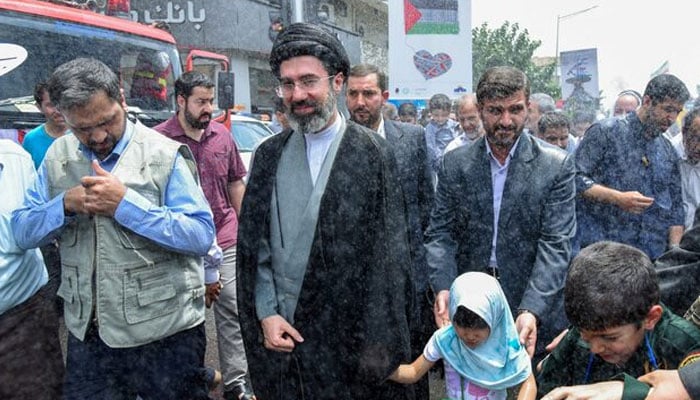
Thousands of Iranians rallied Thursday in a tribute to former supreme leader Ali Khamenei, killed on the first day of the war with the United States and Israel, expressing criticism of talks expected in Pakistan this week.
Holding portraits of their deceased leader and waving the national flags of the Islamic republic, supporters of Khamenei took part in rallies across the country after he died in the US-Israeli attack on February 28.
The International Monetary Fund will lower global growth forecasts due to the Middle East war, its managing director Kristalina Georgiev said Thursday, warning of the conflict’s “scarring effects” despite a fragile ceasefire.
The IMF also anticipates having to provide up to $50 billion in immediate financial assistance to countries affected by the war, with food insecurity set to affect at least 45 million people.
Oil prices jumped back towards $100 and most stock markets fell Thursday as investors weighed the prospects of a shaky Middle East ceasefire lasting the Strait of Hormuz fully reopening.
Turkish President Tayyip Erdogan told Iran’s President Masoud Pezeshkian by phone on Thursday that the upcoming US-Iran talks must be utilised to the utmost degree to achieve lasting peace, Erdogan’s office said. It quoted Erdogan as saying it was of critical importance not to give opportunities to those seeking to undermine the process, and that Turkiye was ready to help in all ways in the new process.
Turkish Foreign Minister Hakan Fidan told a news conference with his Syrian counterpart in the capital Ankara, “It is also of great importance that the parties adopt a conciliatory, flexible, patient, and constructive attitude in the talks that will begin in Pakistan.”
German Chancellor Friedrich Merz said the continued Israeli military campaign in Lebanon could jeopardise peace talks expected between the United States and Iran.
Russian Foreign Minister Sergei Lavrov hailed the ceasefire in a phone call with Iranian counterpart Abbas Araghchi, with the ministry saying in a read-out that “Moscow firmly believes that these agreements... have a regional dimension and, in particular, apply to Lebanon”.
Saudi Foreign Minister Prince Faisal bin Farhan held a phone conversation with his Iranian counterpart Abbas Araghchi, the Saudi foreign ministry said Thursday, in the first official contact between the countries since Tehran launched strikes against its Gulf neighbours in retaliation for Israeli-American attacks. “The call focused on reviewing developments in the situation and ways to slow the pace of tensions so as to help restore security and stability in the region,” the Saudi Foreign Ministry said in a statement.
British Prime Minister Keir Starmer said that Israel’s continued attacks on Lebanon were “wrong” as he travelled to discuss the shaky Middle East ceasefire with Gulf leaders. Starmer spoke while visiting Bahrain on a tour of the region, after meeting leaders of Saudi Arabia and the United Arab Emirates.
He rejected a suggestion from Iran that it could charge for letting ships through the vital Gulf waterway, telling ITV: “Our position is ‘open’ means open for safe navigation.” “That means toll-free navigation and vessels can get through,” he added.
Spain will reopen its embassy in Iran, which was closed in March due to the war, Spanish Foreign Minister Jose Manuel Albares said Thursday.
The Middle East conflict is exacerbating tensions over the humanitarian supply of medicines in Africa, a sector already severely impacted by funding cuts, with nonprofits warning of emptying shelves.
Italian Prime Minister Giorgia Meloni said the European Union should consider temporarily suspending its strict spending rules if the Iran war and the resulting energy shock worsens.
India has hiked subsidies for farming fertilisers by 11 percent from last year to support its vast agriculture sector from surging prices sparked by the Middle East war.
Nato would be willing to a play a role in a possible Strait of Hormuz mission if it is able to do so, the military alliance’s chief Mark Rutte said on Thursday.
Dubai’s Integrated Economic Zones authority has launched set of economic measures to strengthen business resilience and empower partners, Dubai media office said on Thursday.
Israeli Prime Minister Benjamin Netanyahu’s long-running corruption trial will resume on Sunday, the courts’ spokesperson said on Thursday, hours after Israel lifted a state of emergency imposed over its war with Iran.
With a view to speeding delivery of energy supplies from the Gulf, India recently granted waivers to allow two Iranian cargoes aboard an older tanker and another under international sanctions to enter its ports, two officials familiar with the matter said.
South Korean Foreign Minister Cho Hyun will send a special envoy to Iran to discuss the Middle East situation and bilateral issues, the ministry said on Thursday.
Europe’s aviation safety regulator EASA on Thursday extended until April 24 its advisory to airlines to avoid the Middle Eastern and Gulf airspace, according to an updated bulletin on conflict zones.
Russia will see revenue from its biggest single oil tax double to $9 billion in April due to the oil and gas crisis triggered by the US and Israeli attack on Iran, Reuters calculations showed on Thursday.
More than 3,000 people were killed throughout Iran during the war that began on February 28, Iran’s forensic chief told state media on Thursday, adding that 40 per cent of the dead needed forensic work to be identified and returned to families.
US President Donald Trump said on Wednesday that imports from countries supplying Iran with military weapons will face immediate 50 per cent tariffs with no exemptions, threatening the move just hours after agreeing to a two-week ceasefire with Tehran.
China Foreign Ministry said it hoped the “relevant parties can grasp this chance at peace and bring the region back to stability as soon as possible” in response to a question on the Iran war in a daily press briefing.
Russian Foreign Ministry Spokesperson Maria Zakharova on Cessation of Hostilities in the Middle East stated that Russia welcomes the achievement of an agreement on the cessation of hostilities between the United States and Iran.
From the very first days of the destructive war in the Middle East, unleashed by the American–Israeli tandem, Russia has advocated a ceasefire and the resumption of political and diplomatic efforts to settle the conflict. We have worked consistently and persistently in this direction, including on the platform of the UN Security Council, while maintaining close coordination with other responsible members of the international community. Particular recognition is undoubtedly due to the positive mediating role of Islamabad.”
The US State Department will host a meeting next week to discuss ongoing ceasefire negotiations between Israel and Lebanon, a State Department official said on Thursday.
Kuwait said a National Guards’ site was targeted by drones resulting in significant material damage, no injuries, state news agency reported.
Attacks on Saudi energy facilities have cut the kingdom’s oil production capacity by around 600,000 barrels per day and the throughput on its East-West pipeline by about 700,000 bpd, Saudi state news agency SPA reported on Thursday, citing an official source at the energy ministry.