LAHORE: The Punjab Agriculture, Food and Drug Authority (PAFDA) has signed a Memorandum of Understanding (MoU) with Forman Christian College (A Chartered University) (FCCU), Lahore, to strengthen collaboration in scientific research, analytical testing, laboratory capacity building, and professional training across agriculture, food, water, and pharmaceutical sectors.
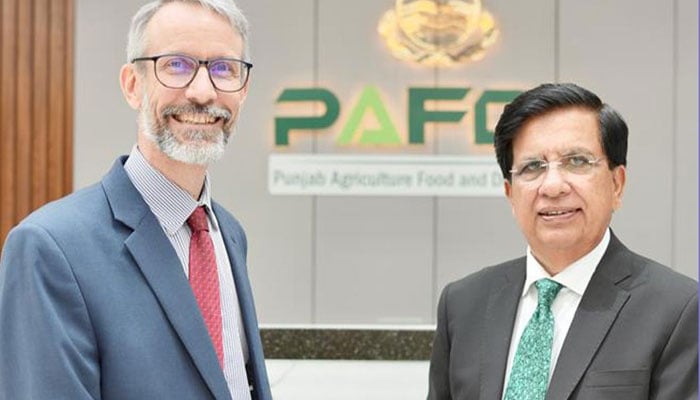
The MoU was signed by Dr Talat Naseer Pasha, Director General, PAFDA, and Dr Douglas E Trimble, Vice Rector, FCCU, during a ceremony held at PAFDA headquarters here on Tuesday. Under the MoU, both institutions will collaborate on key areas including pesticide residue testing in water, development and validation of advanced analytical methods, support for ISO/IEC 17025:2017 accreditation systems, joint training programmes, and research in pharmaceutical stability and shelf-life estimation.
The agreement also covers collaboration in advanced scientific domains such as genomics, molecular diagnostics, and multi-omics applications, particularly in agriculture, food safety, and biological sciences.
The partnership further envisions joint research initiatives, exchange of expertise, and development of scientific data systems, including environmental monitoring and geochemical mapping.
Capacity building through training of students, researchers, and laboratory professionals will remain a central pillar of this engagement.Speaking on the occasion, Dr Douglas E Trimble termed the collaboration “a significant new beginning for scientific advancement in Punjab and Pakistan,” emphasising that both institutions will work together to translate scientific knowledge into tangible benefits for society and contribute meaningfully to the well-being of the masses.
Dr Talat Pasha highlighted that the collaboration aligns closely with the authority’s mandate of “protecting health, enabling trade, and driving innovation,” and supports its Vision 2035 aimed at building a globally recognized conformance and analytical ecosystem in Pakistan.