PM Shehbaz Sharif has taken the most economically intelligent fuel policy decision Pakistan has made in years — subsidise the poor (Rs9 billion), tax the rich (Rs9 billion). The second step — delivering that money directly to motorcycle riders through MRT — is where history will judge him
Rationing petrol and diesel is a bad idea. Here’s why. First, it punishes motorcyclists, the backbone of daily mobility, while allowing car owners to game the system.
Second, it turns a manageable fiscal strain into a supply-chain disruption. Third, it breeds a black market where prices rise above the free market. Fourth, it demands an enforcement apparatus that cannot be built in time. Fifth, it destroys the price signal that could accelerate Pakistan’s shift to electric mobility.
Red alert: Rationing does not solve the problem, it distorts it.
A targeted, motorcycle relief transfer (MRT) solves three major problems. Problem One: The government will be able to remove blanket price suppression replacing it with a capped, defined cash transfer to a specific population. The government will be able to convert an open-ended fiscal haemorrhage into a budgetable line item. Let’s say, Rs 75 billion for three months covering 10 million motorcycles — fiscally painful but manageable unlike the current trajectory of Rs 69 billion every two weeks with no ceiling.
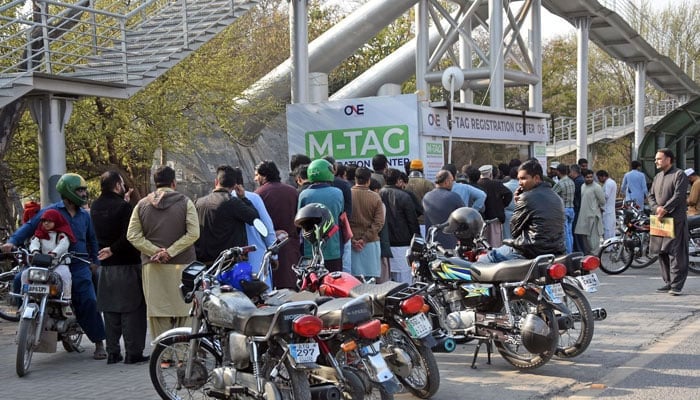
Problem Two: Pakistan’s 27 million motorcyclists — the economy’s backbone: delivery
riders, farmers, informal traders, daily-wage workers — must receive direct, immediate, dignified cash relief, calibrated to their fuel cost increase. No queues. No cards. No gatekeepers at the pump. Cash in their digital wallets — easypaisa, JazzCash, SadaPay, NayaPay — on the first of every month.
Problem Three: MRT protects the poor and excludes the wealthy, by design. It avoids rationing. It avoids blanket subsidies. It avoids full price pass-through. Instead, it achieves all three objectives simultaneously through a targeted motorcycle subsidy.
MRT is not just good economics — it is transformative political communication. Imagine: PM Shehbaz Sharif announcing that ‘car owners (4.5 million) pay full price, motorcycle owners (27 million) get direct cash relief’ — the single most powerful pro-poor message available in the current crisis. MRT redefines the government’s entire relationship with the poor at a moment of maximum political salience.
Blanket price suppression directly violates IMF’s cost-reflective pricing conditionality.
Rationing is price suppression by another name and fails the same test. Cross-subsidisation through the petroleum levy distorts the tax structure the IMF has specifically required Pakistan to reform. The development budget has little left to be raided.
Red alert: MRT is the only policy the IMF cannot object to — every other policy instrument currently being discussed in Pakistan puts the IMF programme at risk.
Under MRT, a full market price at the pump will be maintained. MRT delivers relief as social protection expenditure. MRT will be time-bound and fiscally defined. Plus, MRT will use the existing BISP infrastructure.
Targeting must be data-driven — vehicle registry plus National Socio-Economic Registry plus income filters. Yes, leakage must be designed out, not debated later.
Yes, the system already exists — BISP has moved billions through the same rails. MRT plugs into it. Make sure that MRT remains a bridge, not a permanent entitlement.
Deliver Rs2,500 per month to 10-20 million motorcycle owners via easypaisa, JazzCash, SadaPay and NayaPay driving millions of new mobile wallet activations deepening Pakistan’s digital financial infrastructure in exactly the low-income segments that need it most.
MRT does three things at once. One: it restores price truth. Two: i t protects the working poor. Three: it builds the digital rails Pakistan has failed to build for decades. This is not a subsidy, it is a reset.
The writer is an Islamabad-based columnist.