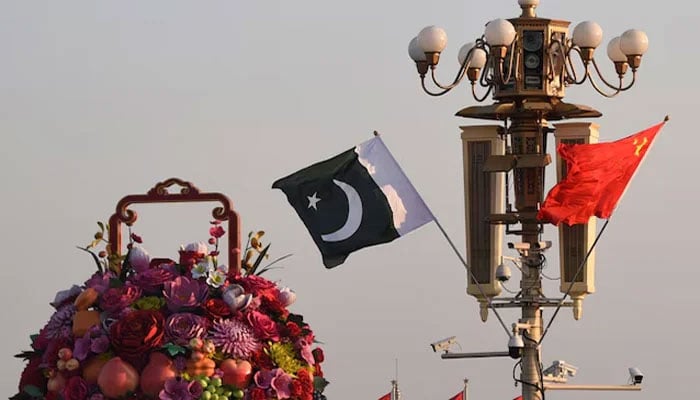
Pakistan and China are celebrating the 75th anniversary of their relationship to honor sacrifices and celebrate success stories. H.E. Wang Yi and Senator Ishaq Dar unveiled the logo following the strategic dialogue in Beijing, marking the start of the celebrations. The celebrations are well deserved, as both have nurtured their relationship through blood and sweat. The Karakoram Highway, built through the mighty mountains, is the most prominent example of this relationship. It shows how both nations cultivated it and how brave soldiers and workers nourished it with their blood and limbs. These sacrifices demonstrate the strength and commitment. Therefore, the relationship has sustained all the ups and downs, deep-rooted conspiracies, violent opposition, and attacks.
The most distinguishing characteristic of the relationship is that it is guided by top leadership in accordance with the will of the people. The leaders are never satisfied with their achievements; they always strive to do more to strengthen relationships. In furtherance of this policy, President Xi and PM Sharif signed the Action Plan to Foster an Even Closer China-Pakistan Community with a Shared Future in the New Era last year. The action plan is a comprehensive document and vision that encompasses 7 areas. First, it focuses on enhancing political exchanges and cooperation, led by the top leadership. Foreign offices will maintain close coordination and align their positions internationally. To strengthen political linkages, the China-Pakistan Political Parties Forum will hold meetings in China, among others.
Second, it was decided that both countries will work to deepen alignment among CPEC-II, the Five Corridors, URAAN Pakistan, the 5Es framework, and China’s eight major steps to support high-quality Belt and Road cooperation. Third, China and Pakistan will also enhance cooperation in trade, the economy, and finance. Fourth, they will strengthen cooperation in science, technology, and human resource development. It will help Pakistan cultivate a culture of innovation and technology development.
Fifth, China and Pakistan agreed to deepen and expand exchanges and cooperation in education, youth, culture, media, think tanks, publications, radio, film and television, sports, cultural relics, and the environment, as well as between the peoples. It is necessary to pass on the spirit of friendship to future generations.
Sixth, security and defence are other areas where cooperation will be expanded and strengthened. They will work to advance bilateral and multilateral counterterrorism security cooperation and to enhance exchanges and cooperation in the judiciary and law enforcement, in line with the six core concepts of the Global Security Initiative.
Seventh, China and Pakistan will deepen their multilateral coordination and collaboration. They believe in and will remain committed to upholding multilateralism and promoting regional peace, stability, development, and prosperity.
However, both countries need to be mindful that, in a changing environment, the challenges will be dynamic and multifaceted. The so-called rule-based order has been broken, hegemonic aspirations are back, and the colonial mindset is gaining strength.
In this context, both countries must be vigilant and refine their policies and actions across security, diplomacy, the economy, and culture, with a special focus on communication, public diplomacy, and the financial system.
First, China and Pakistan should comprehend that the West has weaponized communication and uses it to undermine the sovereignty of countries, ignite color revolutions, and sow mistrust among people in countries. Unfortunately, the China-Pakistan relationship is the prime target of this policy. They have launched a malicious campaign through the penta-complex (military-industry-academia-NGO-media). For example, they have dubbed CPEC a “debt trap” and a new “East India Company”. They are also igniting violence against Chinese citizens and investment by constructing fake stories and feeding them to terrorist organizations such as the BLA in Balochistan. For example, immediately after the launch of CPEC-II and the Action Plan, foreign-funded proxies began attacking and creating security challenges in Balochistan.
They also use religious sentiments by fabricating fake stories about the miseries of Uyghur Muslims in China and use terrorist organizations such as TTP to launch attacks on CPEC and Chinese citizens. It is evident from the cooperation between TTP and BLA and their attacks on Chinese interests and citizens.
Second, public diplomacy, once an instrument for creating goodwill and winning people’s hearts, has been transformed into warlord public diplomacy. The West has turned it into a weapon to interfere with and undermine other countries. For example, they are using their strength in education to sow the seeds of division in countries by deputing Western-educated experts to raise questions about countries’ economic, security, social, or diplomatic choices. They are applying the same strategies to Pak-China relations and CPEC. They analyze the relationship and the CPEC using Western philosophical and modeling frameworks that have nothing to do with either. They have also begun using values and culture to satisfy their superiority complex.
Third, the financial system is the most widely used instrument for undermining other nations, their relationships, and economic linkages. Pakistan is one of the biggest victims of financial terrorism. Since the 21st century, Pakistan has been targeted because of its close relationship with China. For example, after signing the FTA and the energy framework with China in 2006, Pakistan was added to the FATF gray list in 2008. After the successful completion of the low-hanging phase of CPEC, Pakistan was again added to the FATF gray list in 2018. The addition to the FATF gray list wreaked havoc on Pakistan’s economy by drying up investment and severely affecting trade. Moreover, the IMF, the World Bank, and other Western financial institutions are urging Pakistan to rethink CPEC.
In conclusion, the discussion above yields two inferences. First, Pakistan and China will work diligently to further strengthen and expand their relationship. Second, however, the journey will not be without challenges. Therefore, they should prepare themselves to address these challenges, particularly in communication warfare, warlord public diplomacy, and finance. It is suggested that they should institutionalize their efforts by establishing three dedicated joint centers: the Center for Communication Cooperation, the Center for Public Diplomacy Cooperation, and the Center for Financial Cooperation.