MUNICH, Germany: The Munich Security Conference is already being described as one for the history books. Will the current edition be remembered as such?
As participants rushed between sessions and side events while Munich was being whitewashed with snow, there was a palpable sense of collective unease — a recognition that we are living in an unpredictable world spelling out its realities loud and clear.
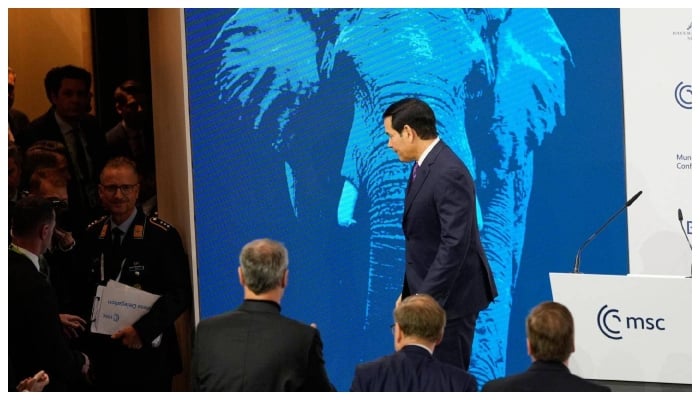
Was the MSC able to address the elephant(s) in the room? From reminders of these unaddressed elephant(s) displayed on digital screens, tote bags, and even Lego structures, the questions lingered.
At the closing ceremony of the 62nd edition of the MSC, held on the Main Stage at the Hotel Bayerischer Hof, Wolfgang Ischinger, Chairman of the MSC, referred to the MSC Report 2026, launched almost a week earlier and titled “Under Destruction.”
He spoke about an international system under strain -- some would argue under destruction -- and about claims that the liberal international order is not merely under attack, but may already be over.
Referring to US Secretary of State Marco Rubio’s message of “renewal and restoration”, Ischinger outlined the spectrum of views expressed at the conference: whether the task ahead is to repair, restore, or accept that something may need to be rebuilt almost from scratch. Yet alongside reassuring voices, he noted, “We also heard profound expressions of doubt.
Doubts about whether what we used to call the West, and whether we still share the same values… still play by the same rules… and whether we are in fact still on the same team. Our friends from Denmark and Greenland, in particular, reminded us that if you cross certain lines, that will simply not be ignored and need to be taken into account.”
He spoke of a “much greater spirit of European resolve to hold these lines, to defend what we believe are essentially European values.” He emphasised the EU’s collective responsibility to preserve peace and prevent conflict.
For Ischinger, the moment requires moving beyond speeches. “What we need now is a plan for action… an answer to what exactly we Europeans prepare to do, and if so, by when and how. How do we, my European friends, EU friends, bring the mutual assistance clause, which is in the European Union Treaty, to life?”
While Secretary Rubio delivered a message reminding Europeans that they are part of one Western civilisation “bound to one another by the deepest bonds that nations could share, forged by centuries of shared history, Christian faith, culture, heritage, language, ancestry, and the sacrifices our forefathers made together for the common civilisation to which we have fallen heir,” and emphasized how the transatlantic partners are “connected spiritually and culturally,” he also conveyed his president’s expectation of “seriousness and reciprocity from our friends in Europe.”
Yet as ancient bonds, ancestry, and shared history were invoked, the question arises: what happens when those bonds are tested by shifting interests? When the priorities of the current US administration appear guided by a worldview reminiscent of the 19th century -- one that suggests the strong do as they please -- how durable are those ties?
It was China’s Foreign Minister Wang Yi who stressed the principle of equal sovereignty in global affairs. “Multilateralism should always be promoted and strengthened. It must not happen that some countries dominate others. (...) Without the UN, we would return to a rule of might, where the strong defeat and dictate to the weak.”
As the movers and shakers navigated the corridors of the Hotel Bayerischer Hof and the Rosewood Munich, the central question remained: what about the elephant? Is it still confined to the room -- or has it already been set free?